



 0
0
Clam
Grow a Garden Clam Chance not Consumed Watering Cans
Unlimited
Auf Lager
1
- 1
- 2
- 3
- 4
- 5
- 6
$1.19
You May Also Be Interested In:
Auf Lager

Cheetah / Legendary
Auf Lager


Frost Dragon / Divine

Unlimited
Auf Lager
1
Professionell und freundlich, Pets direkt da.
Echt guter Service. Pets kam pünktlich, und Fragen wurden sofort geklärt.
Sofort erhalten, gerne wieder.
Konkurrenzfähig Pets Preis aber Servicegebühr da
Direkt da, guter Service.
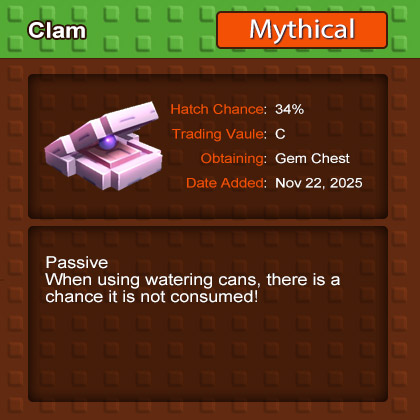
If you're constantly burning through watering cans in Grow a Garden, the Clam offers a lightweight, high-value fix. Its hallmark trait introduces a not consumed check when you water, nudging your supply to last longer and stabilizing costs during busy planting cycles. Here's a structured walkthrough, from how to get it, to how to make it pay off - so your high-frequency watering feels efficient rather than exhausting.
This section clarifies what the Clam is, when it arrived, and why it matters.
- Core identity: The Clam is an Uncommon pet—pink shell, purple pearl—added with the Trader Event.
- Availability window: Introduced on 2025-11-22 (Trader Event context).
- Beginner upside: It directly impacts watering can consumption, which is a key pain point for new players. That makes it a smart gift to onboard newcomers.
How you can reliably get the Clam.
- Primary sources: Obtainable during the Trader Event; tradable and often gifted by veteran players to help starters.
- Drop reference: Player-reported data notes a 34.5% drop rate for Clam (Resource Saver) from Gem Chests.
- Actionable tips:
- If time is tight, focus Gem Chest runs; the rate is respectable for Uncommon targets.
- If budget is tight, lean on event exchange and player trades to limit spend.
Objective: Understand how Water Reserve actually saves resources.
- Trait description: Water Reserve—when you use a watering can, there's a chance it is not consumed.
- Key figure: About a 6.58% chance per use (roughly 6–7 out of 100 waterings won't consume a can).
- What this means:
- In high-frequency watering, your cans last longer; purchase and refill cycles stretch out, flattening upkeep costs.
- In resource-scarce early play, you reduce the risk of mid-task supply breaks.
| Metric | Value / Notes |
|---|---|
| Rarity | Uncommon |
| Event | Trader Event (2025-11-22) |
| Appearance | Pink clam with a purple pearl |
| Non-consumption chance | ~6.58% per watering |
| Drop reference | ~34.5% from Gem Chest (player-reported) |
Takeaway: 6.58% looks small, but with high-maintenance plants, the cumulative savings are consistent and noticeable over long runs.
This part turns small probabilities into stable savings.
- Why stack: The Clam alone can feel subtle. When paired with Ruby Squids, the overall non-consumption rate rises.
- How it works: Resource-preserving effects typically resolve via independent checks. With multiple independent checks, the chance that at least one prevents consumption increases.
- Intuitive example (illustrative):
- If Clam p1 = 6.58% and Ruby Squid p2 = X%, independent checks yield combined non-consumption ≈ 1 − (1 − p1) × (1 − p2).
- Across 100 waterings, going from 6–7 saved cans to low double digits changes your refill cadence meaningfully.
- Steps to execute:
1) Confirm both pets are active and eligible in your squad.
2) Run 50–100 consecutive waterings on high-maintenance plants; track can usage to verify uplift.
3) If uplift is muted, check pet levels, environment modifiers, and any squad slot conflicts.
Decide when the Clam deserves a slot.
- Early-game: If you notice cans depleting constantly, slot the Clam to stabilize early progression.
- High-maintenance plants: Frequent watering amplifies probability-based savings; low-maintenance plants show weaker impact.
- Tight-resource weeks: During event starts or expansion pushes, the Clam helps smooth spend and time pressure.
Guard against misinterpretation and over-expectation.
- Small probability: 6.58% is incremental, not a blanket free watering. Evaluate on long-run averages.
- Patch variability: Balance updates may adjust checks or stacking behavior. Track patch notes.
- Sampling bias: Player-reported drop and trigger rates can vary by sample size, event cycle, and server.
A practical measurement routine to validate savings.
- Test setup: Perform 200 waterings in a high-maintenance plot; log can consumption across pet setups.
- Single Clam sample: Expect roughly 10–14 non-consumptions (ideal ~13). Small fluctuations are normal.
- Clam + Ruby Squid sample: If Ruby Squid offers an additional ~8–10% independent check (illustrative), combined non-consumption can approximate 14–16%; across 200 waterings, that's ~28–32 cans saved.
- Practical inference: If realized savings are much lower, investigate hard caps, regional modifiers, or inactive bonuses.
Convert probability into dependable savings.
- Batch operations: Cluster watering sessions; consecutive actions surface the effect more clearly.
- Squad composition: Ensure both the Clam and Ruby Squid are active and not displaced by non-synergistic pets.
- Weekly review: Track consumption and savings, then tune plant selection and watering cadence to maintain a smooth resource curve.
- Is the 6.58% fixed?
- Generally stable, but events or patches can tweak it. Follow official notes and player testing.
- Is stacking linear or independent?
- It's closer to independent checks composed into a combined probability—not simple addition.
- Do beginners need both pets immediately?
- If budget is tight, start with the Clam; add Ruby Squid once you enter heavy-watering play or feel resource strain.
- How reliable is the 34.5% drop rate?
- It's player-reported. Expect deviation; running Gem Chests during event windows improves consistency.
The Clam shines as a low-barrier, steady resource saver. In heavy-watering setups, its non-consumption check behaves like a quiet background script that extends your cans and smooths costs. Pairing with Ruby Squids elevates the effect from nice to have to tangibly felt. In short: for high-maintenance plant lines, use small, repeatable probability over long horizons to turn resource savings into a stable advantage.

Wir verwenden Cookies, um die Funktionalität der Website zu gewährleisten und Ihr Erlebnis zu verbessern. Klicken Sie auf "Alle akzeptieren", um zuzustimmen, oder auf "Anpassen", um Ihre Präferenzen zu verwalten. Siehe unsere Datenschutzerklärung.