



 0
0
Yeti
Grow a Garden Yeti: Yeti Night Weather, Mutation Cost
Unlimited
Auf Lager
1
- 1
- 2
- 3
- 4
- 5
- 6
$0.92
You May Also Be Interested In:
Auf Lager

Cheetah / Legendary
Auf Lager


Frost Dragon / Divine

Unlimited
Auf Lager
1
Blitzlieferung, sehr zufrieden.
Blitzschnell geliefert. Divine Pets wie beschrieben, alles passt.
Blitzlieferung, seriös.
Verkäufer kennt sich aus. Schritt-für-Schritt erklärt, Pets kamen sofort.
Gute Ersparnis Pets im Vergleich zu anderen
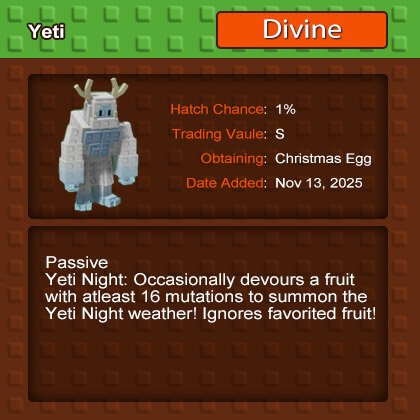
Most Divine pets in Grow a Garden give you more stats, more XP, or more convenient automation. The Yeti is different. It walks into your garden, looks at one of your most valuable fruits—something with at least 16 mutations—and literally devours it every ~15 minutes just to summon a special weather called Yeti Night.
From a distance that sounds insane. Why would you let a pet eat something that took you hours (or days) to roll? The answer is simple: if you can afford that sacrifice, you gain something no other pet currently offers—direct control over a powerful, mutation-focused weather state.
In this product sheet, I'll break down what the Yeti is, exactly how its trait works, why it's designed to feel expensive but worth it, and when you, as a player, should actually let this big fluffy menace loose in your garden.
First, the basic spec and where it sits in the Christmas Harvest Event ecosystem.
| Field | Value |
|---|---|
| Name | Yeti (Festive Yeti variant in event context) |
| Rarity | Divine (Limited) |
| Event Part | Christmas Harvest Event – Part 2 |
| Source | Christmas Egg |
| Category | Weather-controlling pet / Mutation support |
The Yeti is one of the headline pets introduced in the second part of the Christmas update, expanding the roster of high-impact, event-flavored pets.
It's also notable for a design first:
The Yeti is the first pet in Grow a Garden that can actively spawn a weather state.
Official appearance description:
From an art direction standpoint, it clearly anchors the winter boss fantasy: this isn't a cute snowman, it's the thing that walks in and changes the climate.
The heart of the Yeti is its unique trait, Yeti Night.
Trait:
Yeti Night – Occasionally devours a fruit with at least 16 mutations to summon the Yeti Night weather. Ignores favorited fruit.
Refined into mechanical terms:
| Aspect | Value / Behavior |
|---|---|
| Trigger Interval | Roughly every 14.56–15 minutes |
| Fruit Requirement | Fruit must have ≥ 16 mutations |
| Action | Devours (deletes) that fruit from your garden |
| Effect | Summons Yeti Night weather |
| Favorites | Ignores favorited fruit (will not respect your favorite flag) |
| Pet Category First | First pet in the game that can spawn a weather |
Two important nuances:
1. The fruit requirement is very high—16 mutations is not something casual players hit by accident.
2. Ignores favorited fruit means you cannot simply safe-lock your best fruit and expect the Yeti to leave it alone.
So the trait is unapologetically high-cost and high-impact.
Requiring at least 16 mutations on the sacrificial fruit has several design implications:
If you're still excited about your first 6–8 mutation fruit, this trait is not aimed at you yet. That's intentional; this is a feature for players already farming high-end mutations as a regular activity.
The trait doesn't stop at eat fruit. The payoff is Yeti Night, a special weather state.
While the exact numeric bonuses of Yeti Night depend on the internal balance, the conceptual design is clear:
In practice, this means:
From a product designer's view, the loop looks like this:
| Element | Cost | Benefit |
|---|---|---|
| Sacrifice | 1 fruit with ≥ 16 mutations (very expensive) | A full Yeti Night weather activation |
| Time | ~14.56–15 min between activations | Regular, predictable weather spikes |
| Control | Pet-controlled (not a manual button) | Low micro, high planning requirement |
If you're willing to burn a 16+ mutation fruit every ~15 minutes, you get:
If you're not ready to take that hit, the Yeti will feel like an expensive trophy you're afraid to actually use.
This is the part where wearing a product manager hat really matters: why did we design a Divine pet to consume something so valuable?
The Yeti is deliberately aimed at players who:
For that audience, the trade-off makes sense:
I sacrifice one very good resource now to multiply the effectiveness of everything I do during the weather window.
Yeti marks an important shift: it's the first pet that acts as a weather controller, not just a passive stat modifier.
That opens up several systemic design possibilities:
If you've ever had a moment where you thought, I wish I could just force this good weather to happen right now, the Yeti is the prototype answer to that fantasy.
The structure here is intentionally harsh at the start and generous later:
So the Yeti teaches a particular mindset:
Stop hoarding every perfect fruit forever; start thinking in terms of cycles and multipliers.
Now let's translate the design into should you actually use this pet, and when?
You are the intended audience for Yeti if:
For you, the Yeti can act as an event controller:
On the other hand, you should probably avoid or delay active use if:
If you find yourself staring at your one beautiful 16‑mutation fruit thinking There's no way I'm feeding this to anything, then the Yeti is, for now, more of a collector's Divine than a functional tool.
A typical high-end Yeti usage pattern could look like this:
1. Spend a session building up a stockpile of 16+ mutation fruits.
2. Keep Yeti active in your garden.
3. When it devours a fruit and triggers Yeti Night:
4. Let weather expire, go back to prep mode, and repeat when the next activation comes up.
If you notice that your overall mutation output per hour jumps significantly when you do this, that's exactly the kind of late gain the Yeti is designed to unlock.
Q1: Can I protect my favorite 16+ mutation fruit from being eaten by the Yeti?
A: No. The trait explicitly ignores favorited fruit, which means the usual favorite lock doesn't prevent the Yeti from devouring it. If you truly don't want a specific fruit consumed, you should keep it out of the Yeti's reach (e.g., not in the active garden area where the pet operates) or delay using Yeti until you're comfortable sacrificing that tier of fruit.
Q2: How often can the Yeti trigger Yeti Night?
A: Approximately once every 14.56–15 minutes, assuming it has access to an eligible fruit (≥ 16 mutations) to devour. If there is no suitable fruit, the trait simply can't fire.
Q3: Is the Yeti useful if I can't consistently produce 16‑mutation fruits?
A: Not really. The Yeti's entire value proposition is built around trading one high-end fruit for a strong weather effect. If producing such a fruit is a rare event for you, the cost will feel too high and the weather too infrequent to justify.
Q4: Does the Yeti improve my pets' stats directly?
A: Its main value is indirect: it controls weather rather than boosting stats or XP directly. The stat gains you see come from doing more and better mutations, farming, or event activities during Yeti Night, not from a raw stat buff on the Yeti itself.
Q5: Is the Yeti mandatory for late-game mutation play?
A: No, but it's a powerful accelerator if you already have a strong mutation engine. You can still progress without it; the Yeti simply gives you more control and more frequent high-value weather windows.
The Yeti is a very specific kind of Divine pet in Grow a Garden: it doesn't just make numbers bigger, it asks you to burn something precious—a 16‑mutation fruit—so that your entire garden briefly operates under a supercharged weather state called Yeti Night.
If you're early in your progression, that cost will feel outrageous, and you're right to treat the Yeti as a collectible rather than a core tool. But if you're deep into the mutation game, producing high-mutation fruits in batches and thinking in terms of hourly yield instead of individual items, the Yeti turns into a weather lever you can pull on demand.
Used well, it lets you trade one very good fruit for a window where everything you do becomes better: more mutations, more event progress, and more meaningful returns on your time. Used too early, it just feels like you invited a very fancy Divine guest into your garden to eat your one and only masterpiece.

Wir verwenden Cookies, um die Funktionalität der Website zu gewährleisten und Ihr Erlebnis zu verbessern. Klicken Sie auf "Alle akzeptieren", um zuzustimmen, oder auf "Anpassen", um Ihre Präferenzen zu verwalten. Siehe unsere Datenschutzerklärung.