


 0
0 Created: Oct 7,2026 | Aion 2
Aion 2 Kinah Farming: Gem Routes, Market Listings, and Crafting Costs

When dungeon energy runs out, we recommend testing a sapphire, ruby, or diamond gathering route, then selling a small batch before extending the farm. Choose your next route using completed sales after fees, not the highest price displayed on the market.
Our working sequence is simple:
1. Check recipe ingredients and competing listings.
2. Gather one short, repeatable route.
3. Sell manageable quantities.
4. Compare net proceeds with total time spent.
- Choose a Gem Before Choosing a Route
- Match the exact ingredient
- Map a compact circuit
- Measure Gathering Output Without Misreading Luck
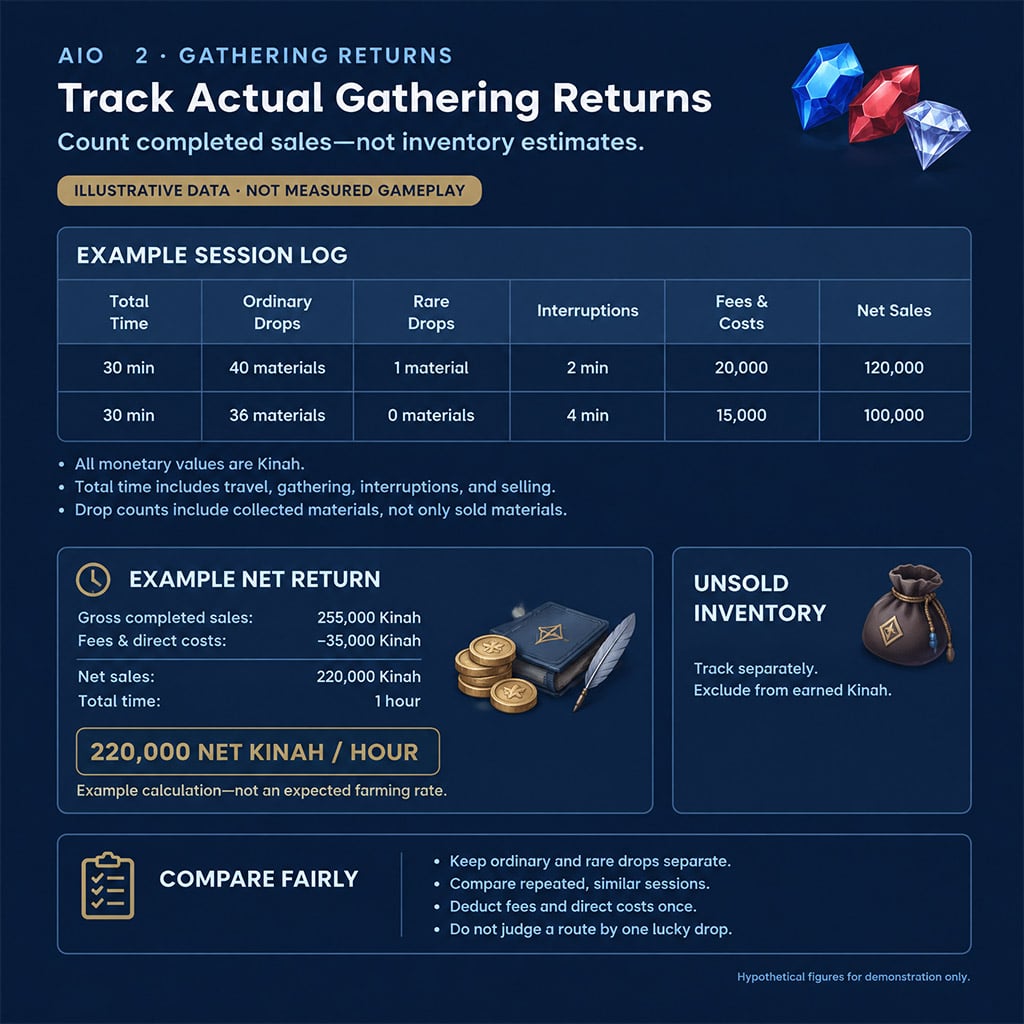
- Record a complete session
- Test passives under comparable conditions
- Sell Efficiently Before Funding Crafts
- Test quantities, not just prices
- Compare the full crafting chain
- Know when to stop
- FAQ (Frequently Asked Questions)
- How do we earn Kinah without dungeon energy?
- Which gem is best for Kinah farming?
- Why are my materials not selling?
- Should we sell materials or craft accessories?
- Can gathering reliably make millions of Kinah?
Choose a Gem Before Choosing a Route
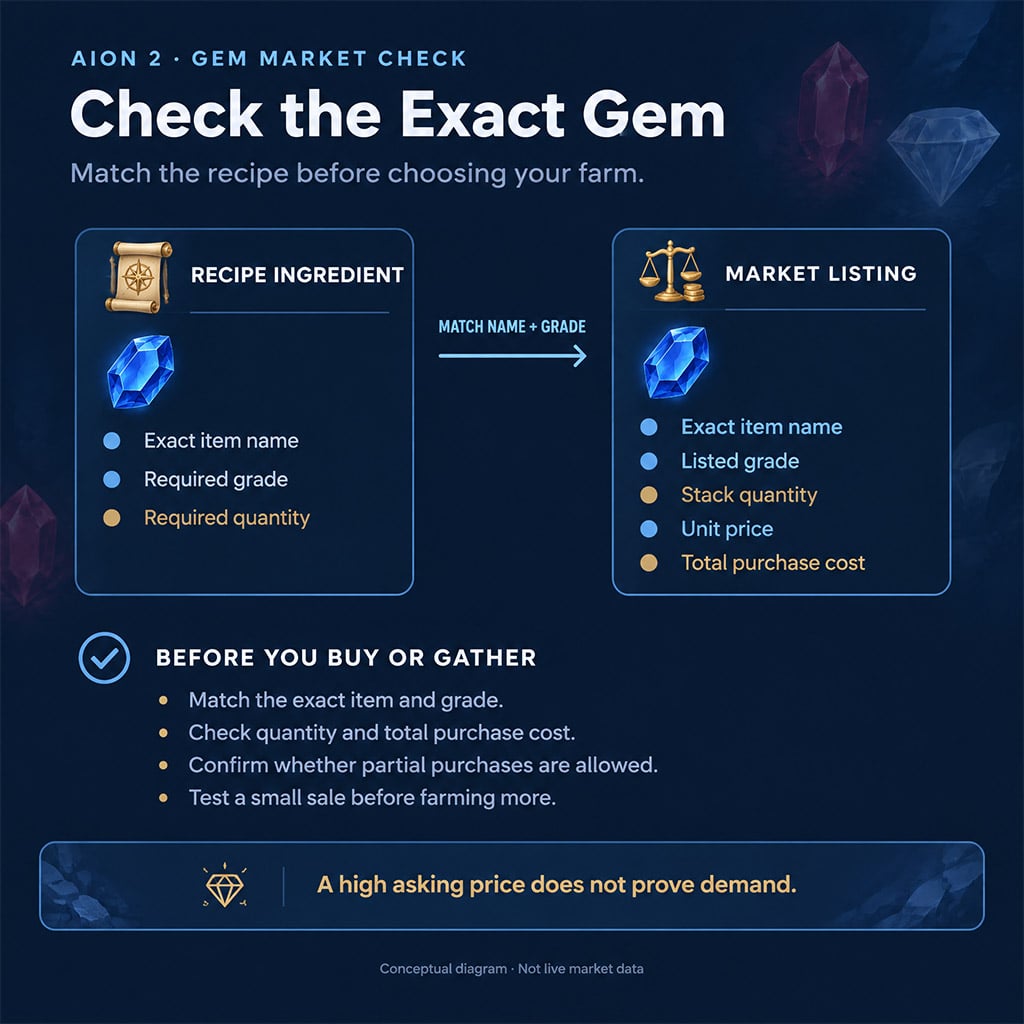
A high asking price means little if the material sits unsold. We start with a market check, then select a route that avoids excessive travel, combat, and competition.
Match the exact ingredient
The community gem database lists sapphire, diamond, and ruby gathering entries for both Elyos and Asmodians. It does not establish which gem is most profitable on your server.
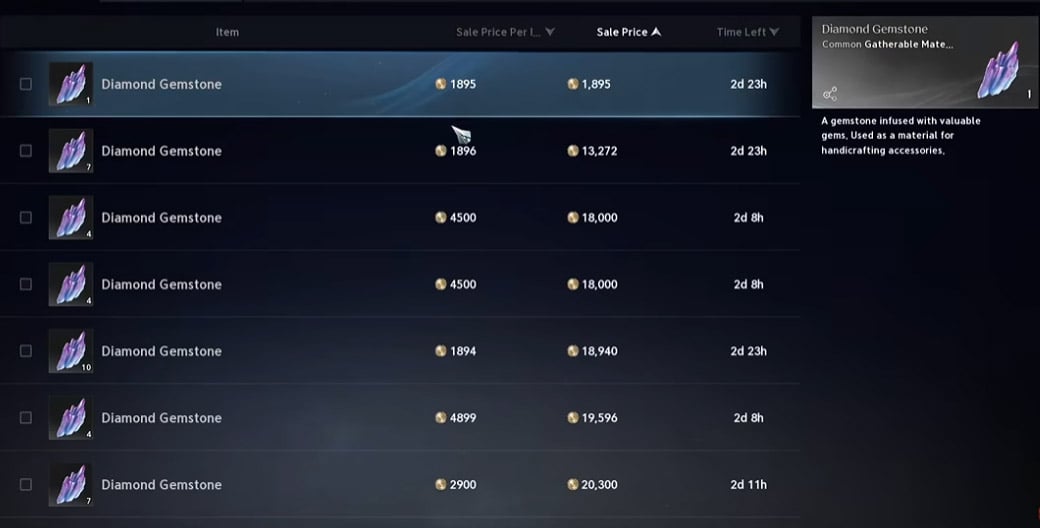
Open a crafting recipe and check its ingredient listings. Match the exact item name, grade, and quantity; a similarly named material may not satisfy the recipe.
Use this decision table before leaving town.
| What you find | What we do | What would change the decision |
|---|---|---|
| Competitive listings at affordable totals | Gather a small test batch | Your batch repeatedly fails to sell |
| High prices but no sales evidence | Limit inventory exposure | Completed sales confirm demand |
| Cheap gems on a compact route | Compare output against a pricier route | Travel or failures erase the advantage |
| Crowded or dangerous nodes | Test another route | Better availability restores efficiency |
| Different material grades | Evaluate each separately | The recipe accepts a cheaper alternative |
Choose the route that turns materials into Kinah reliably, not the one with the most impressive inventory valuation.
Map a compact circuit
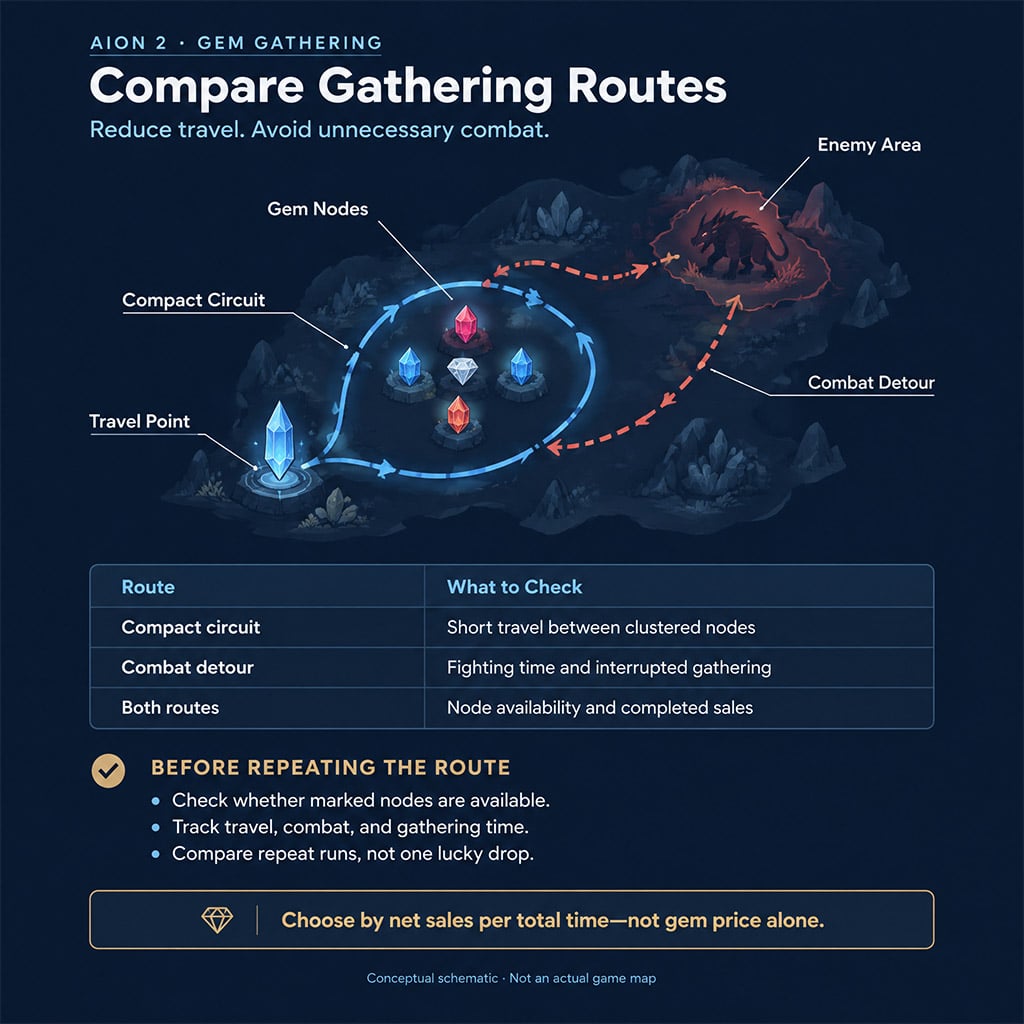
Use the Aion 2 interactive map, which lists gathering nodes alongside travel points and other locations. Select the relevant region, hide unrelated markers, and identify a small circuit you can repeat.
Do not treat a map marker as a live availability indicator. Check whether nodes are present and accessible when you arrive.
Measure Gathering Output Without Misreading Luck
One rare drop can make a weak route look excellent. We compare repeated sessions and keep ordinary output separate from exceptional drops.
Record a complete session
For each run, note:
- Elapsed time, including travel.
- Material quantities by exact item and grade.
- Failed or interrupted attempts.
- Time spent fighting or waiting.
- Direct spending.
- Net proceeds from completed sales.
Keep unsold materials in a separate inventory column. They are potential value, not earned Kinah.
Test passives under comparable conditions
The supplied account reports two 40-minute sessions, one with Lady Luck and one with Delicate Touch, but provides no complete output totals. That is insufficient to declare a universal winner.
If you compare gathering passives, use the same route, similar conditions, and equal session lengths. Check respec costs before experimenting.
Compare successful output per minute—not animation speed alone.
Also inspect the current gathering interface for detection skills, progression caps, and profession-upgrade requirements. If enemies repeatedly interrupt extraction, move to safer nodes rather than forcing every interaction.
Sell Efficiently Before Funding Crafts
If materials are not selling, examine the buyer's total commitment before lowering the unit price. Then compare crafting against selling the ingredients directly.
Test quantities, not just prices
Inspect the market's current purchase rules. If buyers must purchase an entire listing, bulk stacks can exclude players who need only a few ingredients.
These illustrative quantities show how purchase cost changes.
| Quantity | Illustrative unit price | Total purchase cost |
|---|---|---|
| 1 | 4,000 Kinah | 4,000 Kinah |
| 10 | 4,000 Kinah | 40,000 Kinah |
| 100 | 4,000 Kinah | 400,000 Kinah |
Test recipe-sized batches before undercutting again; use singles only when fees and listing limits justify them.
Record posting charges and final deductions from your own interface. Do not assume a historical tax rate still applies.
For example, 120,000 Kinah in completed net sales over 30 minutes equals 240,000 Kinah per hour. This is an arithmetic example, not a measured farming rate.
Compare the full crafting chain
Before buying a base or crafting an accessory:
1. Open the finished-item recipe.
2. Price the base and every additional ingredient.
3. Include crafting charges and any displayed failure or variable-output mechanics.
4. Estimate realistic sale proceeds after market charges.
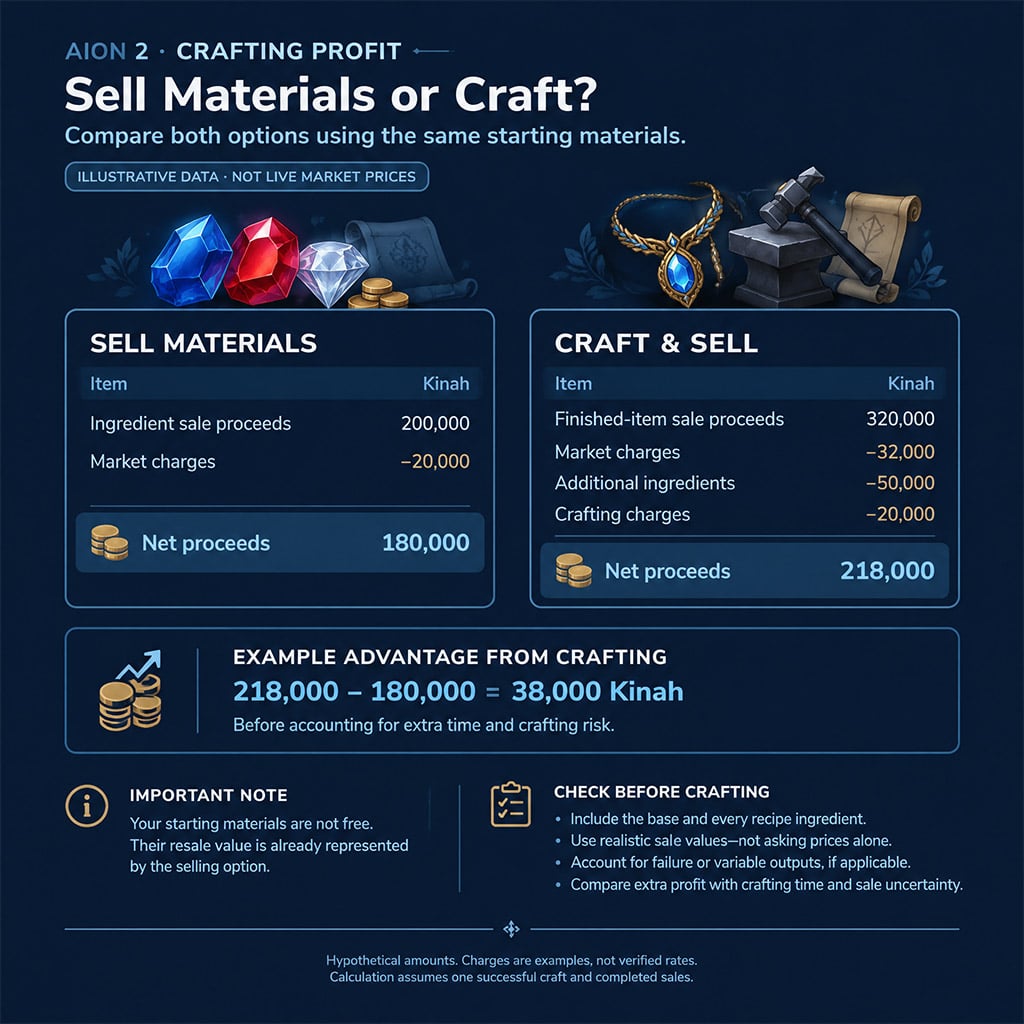
5. Compare that result with selling the ingredients.
Self-gathered materials still have value. Using them sacrifices their potential sale proceeds.
For crafting decisions, we use realistic ingredient sale values. For cash-flow tracking, we also record what we actually paid; these answer different questions.
Know when to stop
Pause the farm when stock accumulates faster than it sells. Avoid buying more materials simply because their price has fallen.
Likewise, treat energy conversion as a separate purchase decision: include the materials' sale value, conversion charges, and the time required to earn the resulting reward. An alt using its own dungeon energy is additional income—not energy-free gathering.
FAQ (Frequently Asked Questions)
How do we earn Kinah without dungeon energy?
Gather materials and sell them through the market, subject to your current trading access. We recommend testing a short gem route and a small sale before committing to a long session.
Which gem is best for Kinah farming?
There is no verified universal winner among sapphires, rubies, and diamonds. Choose using your server's completed sales, route output, and total time—not asking price alone.
Why are my materials not selling?
The price, quantity, total purchase cost, or demand may be wrong. Check the exact item and grade, then test a smaller batch before lowering the unit price again.
Should we sell materials or craft accessories?
Sell when the ingredients' net sale value exceeds the finished item's expected net proceeds. Craft only after accounting for the base, additional ingredients, crafting charges, and market costs.
Can gathering reliably make millions of Kinah?
No fixed multi-million-Kinah rate is established by the available evidence. Measure repeated runs and completed sales, then calculate how much time your own target requires.

I’m Tomás Ferreira, a Portuguese SEO Content Editor at GGWTB covering Roblox competitive games, tower defense, and resource-control modes. I organize guides around the decisions that matter in a short match: when to push, where to defend, and whether to spend resources now or save for an upgrade. The goal is to make the answer easy to find before the next round starts.
Most Popular Posts
- Aion 2 Macro Guide: Set Up DPS Macros for PvP & PvE
- AION 2 Global Best Classes: Current Meta, PvE/PvP Roles, and Class Picking Guide
- AION 2 Classes Tier List: Best Difficulty Ranking Global Release
- Aion 2 Global Class Tier List: Best for PvE, PvP & Solo Play
- Aion 2 Global Release Guide: Early Access Servers, Marketplace, PvP, and Server Transfers
- AION 2 Global PvE Endgame Guide: Raids, Dungeons, Bosses & Crafting Priority
Popular Category Lists
- ARC Raiders / (339)
- Grow a Garden / (292)
- CoD: Black Ops 7 / (167)
- Star Citizen / (160)
- MLB 26 / (159)
- Monopoly Go / (152)
- ARK Survival Ascended / (125)
- Steal a Brainrot / (98)
- Blox Fruits / (74)
- Adopt Me / (73)
- Forza Horizon 6 / (72)
- Sailor Piece / (68)
- Grow a Garden 2 / (68)
- Diablo IV / (62)
- CoD: BLACK OPS 6 / (55)
- Path of Exile 2 / (48)
- Monster Hunter Wilds / (46)
- Aion 2 / (45)
- Windrose / (44)
- Donut SMP / (41)