0
Created: Oct 23,2026 | Aion 2
AION 2 Kinah Farming: Alchemy Profits Without Costly Crafting Mistakes Guides

Use intermediate Manastone and Soulstone recipes to pursue superior upgrades, but expand production only after actual sales cover your materials and fees. If you judge profit by a superior stone's asking price alone, you risk converting useful inventory into unsold stock.
We checked the available community recipe references and the supplied gameplay examples; we have not independently tested these recipes in-game. Your current crafting window and completed-sale records take priority over the historical figures below.
- Start With the Intermediate Recipe
- Price Every Ingredient
- Separate the Trigger From the Finished Stone
- Sell a Test Batch Before Scaling
- Use These Stop Conditions
- Keep One Batch Ledger
- Farm Inputs Without Wasting Progression Resources
- Choose Runs That Pay Twice
- Fund Accessories Only After Sales Settle
- FAQ (Frequently Asked Questions)
- Is Alchemy guaranteed to make millions of Kinah in AION 2?
- Does a 20% combo chance guarantee a superior stone every five crafts?
- Where can we farm Manastones and Soulstones?
- Should we sell lesser stones or craft them?
- Should we craft a True Dragon Lord Ring with our Alchemy earnings?
Start With the Intermediate Recipe
The money-making route depends on crafting lower-grade inputs into intermediate stones and triggering a superior result. Buying expensive intermediates for a direct superior recipe is a separate investment—not automatically the cheaper option.
Price Every Ingredient
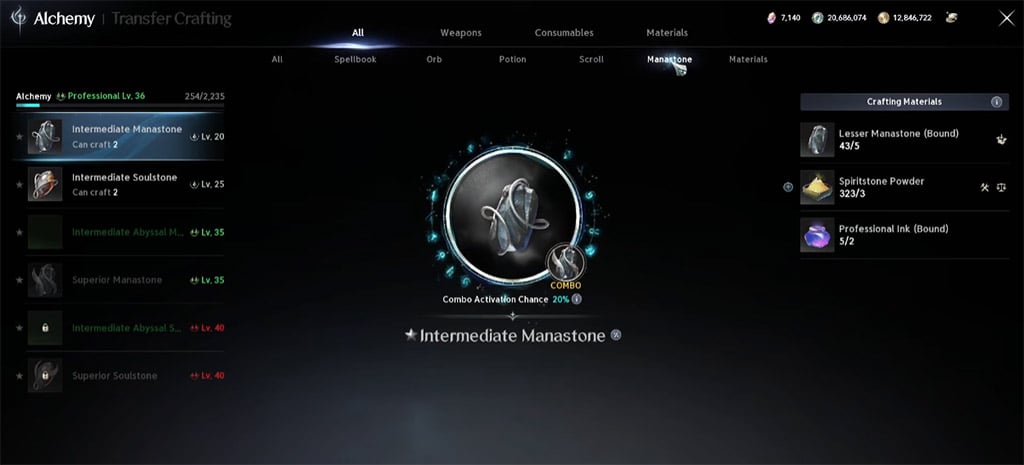
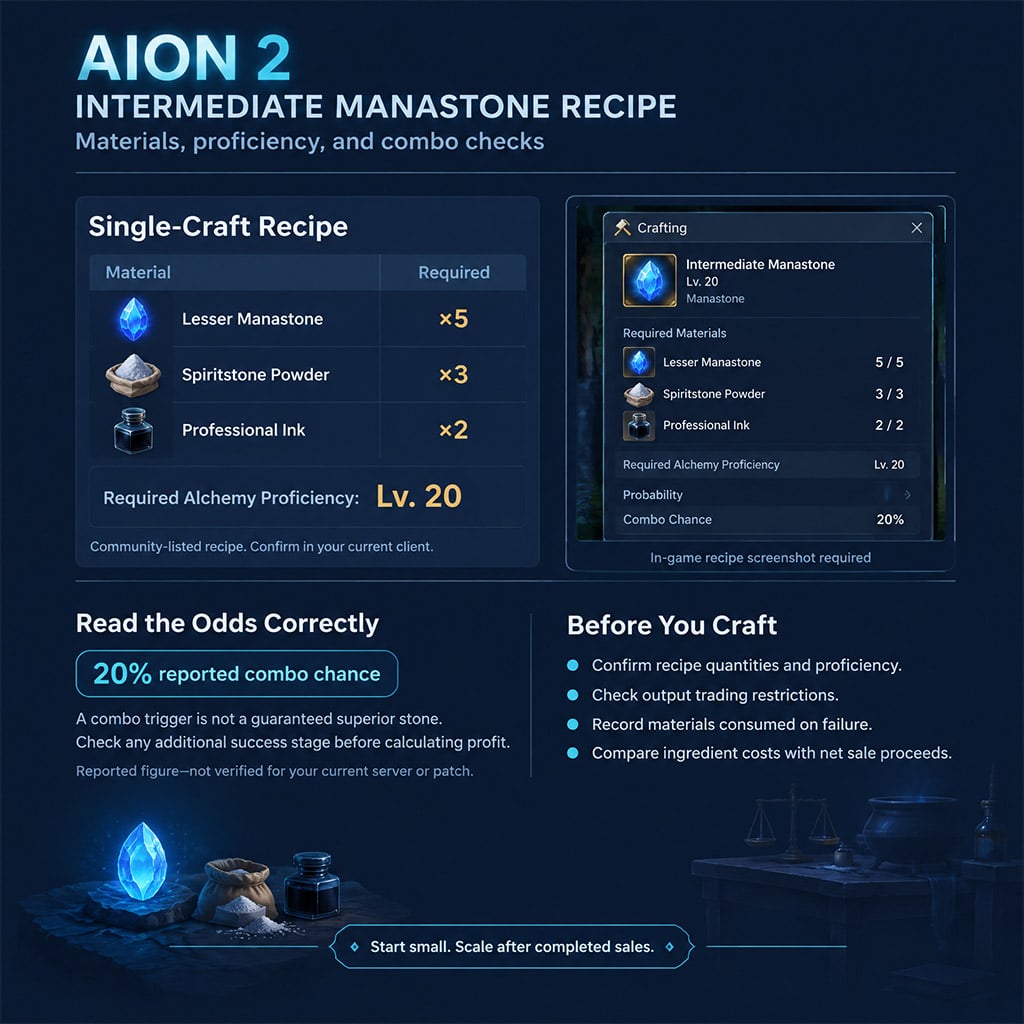
We checked Fextralife's Intermediate Manastone entry, which lists the following single-craft recipe.
| Requirement | Listed amount | Cost to include |
|---|---|---|
| Alchemy proficiency | Level 20 | Any remaining profession-leveling expense |
| Lesser Manastone | 5 | Their realistic resale value |
| Spiritstone Powder | 3 | Purchase cost or resale value |
| Professional Ink | 2 | Your applicable vendor or market cost |
Check these quantities against your client before buying; do not apply this Manastone recipe to Soulstones or Abyssal variants.
The same reference lists a larger recipe with ten times the inputs at a higher proficiency requirement. Check its output quantity and how the game handles each attempt before assuming bulk crafting improves your odds.
Separate the Trigger From the Finished Stone
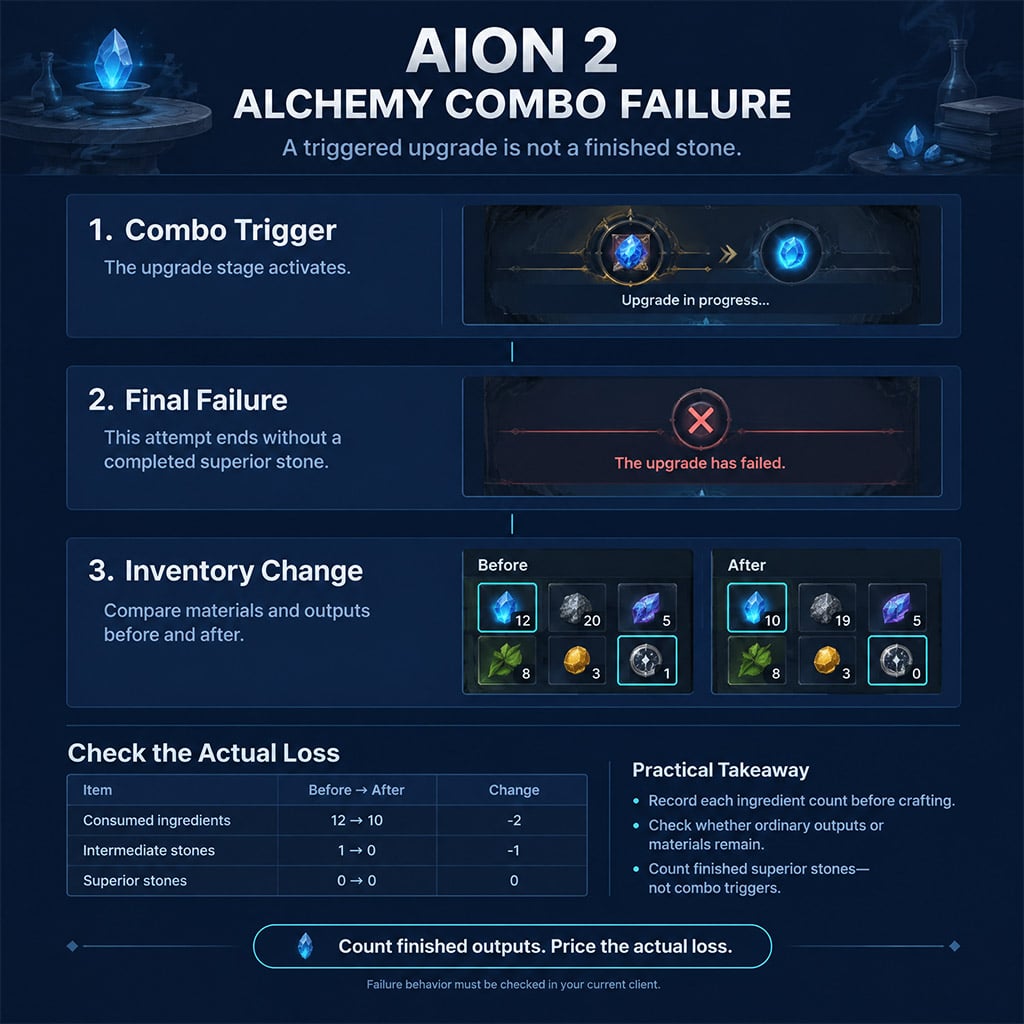
SPACE4GAMES' crafting guide reports a 20% combo chance for intermediate Manastones and Soulstones. The supplied gameplay example also shows a triggered upgrade failing afterward.
A combo is not Kinah.
Our probability check shows that eight independent attempts at a 20% trigger rate have approximately a 16.8% chance of producing no triggers. Subsequent failures can increase the chance of ending without a superior stone.
If you cannot absorb a batch with no superior output, reduce the batch before crafting. Record ordinary outputs and retained materials too; they affect the result.
Sell a Test Batch Before Scaling
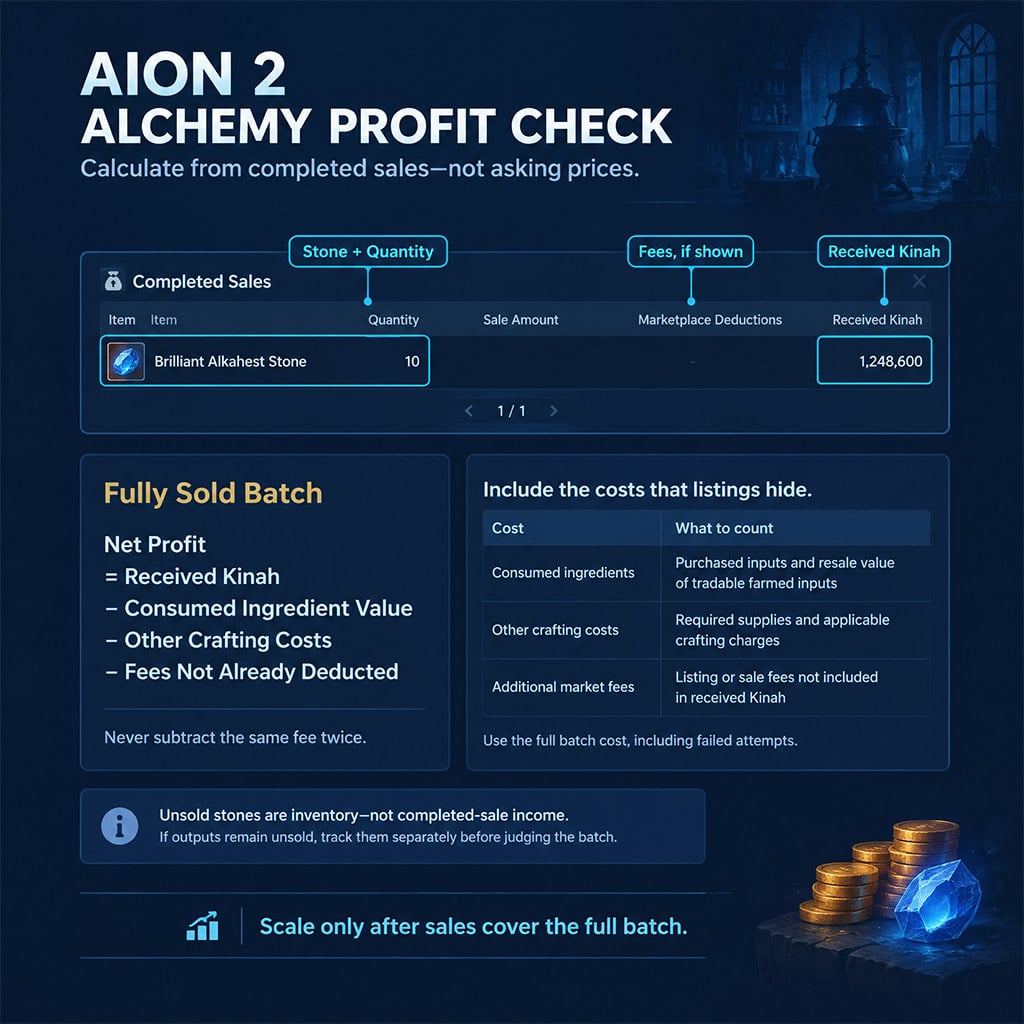
High listings are useful price references, not proof of demand. We need to know what buyers pay, how quickly they buy, and what the market deducts.
The supplied example lists superior Soulstones near 570,000 Kinah and superior Manastones near 700,000 Kinah. It reports four Soulstone sales totaling more than 2 million Kinah, but does not establish the batch's full net profit.
Use These Stop Conditions
Choose your next action from the economics of the entire batch.
| What you find | Action | Reason |
|---|---|---|
| Finished outputs sell above complete costs | Repeat the same affordable batch size | One profitable batch does not establish stable odds |
| Ingredients sell well; output demand is unclear | Sell the ingredients | Avoids crafting risk and delayed payment |
| Superior listings remain unsold | Stop production | More stock increases exposure to falling prices |
| Ordinary outputs also sell | Count their proceeds | They can reduce dependence on rare upgrades |
| Failure consumption or fees are unknown | Test and document them first | Missing costs can erase the apparent margin |
| Your next batch requires an unsold item to sell | Wait | Inventory cannot pay vendor bills |
Do not expand until your first batch settles; unsold superior stones are the clearest signal to pause.
Keep One Batch Ledger
For every batch, record:
- Inputs consumed: value tradable farmed materials at realistic resale prices.
- Additional costs: vendor supplies, required currencies, and applicable crafting charges.
- Outputs received: ordinary stones, superior stones, and any returned materials.
- Completed sales: use settlement proceeds, not listing prices.
- Unsold stock: track separately from realized profit.
Net profit equals completed-sale proceeds minus consumed-input value and all additional costs. If settlement proceeds already exclude a sale fee, do not deduct that fee twice.
If the market lets buyers purchase individual units from a listing, splitting stacks may not help. If buyers must purchase the whole bundle, smaller listings can reduce the upfront amount they need.
Farm Inputs Without Wasting Progression Resources
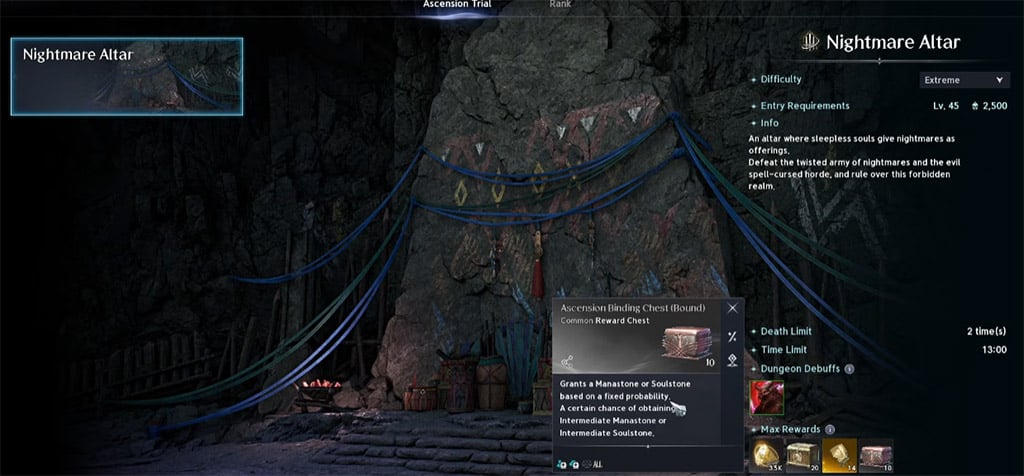
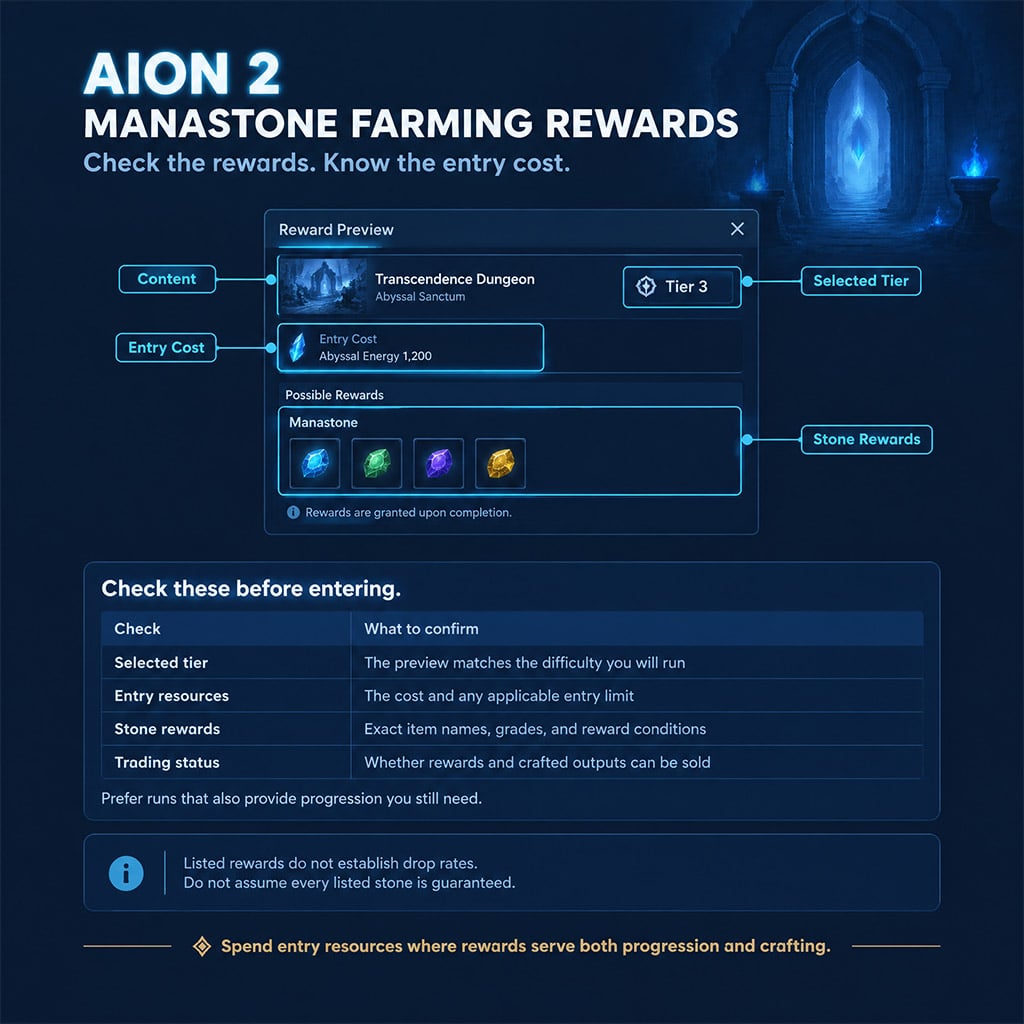
The supplied examples identify Transcendence dungeons and Ascension Trials as stone sources. Fextralife also lists Transcendence content and reward chests among Intermediate Manastone sources.
Check your current reward preview before spending an entry allowance or energy.
Choose Runs That Pay Twice
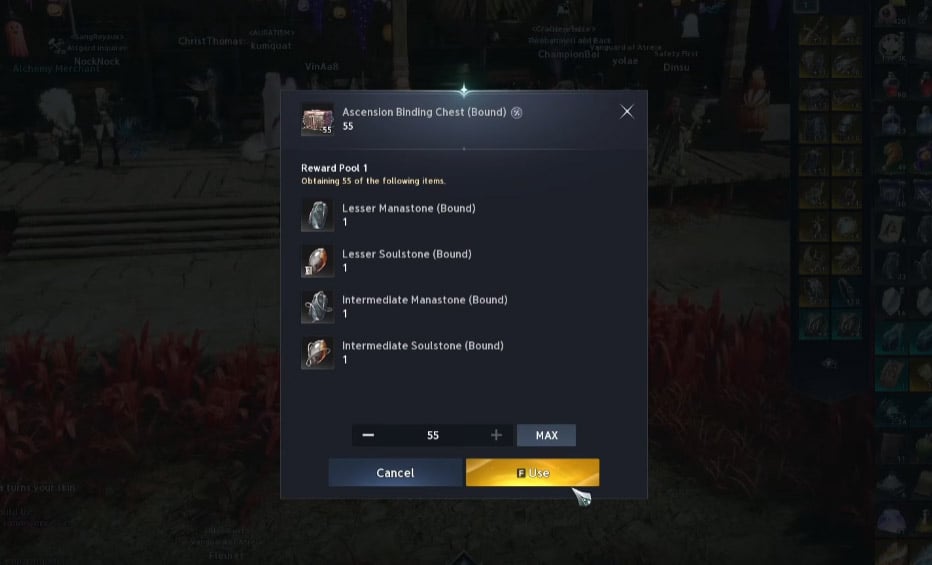
We counted 55 stones in the supplied reward-opening example: 19 lesser Manastones, four intermediate Manastones, 28 lesser Soulstones, and four intermediate Soulstones. That verifies the sample total, not a dependable drop rate.
If you still need a dungeon's progression rewards, run it and use the stones as a secondary return. If you enter only for crafting inputs, compare their expected value with other uses of the same limited resource.
Our route is short:
1. Check the eligible reward tier.
2. Prioritize content that also advances your character.
3. Sort rewards by grade and trading status.
4. Price the tradable ingredients.
5. Craft only the portion your batch budget can absorb.
A bound ingredient has no direct resale opportunity, but its crafted output may also be restricted. Inspect both ends of the recipe before treating it as market fuel.
Fund Accessories Only After Sales Settle
The supplied True Dragon Lord Ring example values materials at 14–15 million Kinah, lists the ordinary ring near 27.78 million, and shows approximately 555,000 Kinah in listing cost.
We recalculated that spread: it leaves approximately 12.22–13.22 million Kinah before uncounted costs and deductions—but only if the ring sells at that price. The example does not confirm that the material valuation includes every precursor failure.
Do not spend that apparent margin.
Before crafting the ring, compare its purchase price with the full expected chain cost. Include earlier rarity upgrades, failure losses, refining materials, and restricted currencies.
If an intermediate component is cheaper to buy than to produce through repeated attempts, skip that part of the chain. Profession experience is useful; it does not justify unlimited losses.
FAQ (Frequently Asked Questions)
Is Alchemy guaranteed to make millions of Kinah in AION 2?
No—Alchemy profits depend on completed outputs, actual sales, and full costs. We should test an affordable batch before purchasing more materials.
Does a 20% combo chance guarantee a superior stone every five crafts?
No—a 20% trigger rate does not guarantee one trigger within five attempts. Any additional failure stage also separates the trigger from receiving a finished superior stone.
Where can we farm Manastones and Soulstones?
The supplied examples identify Transcendence dungeons and Ascension Trials as sources. Check the current reward preview and trading restrictions before committing limited entry resources.
Should we sell lesser stones or craft them?
Sell when their net resale value beats the expected crafting return, or when output demand is unproven. Craft when you have confirmed the recipe costs and can absorb an unsuccessful batch.
Should we craft a True Dragon Lord Ring with our Alchemy earnings?
Craft only when settled earnings cover the project and its full expected cost beats buying the ring. Keep a separate reserve for progression expenses, and check that the ring's actual skill bonuses suit your build.

I’m Emily Zhang, an American Research Writer at GGWTB covering Korean MMORPGs and games based on classic franchises. My guides focus on class choices, leveling routes, and long-term character progression. I look at what a class needs beyond its starter skills—and which upgrades are worth your materials before the next gear tier arrives.
Most Popular Posts
- AION 2 Global Best Classes: Current Meta, PvE/PvP Roles, and Class Picking Guide
- Aion 2 Global Class Tier List: Best for PvE, PvP & Solo Play
- AION 2 Global PvE Guides: Dungeons, Raids and Weekly Priorities
- AION 2 PvE DPS Tier List: Highest-DPS Classes Ranked by Dungeon Data
- AION 2 Pet Guide: Souls, Genus Insight, Owned Effects and What to Farm First
- Aion 2 Best Leveling Build for All Classes: Fast 1–45 Global Launch Guide
Popular Category Lists
- ARC Raiders / (354)
- Grow a Garden / (294)
- CoD: Black Ops 7 / (167)
- Star Citizen / (163)
- MLB 26 / (159)
- Monopoly Go / (153)
- ARK Survival Ascended / (128)
- Steal a Brainrot / (99)
- Blox Fruits / (74)
- Adopt Me / (74)
- Forza Horizon 6 / (72)
- Sailor Piece / (68)
- Grow a Garden 2 / (68)
- Diablo IV / (62)
- CoD: BLACK OPS 6 / (55)
- Aion 2 / (53)
- Path of Exile 2 / (48)
- Monster Hunter Wilds / (46)
- Windrose / (44)
- COD: Modern Warfare 4 / (43)