



 0
0 Created: Jan 23,2026 | Dreadmyst
Dreadmyst Endgame Affix Discipline, Market Economy & Class Builds Guides

Getting affixes kind of right in Dreadmyst feels okay—until you compare your time-to-kill, boss safety, and dungeon consistency against someone with the same combat rating who simply rolled better affix efficiency. The difference usually isn't a secret build; it's disciplined stat priorities, strict adherence to pairing rules, and understanding the market economy.
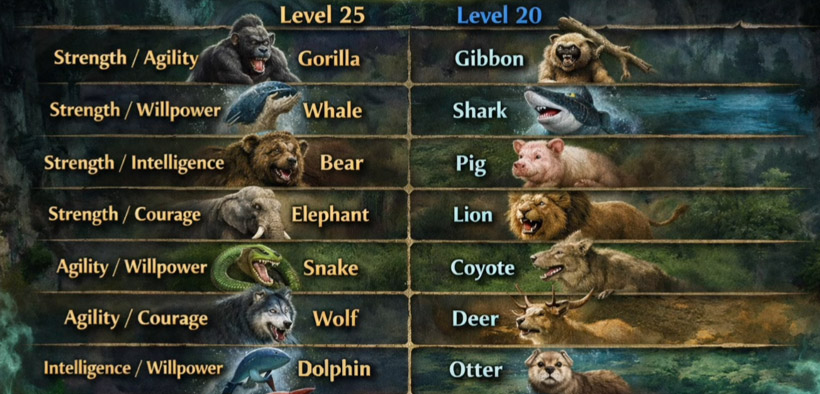
Below is the structured guide we use internally. It breaks down how to stop wasting Dreadmyst gold on fake upgrades and how to build a character that actually clears content.
- 1. Affixes and the Two-Column Rule
- 1.1 The Column Logic
- 1.2 Why 25/25 is the Only Tier That Matters
- 2. Buying Smart and Enchanting Safely
- 2.1 The Purchasing Workflow
- 2.2 The Risk Management Ladder
- 2.3 Gems and Extractors
- 3. Class-Specific Build Guides
- 3.1 Ranger: Simple Scaling, Brutal Efficiency
- 3.2 Mage: The Triad Building Method
- 3.3 Cleric (Healer): Shield and Output Engine
- 3.4 Cleric (Hybrid): Heal First, Damage Second
- 3.5 Paladin (Hybrid): The Strength/Courage Core
- FAQ: Common Pitfalls
- Final Thoughts
1. Affixes and the Two-Column Rule
Before looking at class stats, you must understand the constraints of the gear itself. Affixes in Dreadmyst are not a free-for-all; they are governed by a strict structure that determines what combinations are legally possible.
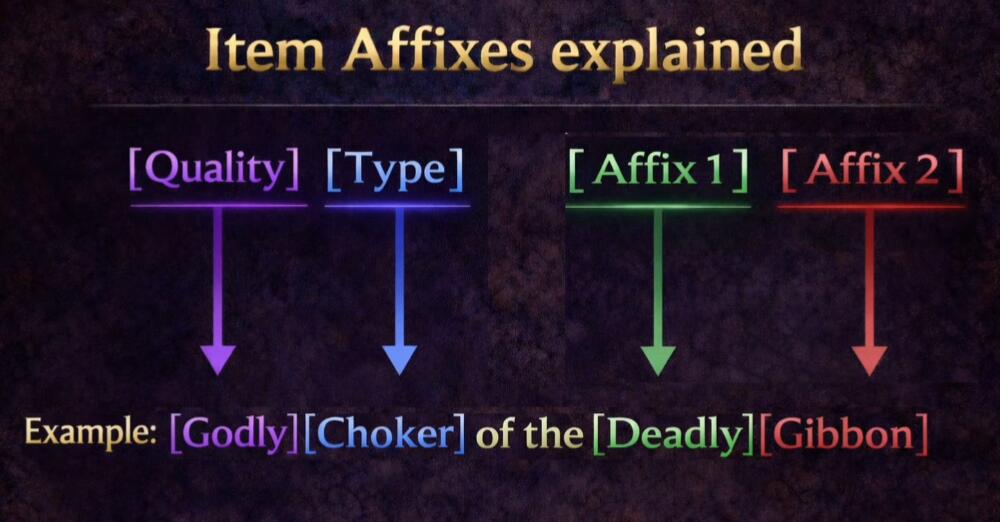
1.1 The Column Logic
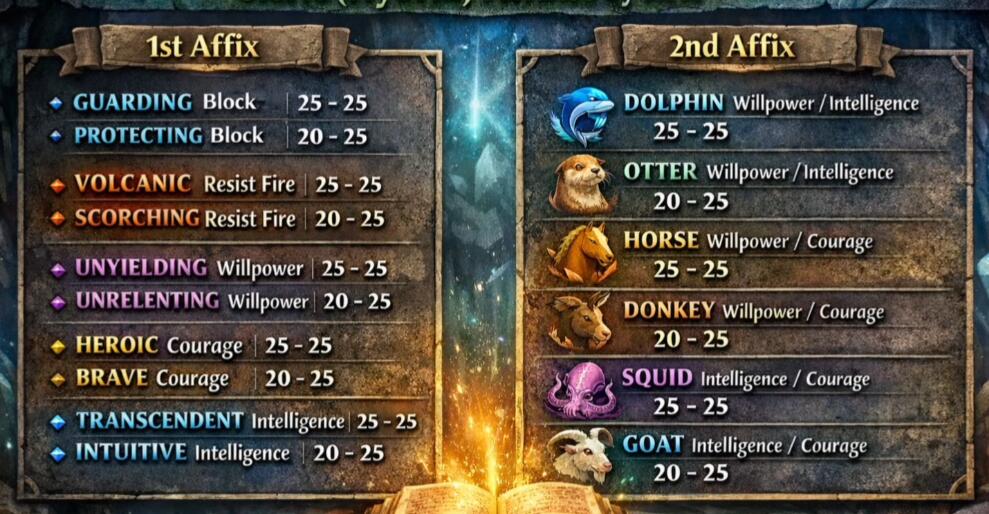
Every item draws its stats from two distinct pools: Affix 1 (Column 1) and Affix 2 (Column 2). You get one from each. This is the most critical rule in the game because it dictates that you cannot stack overlapping stats if they reside in the same column, nor can you roll two affixes from Column 1 on a single item.
Practical Consequence:
If your desired prefix is pure Willpower, and Willpower is also a prefix-exclusive stat, your paired affix cannot include Willpower again. This is why many perfect items people dream of are mathematically impossible to generate.
1.2 Why 25/25 is the Only Tier That Matters
You will see gear labeled with affix tiers, typically 20–25 or 25/25.
- 20–25: Can roll on lower-level gear. These are temporary bridges.
- 25/25: Only rolls on Level 25 gear. These deliver the highest value per slot.
Because each gear slot is capped, higher-tier affixes compound massively across a full set. A single almost good roll is acceptable; six almost good rolls result in a build that is permanently 15% behind the curve.
| Tier Label | Where It Rolls | Strategic Use |
|---|---|---|
| 20–25 | Multiple levels | Bridge Gear: Use to fix a missing resist or hit cap temporarily. |
| 25/25 | Level 25 only | Endgame: The only gear we invest heavy enchanting materials into. |
2. Buying Smart and Enchanting Safely
Dreadmyst's UI doesn't teach value; the market does. We follow a strict loop to ensure we aren't burning gold on items that don't scale.
2.1 The Purchasing Workflow
Before optimizing, we sanity-check the market.
- 1. Filter by Quality: Look for the highest quality you can afford (e.g., Holy/Godly).
- 2. Filter by Exact Affixes: Do not settle for close enough.
- 3. Check Liquidity: Sort by time listed.
If you notice many items with your stats expiring unsold, the price is inflated. Negotiate or wait.
If you notice new listings vanish instantly, you are in a high-demand lane. Plan to keep your current gear longer.
2.2 The Risk Management Ladder
Enchanting is where players vaporize progress. Success rates drop as levels rise (e.g., +0 to +1 is 100%, but +1 to +2 drops to ~93% on Holy gear). We use a Hybrid Strategy to manage this risk.
| Strategy | How We Use Orbs | Best For |
|---|---|---|
| Safe Path | High-quality orbs early | Players who cannot afford setbacks. |
| Hybrid Path | Cheap/Lesser orbs for low levels, Major/Divine for high levels | Most efficient long-term play. |
| Aggressive | Cheap orbs until they fail | High variance; only for those with massive gold reserves. |
Rule of Thumb:
If you notice your gold stash is shrinking faster than your power is rising, you are enchanting too deep on gear that you are about to replace.
2.3 Gems and Extractors
Gems are the cleanest always useful progression layer. However, moving them costs money (or destroys the item).
- The Trap: Putting a Refined (top tier) gem in a temporary item.
- The Fix: Use Mid-tier gems for travel gear. Save Refined gems for 25/25 pieces you will keep for weeks.
Extraction:
Only use an Orb/Gem Extractor if the reclaimed material is worth more than the item itself, because extraction destroys the gear.
3. Class-Specific Build Guides
Once you understand the economy and affix rules, you apply them to your class. Here is the priority matrix we use for our group.
3.1 Ranger: Simple Scaling, Brutal Efficiency
Ranger damage is straightforward: Flat Damage + Ranged Weapon Value + Attribute Scaling. Simplicity is a gift, provided you don't dilute it with useless stats.
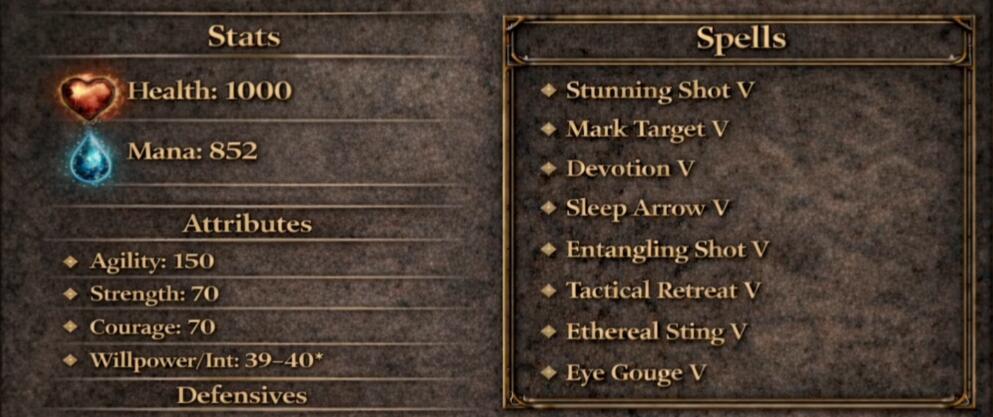
Stat Priorities:
- 1. Agility: The always good stat.
- 2. Strength vs. Courage: Strength for melee/dagger value; Courage for resistances.
- 3. Intelligence: Low priority. Only for niche scaling.
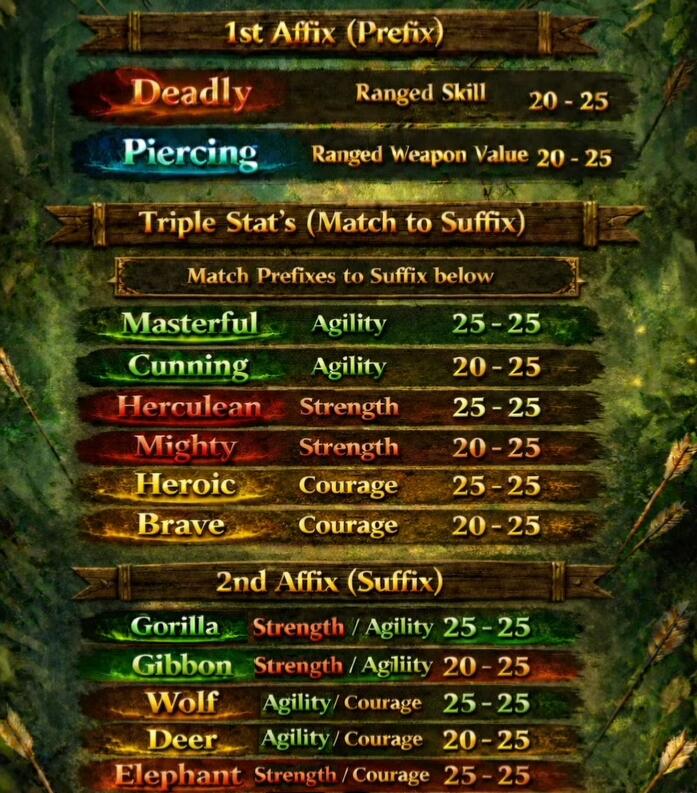
Affix Strategy (25/25 Focus):
We prioritize consistency over big numbers.
- Goal 1: Hit Range Skill targets.
- Goal 2: Ranged Weapon Value (raises your floor).
- Goal 3: Tri-stat mixes (AGI/STR/Courage).
| Your Situation | Affix Direction | Why? |
|---|---|---|
| Inconsistent Damage | Range Skill + Defensive | If your skills aren't landing, your theoretical DPS is zero. |
| Low Average Hits | Ranged Weapon Value + Tri-stat | Fixes real DPS better than raw stats. |
| Dying to Magic | Tri-stat + Resists | Dead rangers do no damage. |
Diagnostic:
If you notice enemies parry or you whiff too often, then Weapon Value/Range Skill fixes your output better than more Agility.
3.2 Mage: The Triad Building Method
Mages often underperform not because of their kit, but because their stats are scattered. We use Triad building: One 25/25 Single-Stat Affix + One 25/25 Dual-Stat Affix.
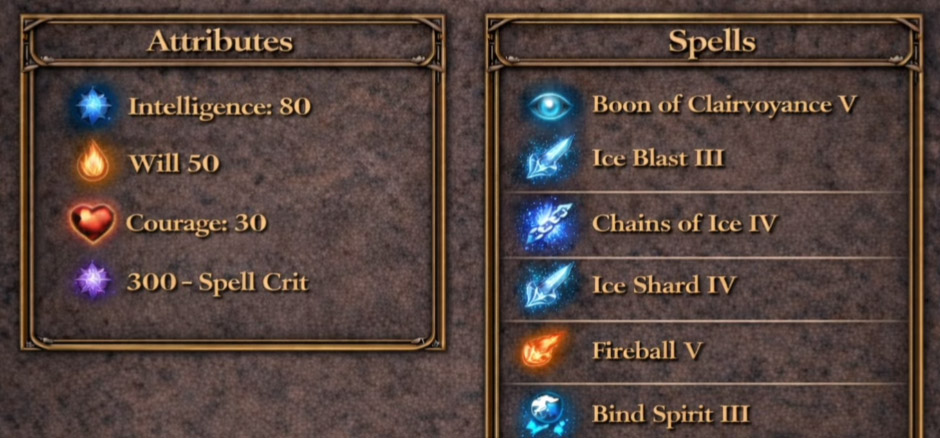
Stat Priorities:
- 1. Intelligence: Cleanest scaling.
- 2. Willpower: Sustain and buff value.
- 3. Courage: Crit and survival.
The Triad Rule (No Duplicates):
You must pair stats that do not overlap to maximize the slot.
| Prefix (Single) | Suffix (Dual) | The Logic |
|---|---|---|
| Willpower | INT + Courage | Sustain focus. Dual-stat must NOT include Willpower. |
| Intelligence | Willpower + Courage | Output focus. Dual-stat must NOT include Intelligence. |
| Courage | INT + Willpower | Survival focus. Dual-stat must NOT include Courage. |
Diagnostic:
If you notice you are a glass cannon who can't finish casts, prioritize Willpower/Courage layers immediately.
3.3 Cleric (Healer): Shield and Output Engine
Your job is to stay alive while healing others. Shield scaling is your survival cornerstone.
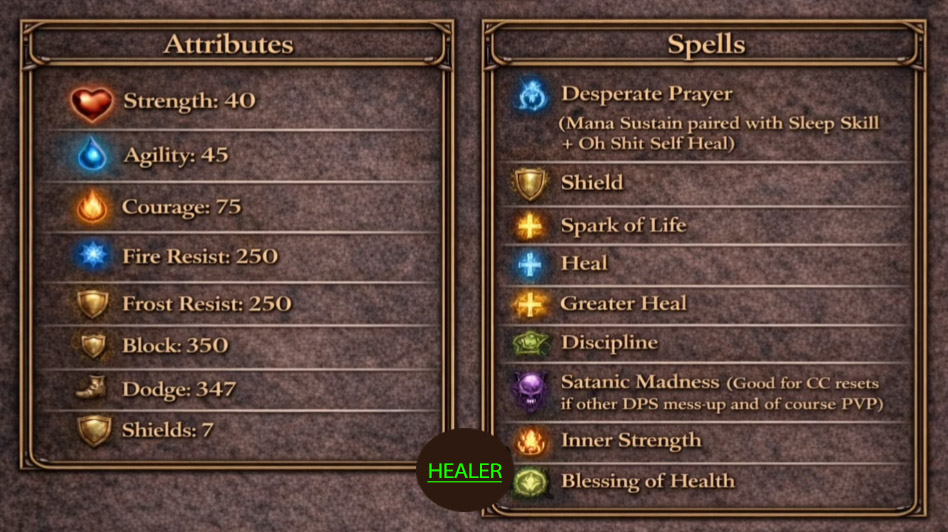
Stat Priorities:
- 1. Willpower: Primary healing scaler; makes shields thick.
- 2. Intelligence: Throughput.
- 3. Courage: Resistances and toughness.
Critical Warning:
If your first affix is Willpower, your second affix cannot include Willpower. This is where many healer sets quietly lose 1–2 full slots of value.
Diagnostic:
If you notice you are forced to self-heal constantly, your shield scaling is underbuilt. Swap to Willpower/Armor Value affixes.
3.4 Cleric (Hybrid): Heal First, Damage Second
Hybrid clerics keep the run moving. You need to carry dungeon pace without failing your primary healing duties.
Stat Priorities:
- 1. Willpower: Still the backbone.
- 2. Intelligence: Hybrid offense/healing.
- 3. Courage: Survival.
- 4. Block/Crit: The tuning knobs.
The Gear Goals:
- Block Target: Aim for a functional baseline (e.g., ~700).
- Crit Tuning: Once block is safe, add crit for speed.
Diagnostic:
If you find you are getting clipped by bosses while trying to cast, Block/Resists are the first fix. If healing is fine but runs are slow, add Crit.
3.5 Paladin (Hybrid): The Strength/Courage Core
Paladins often fall into the trap of stacking pure Strength and ignoring consistency. You are a bruiser; you need to actually hit the target.
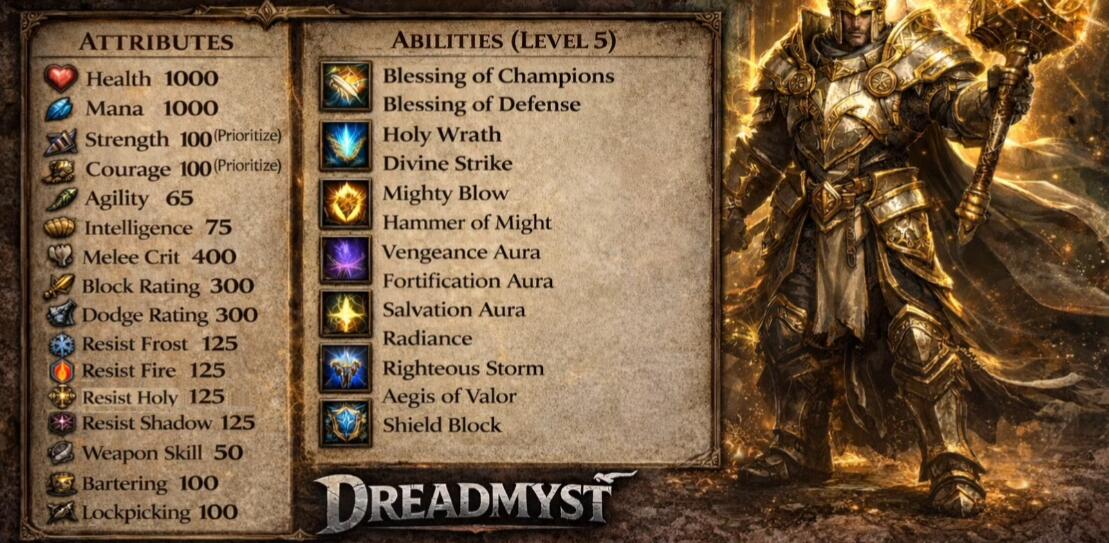
Stat Priorities:
- 1. Strength + Courage: Co-primary stats.
- 2. Agility: Minimum for gear requirements only.
- 3. Weapon Skill/Value: The hidden DPS stats.
Leveling vs. Endgame:
Build Strength/Courage 1:1 until your kit comes online. Once you hit endgame, you must add Weapon Skill and Melee Crit.
| Problem | Affix Fix | Trade-off |
|---|---|---|
| Feeling Squishy | Block Rating + Dodge | Slower DPS, higher effective HP. |
| Missing/Parried | Weapon Value / Skill | Converts stats into consistent hits. |
| Slow Clears | Melee Crit + STR/COUR | High burst, punishes mistakes more. |
Diagnostic:
If you notice you are sturdy but fights drag on forever, you are likely getting parried. Swap raw Strength for Weapon Value/Skill.
FAQ: Common Pitfalls
1. Why do we prioritize 25/25 affixes so aggressively?
Because affix slots are limited. A full set of 25/25 gear provides a mathematical advantage that good stats on lower-tier rolls cannot overcome. It is about maximizing the return per slot.
2. When is 20/25 gear acceptable?
It is acceptable as a bridge. If you are missing a hard requirement—like a specific resist cap or range skill threshold—use a 20/25 piece to fix it temporarily. Replace it as soon as the build stabilizes.
3. What is the most common pairing mistake?
Ignoring the column rule. Players often try to find two stats that exist in the same column (e.g., trying to double up on a specific prefix-only stat). Always check if your desired pairing is legal (one from Column 1, one from Column 2) before shopping.
4. Should I extract orbs or gems from old gear?
Only when the reclaimed material is worth more than the item and the replacement item is a long-term upgrade. Remember, extraction destroys the gear. Do not extract from bridge gear unless the gem is Tier 3 (Refined).
5. Is the Divine Orb always worth the cost?
No. Divine orbs shine when pushing high enchant levels where success rates are low. Using them on early levels (+1 to +3) is a waste of gold.
6. Ranger feels inconsistent—what do I fix?
Fix your Range Skill and Weapon Value first. Reliable hits raise average DPS far more than occasional big crits.
7. Hybrid Paladin: Why not just stack Strength forever?
Because missing hits and getting parried reduces your real output to zero. Weapon Value and Skill are effectively damage multipliers because they ensure your Strength actually connects.
Final Thoughts
Building a character in Dreadmyst isn't about finding the item with the highest single number on the tooltip. Real power comes from legal affix pairing, prioritizing 25/25 tiers, and strictly following a no-duplicate rule for your stats.
When you follow this loop—market check → affix legality check → selective enchanting → smart gem investment—your character gets stronger faster, and you stop paying tuition to the RNG. You are no longer asking Is this good?; you are asking Which gap does this solve, and does it fit the rules?
Most Popular Posts
Popular Category Lists
- ARC Raiders / (343)
- Grow a Garden / (292)
- CoD: Black Ops 7 / (167)
- Star Citizen / (160)
- MLB 26 / (159)
- Monopoly Go / (152)
- ARK Survival Ascended / (126)
- Steal a Brainrot / (98)
- Blox Fruits / (74)
- Adopt Me / (73)
- Forza Horizon 6 / (72)
- Sailor Piece / (68)
- Grow a Garden 2 / (68)
- Diablo IV / (62)
- CoD: BLACK OPS 6 / (55)
- Path of Exile 2 / (48)
- Monster Hunter Wilds / (46)
- Aion 2 / (45)
- Windrose / (44)
- Donut SMP / (41)
