



 0
0 Created: Oct 16,2026 | Enshrouded
Enshrouded Base Locations: How to Choose a Site and Build Smarter

We recommend an intact settlement for faster setup, a flat clearing for custom construction, and a waterfront site for a village layout. Before moving supplies, test the workshop footprint, crafting-storage access, and one resource-return route.
- Choose the Location by Your Building Goal
- Separate the Production Base From the Scenic Retreat
- Run a Small Trial Before Relocating
- Test the Finished Footprint
- Walk the Return Route
- Check Hazards Separately
- Verify Storage and Resting Access
- Test Magic Chests From the Actual Crafting Location
- Measure Comfort From One Resting Position
- Establish References Before Adding Detail
- FAQ (Frequently Asked Questions)
- What Is the Best Type of Early Base Location?
- Is a Waterfront Base Better Than an Inland Base?
- How Do We Check Magic Chest Crafting Access?
- Does a Flame Altar Make the Whole Area Safe?
- How Do We Increase Rested Duration Efficiently?
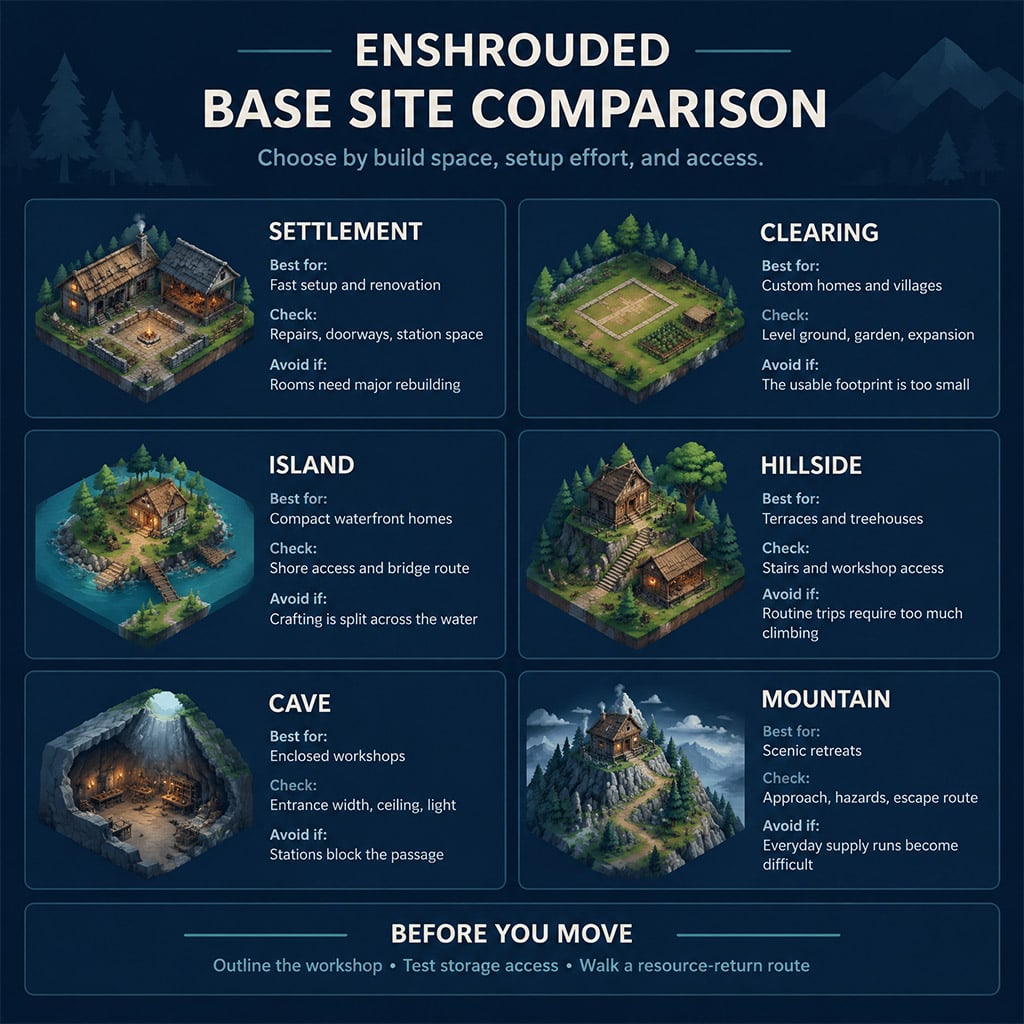
Choose the Location by Your Building Goal
If you need a working base quickly, inspect existing rooms before committing to repairs. If you want a large custom settlement, measure usable ground before clearing trees or excavating.
Use these site types to narrow the search.
| Location type | Best fit | Reject it when… |
|---|---|---|
| Intact settlement or tavern | Fast workshop setup | Repairs and cramped rooms outweigh the existing shelter |
| Flat clearing | Custom house or village | Your workshop and garden cannot fit inside the planned claim |
| Waterfront or island | Lakeside home and connected village | Shore access forces awkward travel between essential buildings |
| Forest hillside or treehouse | Terraced or vertical construction | Stairs dominate routine crafting trips |
| Cave or mining structure | Enclosed workshop or lower-level rooms | Entrances, ceilings, or lighting obstruct the layout |
| Mountain or hazardous terrain | Scenic retreat or specialist project | You cannot establish dependable access and an escape route |
Choose the site that supports your daily tasks, not the one requiring the most work to become usable.
Separate the Production Base From the Scenic Retreat
We would keep essential storage and frequently used crafting interactions together. Upper treehouse rooms, cliff balconies, and remote cabins can serve as accommodation without becoming the center of production.
For a prefab, inspect doorways, stairs, and station clearances first. A room that looks spacious may still require substantial alteration once crafting equipment is placed.
Run a Small Trial Before Relocating
Moving the warehouse should be the last scouting step, not the first. We recommend a temporary floor outline and a minimal workshop.
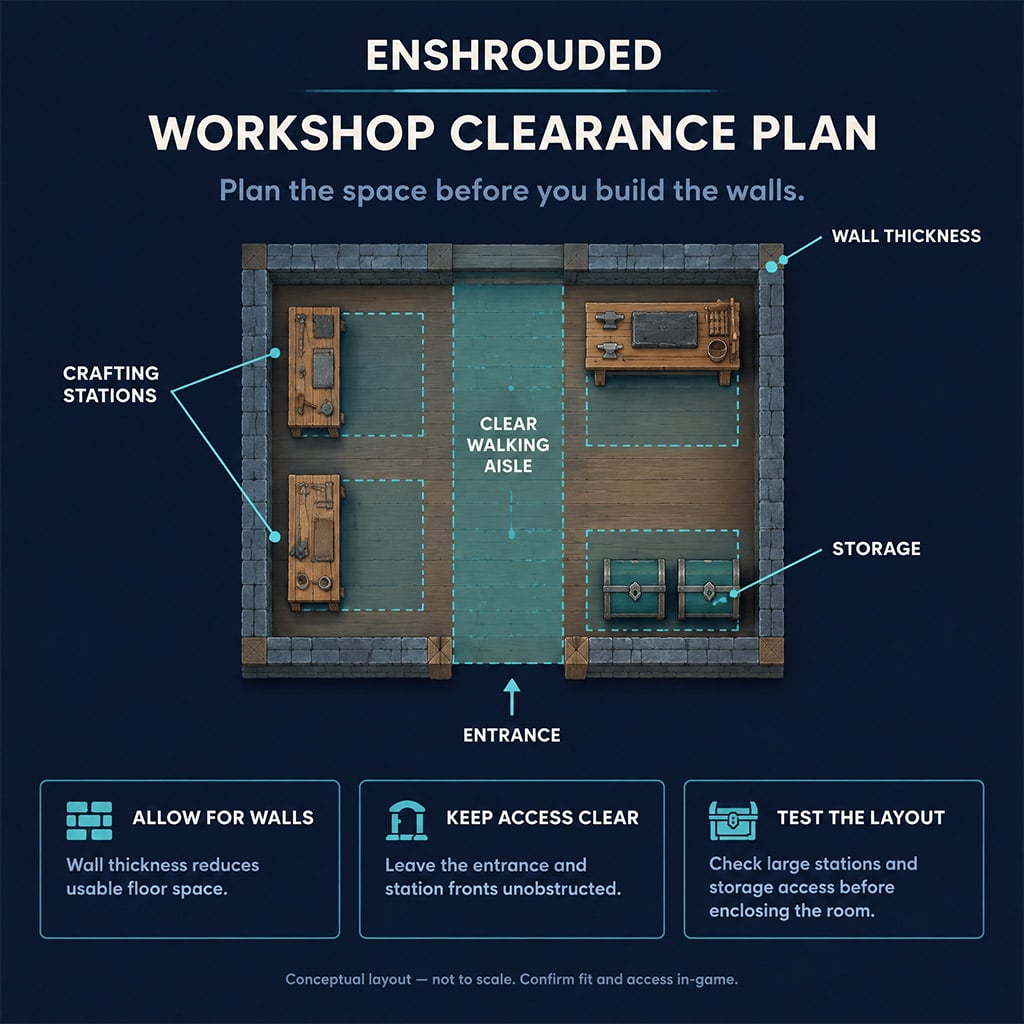
Test the Finished Footprint
Outline the room before building walls. Include wall thickness, entrance clearance, stairs, and the space around large stations.
For an underground room, measure the intended finished interior—not merely the excavation. Wall lining and flooring reduce usable space.
Walk the Return Route
Visit a useful resource area and return to the proposed workshop. Check climbs, cave entrances, water crossings, and the final approach to storage.
We would reject a resource-focused site if its return route is consistently inconvenient. A deposit visible below a cliff is not enough to justify placing the workshop above it.
Check Hazards Separately
Inspect the build boundary, nearby threats, and environmental conditions independently. Do not assume altar placement resolves every surrounding hazard.
For exposed or machinery-dependent sites, establish a walking exit that does not rely on the feature you intend to incorporate into the build.
Verify Storage and Resting Access
A workshop layout fails if its materials remain inaccessible or its resting corner does not provide the expected status. We recommend testing both before expanding.
Test Magic Chests From the Actual Crafting Location
The community storage reference explicitly flags Magic Chest range information as needing updated testing. Avoid designing around an older fixed-distance claim.
Use a controlled access check:
1. Put a recognizable crafting material in a Magic Chest.
2. Remove that material from your inventory.
3. Open the intended crafting interaction.
4. Check whether the material is available.
5. Repeat at every essential crafting location.
We would change the storage position before building a larger warehouse around an access problem.
Measure Comfort From One Resting Position
The comfort reference states that each comfort level adds one minute to Rested duration. It also identifies shelter, warmth, nearby threats, and comfort-providing items as relevant conditions.
Record the displayed comfort level, add or upgrade one furnishing, then check from the same position. We would keep functional improvements near the resting spot rather than assume furniture across the entire base contributes there.
Establish References Before Adding Detail
Repeated construction magnifies a bad starting position. We recommend setting one correct floor height, wall recess, and roof edge before extending them.
| Construction problem | Action | Check before repeating |
|---|---|---|
| Floor preview sits too low | Disable snapping and establish a reference block | Finished floor height and doorway alignment |
| Pillars look attached to a flat wall | Recess wall panels behind the frame | Consistent depth at corners |
| Roof ends flush with the facade | Adjust the first eave outward | Appearance from the entrance path |
| Fine removal damages nearby details | Use a smaller removal shape | Selected volume and depth |
Inspect the first segment before copying its alignment across the build.
We would inspect roofs from ground level as well as above. Confirm that the overhang adds depth without hiding the window trim.
FAQ (Frequently Asked Questions)
What Is the Best Type of Early Base Location?
An intact building with usable workshop space is the best low-construction starting point. We recommend a flat clearing instead when repairs would take more work than a simple custom shelter.
Is a Waterfront Base Better Than an Inland Base?
A waterfront base is better only when its access and footprint suit your layout. We would avoid splitting essential crafting across disconnected island and shoreline buildings.
How Do We Check Magic Chest Crafting Access?
Remove the test material from your inventory and check whether the crafting interaction can use it from the chest. Repeat at each important location because the community reference warns that range information needs updated testing.
Does a Flame Altar Make the Whole Area Safe?
Altar placement alone does not establish that the surrounding area is safe. Check nearby threats, the build boundary, and environmental conditions before moving valuable supplies.
How Do We Increase Rested Duration Efficiently?
Improve comfort at the resting position you actually use. Record the displayed level, change one furnishing at a time, and confirm that shelter and warmth conditions are satisfied.

I’m Hiroshi Tanaka, a Japanese Technical Content Writer at GGWTB covering action RPGs, loot farming, and gear builds. My guides connect character progression with stat priorities, gear synergies, and targeted farming routes. A build needs to work before the perfect drop arrives—not just after every slot is filled.
Most Popular Posts
Popular Category Lists
- ARC Raiders / (350)
- Grow a Garden / (294)
- CoD: Black Ops 7 / (167)
- Star Citizen / (162)
- MLB 26 / (159)
- Monopoly Go / (152)
- ARK Survival Ascended / (127)
- Steal a Brainrot / (99)
- Blox Fruits / (74)
- Adopt Me / (74)
- Forza Horizon 6 / (72)
- Sailor Piece / (68)
- Grow a Garden 2 / (68)
- Diablo IV / (62)
- CoD: BLACK OPS 6 / (55)
- Aion 2 / (50)
- Path of Exile 2 / (48)
- Monster Hunter Wilds / (46)
- Windrose / (44)
- Donut SMP / (41)
