


 0
0 Created: Apr 29,2026 | MLB 26
MLB The Show 26 Free Chase Pack Guide: No Stubs Spent Diamond Pull Strategy

Free Chase Packs are one of the best moments in a No Stubs Spent MLB The Show 26 grind. We are not buying our way into upgrades, so every free pack has a chance to change the team. Sometimes it is a mid-tier diamond for collections. Sometimes it is a real lineup piece. And once in a while, it is a pull like 93 Cody Bellinger that actually makes us stop and rethink the roster.
The key is not just opening the pack. It is knowing what to do before and after the pull.
- Why Free Chase Packs Matter in No Stubs Spent
- Chase Pack Value
- What to Do Before Opening Packs
- Quick Pre-Pack Checklist
- Keep or Sell a Big Diamond Pull?
- Big Pull Decision Guide
- Ranked Comeback Strategy: Why You Should Not Quit Early
- Comeback Game Plan
- Hitting Tips for High-Scoring Ranked Games
- Simple Hitting Fixes
- Pitching Lessons From Getting Shelled
- Pitching Adjustment Table
- Best Uses for 93 Cody Bellinger
- Cody Bellinger Role Guide
- FAQ
- Are free Chase Packs worth it in MLB The Show 26?
- Should I keep or sell 93 Cody Bellinger?
- Why should we not quit ranked games early?
- What is the best way to manage duplicate cards?
- How do we come back from a big deficit?
- What should we do after pulling a diamond?
- Summary
Why Free Chase Packs Matter in No Stubs Spent
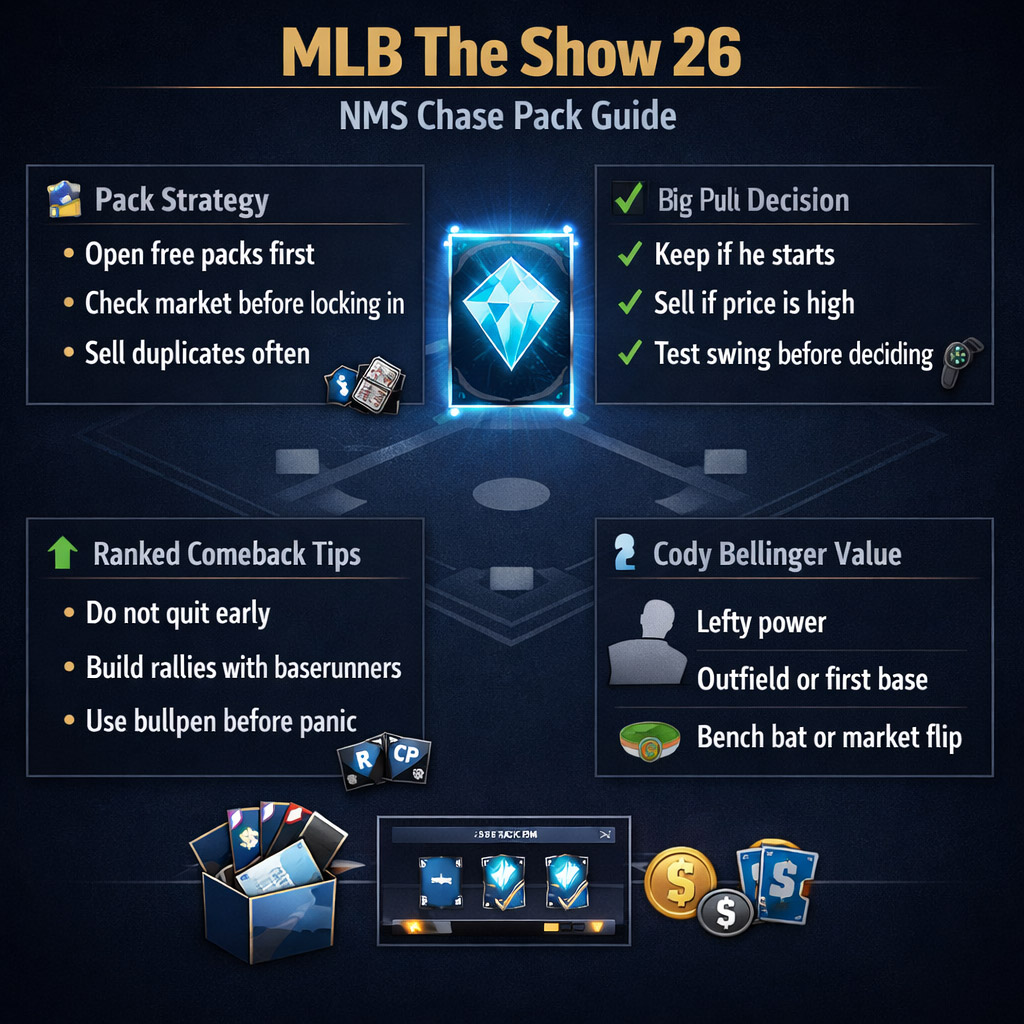
For No Stubs Spent players, a free Chase Pack is pure upside. We are getting a shot at a premium card without risking stubs, and that matters when every upgrade has to be earned.
Chase Pack Value
| Pull Type | Value for NMS | Best Move |
|---|---|---|
| Premium diamond | Major team upgrade or big stubs | Test first, then decide |
| Former Chase card | Often better than expected | Check market price |
| Mid-tier diamond | Collection help | Keep if needed |
| Duplicate diamond | Stub boost | Usually sell |
| No diamond | Still free progress | Move on, keep grinding |
A pull like 93 Cody Bellinger is especially useful because he can help in multiple ways. He brings left-handed power, defensive flexibility, and enough name value to carry market demand. That gives us options, which is exactly what a No Stubs Spent account needs.
What to Do Before Opening Packs
Pack luck is random, but account management is not. Before opening packs, we should know what our team actually needs.
Quick Pre-Pack Checklist
| Question | Why It Matters |
|---|---|
| Do we need a starter or stubs more? | Helps avoid emotional decisions |
| Are we close to a collection reward? | Some small pulls matter |
| Is our bench missing lefty/righty power? | Platoon bats win games |
| Do we have duplicates sitting around? | Frozen stubs slow progress |
| Is the market high right now? | Selling at the right time matters |
From experience, the biggest NMS mistake is letting inventory pile up. If you only sell cards once every few weeks, you might be sitting on thousands of mlb 26 stubs that could already be improving the squad.
Keep or Sell a Big Diamond Pull?
The fun part is seeing the diamond animation. The smart part is making the right decision after it.
Big Pull Decision Guide
| Situation | Keep or Sell? | Reason |
|---|---|---|
| He starts immediately | Keep | Direct lineup upgrade |
| He is only a bench bat | Maybe keep | Depends on price and role |
| His market price is inflated | Sell | Fund multiple upgrades |
| He helps a collection path | Keep | Long-term reward value |
| You dislike his swing | Sell | Attributes do not fix bad timing |
For 93 Cody Bellinger, we would test him before selling. If his swing feels good, he can start in the outfield, play first base, or work as a lefty power bench bat. If your lineup is already stacked and his price is high, selling him can pay for two or three holes instead.
That is the NMS mindset: one card is great, but the best roster move is the one that wins more games.
Ranked Comeback Strategy: Why You Should Not Quit Early
One of the best lessons in MLB The Show 26 is that ranked games can flip fast. We can be down five, six, even seven runs and still crawl back if we stop chasing and start stacking good at-bats.
Quitting early may save a few minutes, but it also costs progress, XP, parallel stats, and sometimes a reward pack. In one ranked run, staying through a brutal start led to a comeback win, reward progress, a free Chase Pack, and eventually a massive diamond pull. That is the full No Stubs Spent loop working perfectly.
Comeback Game Plan
| If You Are Down… | Do This |
|---|---|
| 3-4 runs | Stay patient and track pitch patterns |
| 5-7 runs | Get baserunners before chasing homers |
| Late by 2 runs | Use bench bats aggressively |
| Opponent stops chasing | Throw more early-count strikes |
| Starter gets hit hard | Go to the bullpen earlier |
The mistake is trying to hit a five-run homer. That swing does not exist, sadly. We need one walk, one mistake, one clean inning, and suddenly the game feels different.
Hitting Tips for High-Scoring Ranked Games
When the opponent is scoring nonstop, it is easy to panic at the plate. But if we start swinging at everything, we help them more than we help ourselves.
Simple Hitting Fixes
| Problem | Fix |
|---|---|
| Late on inside fastballs | Start PCI slightly middle-in |
| Chasing low offspeed | Take until they throw it for strikes |
| Weak contact with runners on | Slow down and look for one zone |
| Too many solo shots | Work counts and create traffic |
| Missing meatballs | Sit one pitch speed for an inning |
If you notice your offense only wakes up in the late innings, that usually means you are taking too long to read the opponent. Start tracking patterns earlier: first-pitch fastball, two-strike sweeper, low changeup after foul balls. Good hitters remember the plan before the next at-bat.
Pitching Lessons From Getting Shelled
Some ranked games feel like every pitch gets hit 110 mph. It happens. But we still have to separate bad luck from bad sequencing.
Pitching Adjustment Table
| Problem | What It Means | Adjustment |
|---|---|---|
| Opponent does not chase | They read spin well | Attack the zone early |
| Repeated hard contact | They are timed up | Change pitcher sooner |
| Curveballs get crushed | Bad location or poor tunnel | Use sparingly below zone |
| Fastballs get pulled hard | Too predictable | Mix cutter, sinker, offspeed |
| Walks turn into big innings | Too much nibbling | Throw quality strikes |
The best ranked players punish panic pitches. If we miss, miss with purpose. A ball off the plate is fine. A frustrated fastball down the middle is usually a souvenir.
Best Uses for 93 Cody Bellinger
A big pull only matters if we use it correctly. Bellinger is valuable because he is not locked into one role.
Cody Bellinger Role Guide
| Role | Why It Works |
|---|---|
| Starting outfielder | Lefty power plus defense |
| First base option | Adds athleticism and pop |
| Bench bat | Dangerous late-game lefty swing |
| Collection asset | Helps if needed for progress |
| Market flip | Sell high to fix multiple positions |
If your lineup lacks left-handed power, Bellinger is probably a keep. If your outfield is already crowded, check his price and think practically. No Stubs Spent teams improve fastest when we turn value into wins.
FAQ
Are free Chase Packs worth it in MLB The Show 26?
Yes. Free Chase Packs are excellent for No Stubs Spent players because they give you a chance at premium diamonds without spending stubs.
Should I keep or sell 93 Cody Bellinger?
Keep him if he starts or gives you needed lefty power. Sell him if his price is high and your team has multiple bigger needs.
Why should we not quit ranked games early?
Staying in games gives XP, parallel progress, reward path progress, and comeback chances. Those rewards matter a lot for No Stubs Spent accounts.
What is the best way to manage duplicate cards?
Sell or quick sell duplicates regularly. Unused inventory is basically locked stubs that could be helping your team.
How do we come back from a big deficit?
Stop chasing, get baserunners, use the bullpen earlier, and win one inning at a time. Most comebacks start with one clean defensive inning and one patient rally.
What should we do after pulling a diamond?
Check if he improves your team, helps a collection, or sells for enough stubs to fix bigger roster holes. Do not lock him in emotionally right away.
Summary
A free Chase Pack can be a huge boost for a No Stubs Spent MLB The Show 26 team, especially when it turns into a card like 93 Cody Bellinger. But the real edge comes from managing the pull correctly.
Test the card, check the market, and think about your roster needs. If he helps you win now, keep him. If selling him builds a better overall team, take the stubs and upgrade smart.
That is how we turn one lucky pack into real No Stubs Spent progress.
Most Popular Posts
- MLB The Show 26 Tier List: Best Diamond Dynasty Cards by Position
- MLB The Show 26 Hall of Fame Guide: 99 Hoffman, Best Spotlights & Chase Pack Value
- MLB The Show 26 Top 20 Endgame Cards Ranked for New Seasons
- MLB The Show 26 New Threads 2.0 Tier List Guide: Best Cards, Budget Picks, and Meta Fits
- MLB The Show 26 New 99 OVR Tier List: Best Cards Ranked
- MLB The Show 26 Ben Zobrist Collection Guide: Cheapest No-Money-Spent Route
Popular Category Lists
- ARC Raiders / (354)
- Grow a Garden / (294)
- CoD: Black Ops 7 / (167)
- Star Citizen / (163)
- MLB 26 / (159)
- Monopoly Go / (153)
- ARK Survival Ascended / (128)
- Steal a Brainrot / (99)
- Blox Fruits / (74)
- Adopt Me / (74)
- Forza Horizon 6 / (72)
- Sailor Piece / (68)
- Grow a Garden 2 / (68)
- Diablo IV / (62)
- CoD: BLACK OPS 6 / (55)
- Aion 2 / (53)
- Path of Exile 2 / (48)
- Monster Hunter Wilds / (46)
- Windrose / (44)
- COD: Modern Warfare 4 / (43)