


 0
0 Created: Sep 12,2026 | MLB 26
MLB The Show 26 Top 20 Endgame Cards Ranked for New Seasons

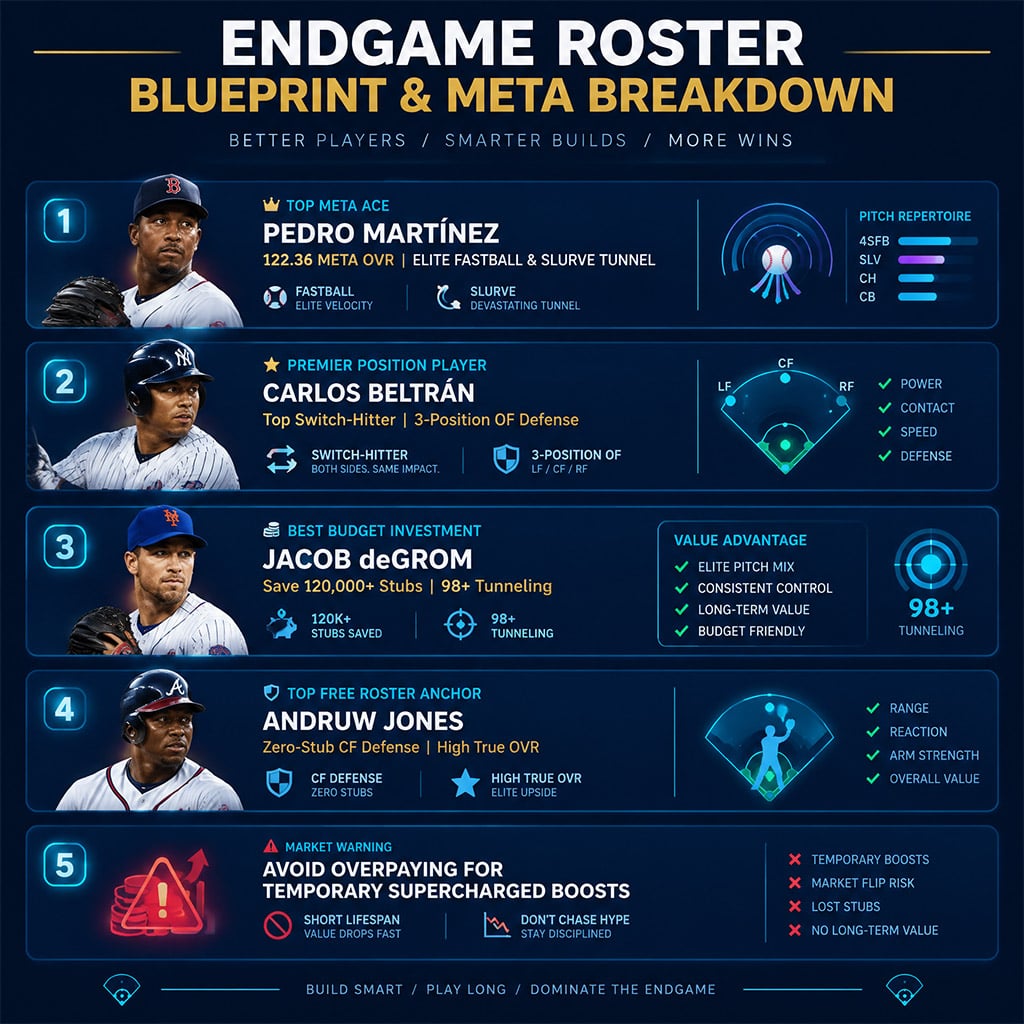
Pedro Martínez holds the highest Meta Overall rating in the MLB The Show 26 competitive meta, with Carlos Beltrán leading all everyday position players. For players managing limited Stubs, Jacob deGrom and Andruw Jones deliver equal competitive impact at a fraction of the market cost.
The rankings below reflect recorded ShowZone benchmark data. Real-time market prices, Supercharged attributes, and database rating formulas adjust continuously, so always confirm live marketplace numbers before locking in Stubs.
- Top 20 Ranked Seasons Meta Rankings
- The Five Cards Defining the Competitive Meta
- 1. Pedro Martínez
- 2. Carlos Beltrán
- 3. Jacob deGrom
- 4. Troy Tulowitzki
- 5. Adley Rutschman
- Positional Strategy and Budget Targets
- Maximizing Andruw Jones: The Free Roster Anchor
- Managing Supercharged Cards: Avoiding the Price Trap
- Lineup Architecture for Competitive Play
- 1. Lock Down Up-The-Middle Defense First
- 2. Prioritize Switch-Hitters to Eliminate Platoon Taxes
- 3. Build Rotation Variety
- 4. Fortify High-Leverage Relievers Early
- FAQ (Frequently Asked Questions)
- Who is the best card in MLB The Show 26?
- Is Jacob deGrom worth 52,000 Stubs?
- What is the best free card in MLB The Show 26?
- Should we use Meta Overall or True Overall?
- Should I buy Supercharged cards for my endgame squad?
Top 20 Ranked Seasons Meta Rankings
Attribute compression peaks during the endgame cycle. When almost every card carries elite hitting or pitching numbers, competitive separation comes down to pitch repertoires, Outlier quirks, switch-hitting balance, defensive thresholds, and acquisition efficiency.
Meta Overall serves as the primary metric for competitive viability, with True Overall used as a baseline attribute check.
| Rank | Player | Series / Card Type | Primary Competitive Value |
|---|---|---|---|
| 1 | Pedro Martínez | Endgame Pitcher | Elite pitch ratings, Outlier fastball, Break Outlier |
| 2 | Carlos Beltrán | Legends & Flashbacks | Switch-hitter with elite three-position outfield defense |
| 3 | Jacob deGrom | Spotlight | Tier-1 fastball-slider mix at high cost efficiency |
| 4 | Troy Tulowitzki | Live Series Collection | Premier two-way defensive shortstop profile |
| 5 | Adley Rutschman | Endgame Catcher | Elite switch-hitting catcher at a scarce position |
| 6 | CC Sabathia | Premium Pitcher | Top left-handed starter for rotation variance |
| 7 | Victor Martinez | Legends & Flashbacks | Pure switch-hitting run producer |
| 8 | Chili Davis | Endgame Hitter | Balanced split ratings from both batter boxes |
| 9 | Johnny Bench | Hall of Fame | Maximum defensive catcher with run prevention |
| 10 | Jimmy Rollins | Weekend Classic | High-speed, elite fielding middle infielder |
| 11 | Seth Hernandez | Pipeline | Top-tier velocity profile among prospect cards |
| 12 | Jesús Montero | Endgame Catcher | Offensive specialist behind the plate |
| 13 | José Soriano | New Threads | Power starter with high-velocity primary mix |
| 14 | Andruw Jones | Program Reward | Premier zero-Stub center fielder |
| 15 | Jonathan Broxton | Prime | High-leverage strikeout reliever |
| 16 | Elly De La Cruz | Live Series (Supercharged) | Elite temporary physical tools (monitor expiration) |
| 17 | Willie Mays | New Threads | Complete five-tool center fielder |
| 18 | Tarik Skubal | New Threads | Deceptive left-handed rotation arm |
| 19 | Alfonso Soriano | Signature | Power-speed combination across multiple positions |
| 20 | Ozzie Smith | Awards / Chase | Pure contact hitting and range at shortstop |
Note on Elly De La Cruz: Supercharged cards are temporary meta rentals. Prioritize core permanent roster pieces unless making an immediate Ranked Seasons push.
The Five Cards Defining the Competitive Meta
Winning consistently in higher divisions requires cards that resist meta tendencies and exploit common pitching habits. Analyzing pitch rank data, handedness balance, and opportunity costs reveals clear separations among the top five options.
1. Pedro Martínez
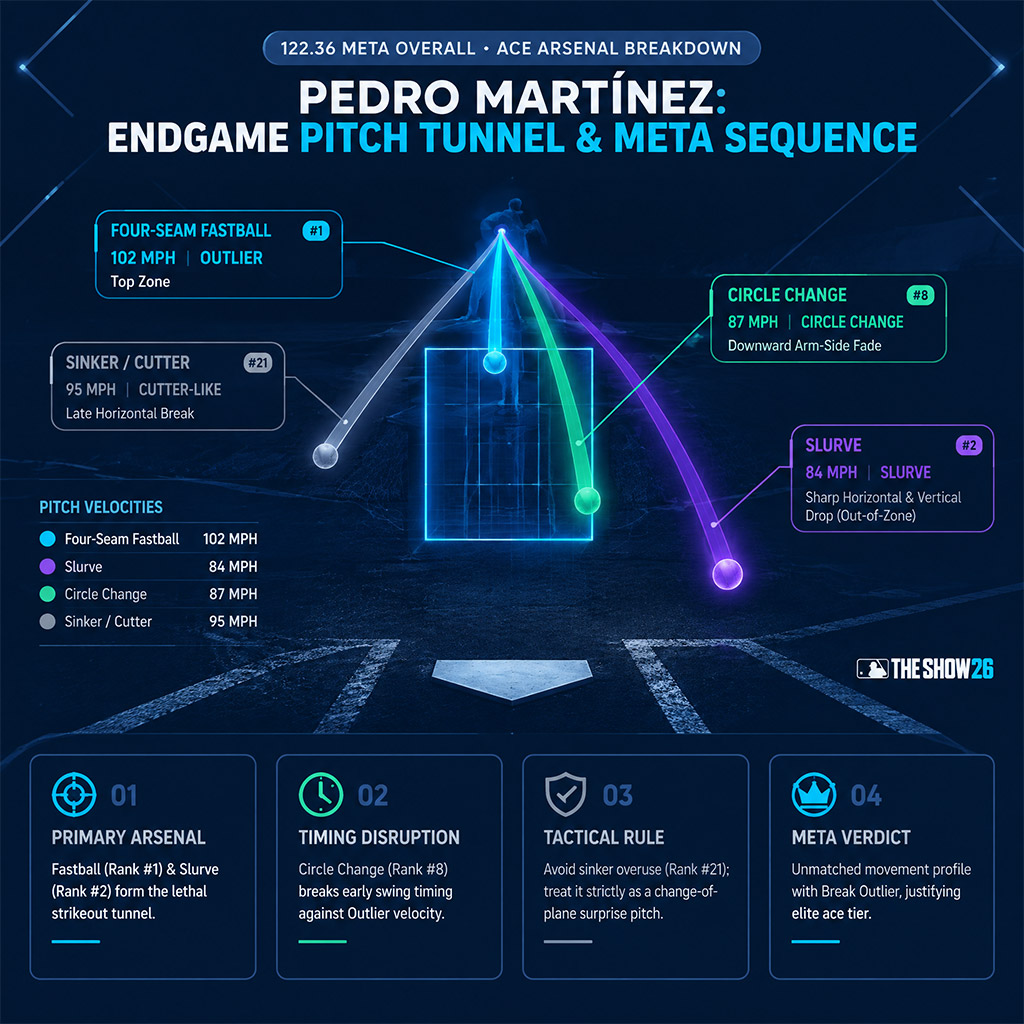
Pedro sits atop the rankings with a 122.36 Meta Overall. His individual pitch grading demonstrates why his arsenal induces low exit velocities:
| Pitch Type | Arsenal Rank | Optimal Sequencing Role |
|---|---|---|
| Four-Seam Fastball | No. 1 | Elevated zone pressure, establish high velocity |
| Slurve | No. 2 | Primary strikeout weapon breaking out of the zone |
| Circle Change | No. 8 | Disruption pitch to break early pull timing |
| Cutter | No. 12 | Jam left-handed hitters, steal called strikes |
| Sinker | No. 21 | Occasional weak-contact change-of-plane pitch |
Rely on the fastball-slurve-cutter core. While sinkers generally dominate the meta, Pedro's sinker grade is notably lower; using it as an off-speed disruption pitch rather than a primary workhorse prevents hard contact.
With Outlier and Break Outlier active, Pedro forces opponents to cheat on the four-seamer, making the low-away slurve exceptionally lethal. However, his 172,000+ Stub price tag means full-roster squads should ensure depth before committing massive capital to a single rotation arm.
2. Carlos Beltrán
Beltrán records a 118.09 Meta Overall and roughly 105 True Overall, ranking first across all three outfield positions and third at designated hitter.
His true strength lies in lineup preservation. Switch-hitting eliminates platoon advantages when opponents turn to bullpen specialists, and his diamond defense in center field eliminates the need for late-inning defensive substitutions. For players investing in a single premium position player, Beltrán offers the safest floor and ceiling.
3. Jacob deGrom
DeGrom represents the most efficient Stub investment among the elite tier. At roughly 52,000 Stubs compared to Pedro's 172,000+, deGrom delivers premier strikeout tools at less than a third of the cost: 3.31
His primary offerings match up against any lineup:
- Four-Seam Fastball: No. 2
- Slider: No. 2
- Slurve: No. 4
- Circle Change: No. 9
- Sinker: No. 88
Pocketing the 120,000-Stub difference allows players to solidify multiple secondary positions. Run deGrom by establishing the fastball-slider tunnel along the edges, mixing in the circle change to disrupt early timing, and reserving the slurve for vertical breaks out of the zone.
4. Troy Tulowitzki
Tulowitzki takes the No. 4 spot with elite all-around hitting and fielding metrics approaching the century mark before Parallel upgrades. Shortstop remains a high-variance position; deploying a defensively elite player who also hits middle-of-the-order pitching removes the burden of managing platoons or defensive subs late in games.
5. Adley Rutschman
Adley captures the No. 1 catcher ranking on the strength of switch-hitting utility and balanced defense. Catchers with complete hitting tools from both sides are scarce; locking down Adley frees up two crucial bench spots that would otherwise be reserved for platoon bats or defensive catchers.
Positional Strategy and Budget Targets
Allocating Stubs across your roster demands targeted problem-solving. Upgrading an already potent corner outfield position delivers diminishing returns if your rotation or bullpen repeatedly surrenders leads.
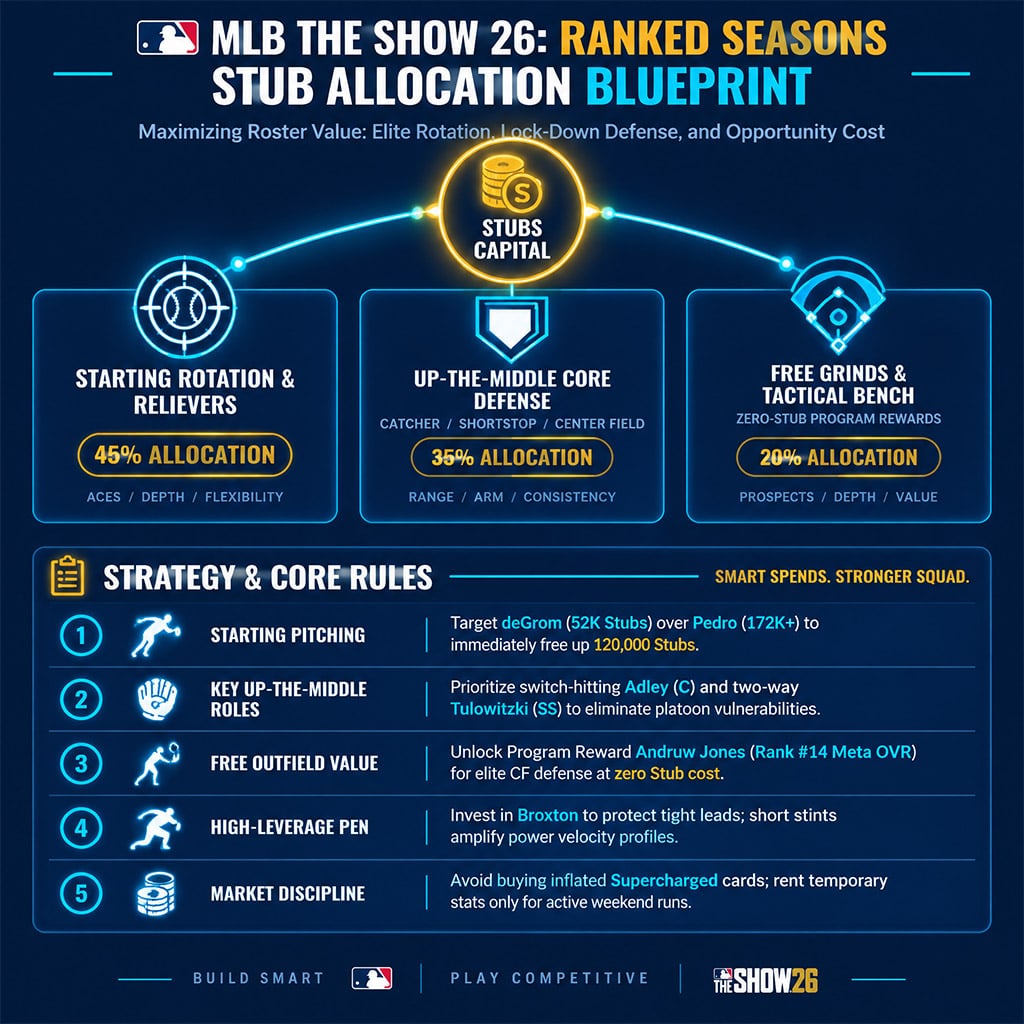
| Roster Priority | Primary Choice | Smart Alternative | Strategic Takeaway |
|---|---|---|---|
| Ace Starting Pitcher | Pedro Martínez | Jacob deGrom | Purchase Pedro only after fixing broader rotation depth |
| High-Value Starter | Jacob deGrom | Tarik Skubal | DeGrom delivers top-tier arsenal depth at a lower cost |
| Left-Handed Starter | CC Sabathia | Tarik Skubal | Essential rotation balance against righty-heavy lineups |
| Premier Outfielder | Carlos Beltrán | Willie Mays | Beltrán's switch-hitting edges out one-sided sluggers |
| Free Outfield Anchor | Andruw Jones | None (Ranked Top 20) | Grind program missions before buying market outfielders |
| Shortstop Anchor | Troy Tulowitzki | Jimmy Rollins | Choose Rollins for speed and bunt-defense mobility |
| Catcher Anchor | Adley Rutschman | Johnny Bench | Rutschman minimizes platoon risk; Bench suits power builds |
| Relief Stopper | Jonathan Broxton | José Soriano | Broxton provides pure strikeout attributes in tight frames |
| Temporary Lever | Supercharged Elly | Jimmy Rollins | Exploit Elly's boost short-term; avoid long-term overpaying |
Maximizing Andruw Jones: The Free Roster Anchor
Overspending on market outfielders is the most common roster-building error. Andruw Jones ranks 14th in Meta Overall and 6th in True Overall, yet costs zero Stubs through program progression.
His true value is capital preservation. Unlocking Jones eliminates the need to spend 100,000+ Stubs on a corner outfielder, allowing those resources to flow directly toward deGrom, Rutschman, or elite bullpen arms.

Optimal Deployment Plan:
1. Start Jones in center field until Beltrán or a comparable switch-hitter is unlocked.
2. Slide Jones to right or left field once your center-field position is upgraded.
3. Level up Parallel tiers to sharpen contact ratings against elite right-handed pitching.
4. Channel saved Stubs directly into your starting rotation and relief corps.
Managing Supercharged Cards: Avoiding the Price Trap
Elly De La Cruz appears at No. 16 Meta Overall due to active Supercharged ratings during the data capture window. These numbers do not reflect his base card performance.
Purchasing Supercharged cards on the secondary market frequently leads to steep value loss once the boost concludes.
Check active boost expiration timers before confirming buy orders.
Match the remaining boost duration against your upcoming Ranked Seasons schedule.
Compare current market pricing against permanent elite options like Troy Tulowitzki.
Maintain a verified replacement option on your bench before the card reverts.
Lineup Architecture for Competitive Play
Top-heavy rosters struggle against experienced opponents who capitalize on predictable pitching patterns and defensive weaknesses. A resilient team build prioritizes defensive security down the middle, pitch variation, and switch-hitting depth.
1. Lock Down Up-The-Middle Defense First
Catcher: Adley Rutschman
Shortstop: Troy Tulowitzki
* Center Field: Carlos Beltrán or Andruw Jones
These three positions handle the highest defensive volume and offer the fewest capable late-game substitutes.
2. Prioritize Switch-Hitters to Eliminate Platoon Taxes
Roster building around switch-hitters like Beltrán, Rutschman, Victor Martinez, and Chili Davis neutralizes high-leverage bullpen matchups. If an offense requires two to three pinch hitters in the sixth inning, the starting construction is overly vulnerable to platoon tactics.
3. Build Rotation Variety
Construct a starting staff with contrasting arm angles and velocities:
1. Pedro Martínez (Righty power, elite slurve break)
2. Jacob deGrom (Righty velocity, tight horizontal slider)
3. CC Sabathia (Lefty power, downhill release)
4. Tarik Skubal (Lefty deception, movement profile)
5. Seth Hernandez (Righty dynamic velocity)
Staggering right-handed power arms with left-handed specialists prevents opponents from locking into consistent release points and timing windows.
4. Fortify High-Leverage Relievers Early
Jonathan Broxton holds the No. 15 ranking because his velocity profile plays up in condensed one-inning stints. Securing lockdown relief arms prevents blown late leads and protects the investment made in your starting rotation.
FAQ (Frequently Asked Questions)
Who is the best card in MLB The Show 26?
Pedro Martínez is the highest-rated card in the current meta with a 122.36 Meta Overall. For position players, Carlos Beltrán holds the top spot due to elite switch-hitting and defensive coverage across all three outfield spots.
Is Jacob deGrom worth 52,000 Stubs?
Yes, deGrom represents exceptional value around the 52,000-Stub mark. With top-two rankings for both his four-seam fastball and slider, he delivers ace-level strikeout output while saving more than 120,000 Stubs relative to Pedro Martínez.
What is the best free card in MLB The Show 26?
Andruw Jones is the best free reward card in the top 20 rankings. His elite center-field defense and top-tier True Overall score make him an essential anchor for both budget and no-money-spent competitive squads.
Should we use Meta Overall or True Overall?
Meta Overall is the preferred metric for competitive Ranked Seasons play, while True Overall reflects balanced card ratings. Close roster comparisons should always be resolved by looking at pitch mix, switch-hitting utility, and defensive positions.
Should I buy Supercharged cards for my endgame squad?
Buy Supercharged cards only for immediate competitive runs, not as permanent investments. Their inflated attributes disappear once the boost timer expires, which often triggers sharp Stub depreciation on the secondary marketplace.

I’m Amara Okafor, a Nigerian Contributing Writer at GGWTB covering sports, racing, and driving games, alongside casual mobile titles. My guides focus on timing a pass, finding a braking point, and choosing upgrades that suit your playstyle. For shorter sessions, I keep the priorities clear: less menu-hopping, more time playing.

Most Popular Posts
- MLB The Show 26 God Squad Guide: Best Lineup, 98 Tarik Skubal, Bullpen Picks, and Legend Tips
- MLB The Show 26 Tier List: Best Diamond Dynasty Cards by Position
- MLB The Show 26 Hall of Fame Guide: 99 Hoffman, Best Spotlights & Chase Pack Value
- MLB The Show 26 Top 20 Endgame Cards Ranked for New Seasons
- MLB The Show 26 New Threads 2.0 Tier List Guide: Best Cards, Budget Picks, and Meta Fits
- MLB The Show 26 New 99 OVR Tier List: Best Cards Ranked
Popular Category Lists
- ARC Raiders / (354)
- Grow a Garden / (294)
- CoD: Black Ops 7 / (167)
- Star Citizen / (163)
- MLB 26 / (159)
- Monopoly Go / (153)
- ARK Survival Ascended / (128)
- Steal a Brainrot / (99)
- Blox Fruits / (74)
- Adopt Me / (74)
- Forza Horizon 6 / (72)
- Sailor Piece / (68)
- Grow a Garden 2 / (68)
- Diablo IV / (62)
- CoD: BLACK OPS 6 / (55)
- Aion 2 / (52)
- Path of Exile 2 / (48)
- Monster Hunter Wilds / (46)
- Windrose / (44)
- Maplestory Classic / (42)