


 0
0 Created: Sep 20,2026 | MLB 26
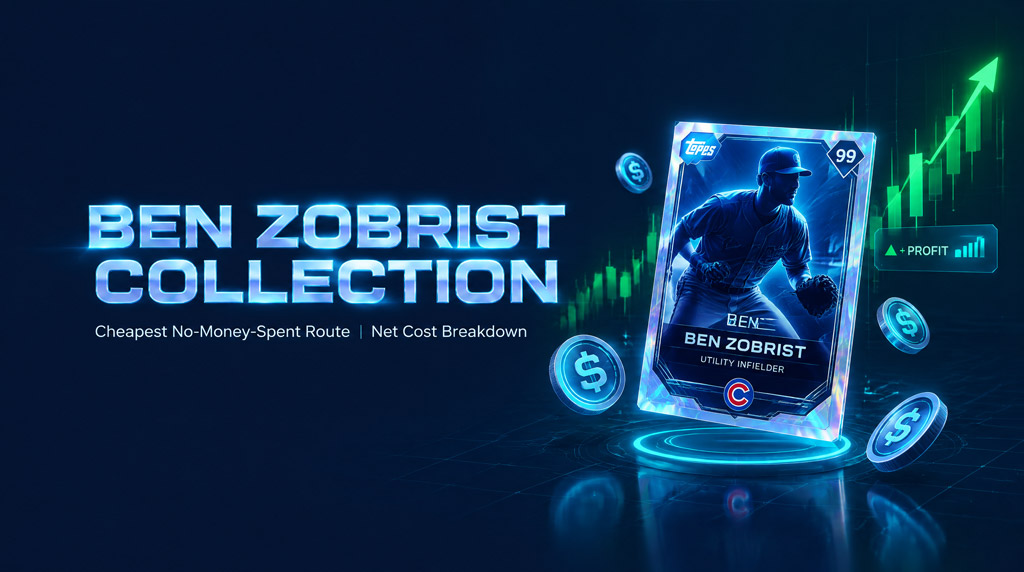
MLB The Show 26 Ben Zobrist Collection Guide: Cheapest No-Money-Spent Route

Locking the Ben Zobrist Legend & Flashback collection does not require draining your stub balance or buying microtransactions. By auditing your existing binder, skipping grind-heavy program vouchers, and selling duplicate cards into launch-day hype, you can finish Zobrist for roughly 100,000 stubs out of pocket while pulling in over 560,000 stubs in gross trade profits.
Here is how to calculate your true completion cost, allocate voucher skips, and turn collection updates into capital.
- The 80% Readiness Rule: Calculate Net Cost
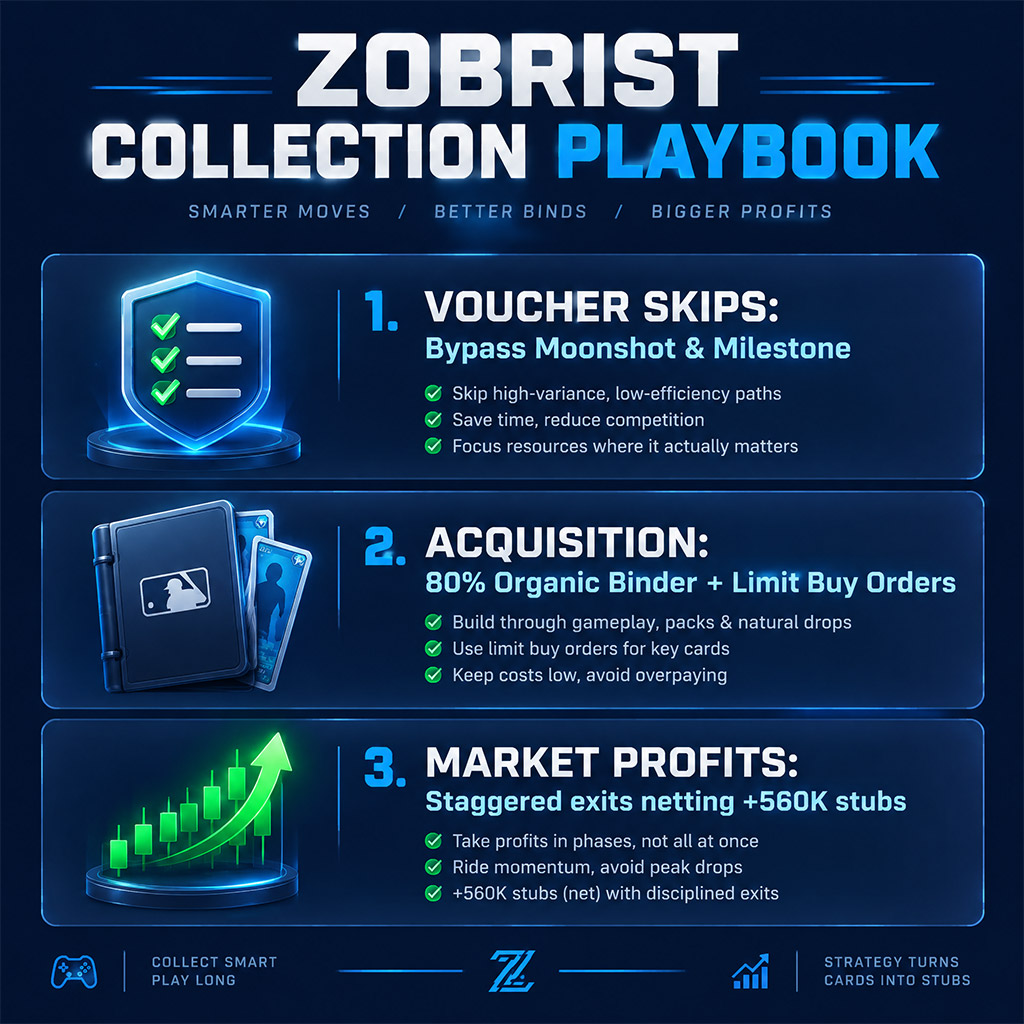
- Voucher Allocation: Which Series to Skip
- Voucher Triage Workflow
- The 560k Trade Engine: Monetizing Launch Liquidity
- Break-Even Tax Calculation
- Realized Trade Ledger
- Staggered Profit-Taking Framework
- Roster Integration: The Mickey Mantle Horizon
- Five Non-Negotiable Marketplace Rules
- FAQ (Frequently Asked Questions)
- What is the cheapest way to complete the Ben Zobrist Collection?
- Which vouchers should I skip for the Ben Zobrist Collection?
- Can I complete Ben Zobrist without spending real money or buying stubs?
- When is the best time to sell cards invested for collection demand?
- Why is Mickey Mantle considered a better long-term investment than Zobrist?
The 80% Readiness Rule: Calculate Net Cost
Third-party database valuations are misleading: they tally the gross market replacement value of every card in the collection tier, completely ignoring the cards already sitting in your binder.
Your true financial metric is Net Completion Cost—the exact stub expense required to clear unavoidable market bottlenecks after claiming all zero-cost program rewards.
Run your inventory through this three-stage triage before submitting a single order:
1. Unsellable (No-Sell) Inventory: Lock non-tradeable cards from completed programs, Team Affinity paths, and conquest maps first. They carry zero opportunity cost.
2. Earnable Gameplay Content: Identify missing cards trapped inside live program reward paths. If earning a card takes under 90 minutes of gameplay, do not buy its marketplace alternative.
3. Hard Market Bottlenecks: Pinpoint cards exclusive to expired Chase packs, early Event tiers, or discontinued packs. These represent your true capital outlays.
Use the 80% Readiness Rule: never initiate collection purchases on launch day unless your owned cards and immediately earnable program assets cover at least 80% of the required vouchers. If you must rebuild multiple series from scratch, stepping into the marketplace during peak demand ensures you buy at the absolute top of the curve.
Voucher Allocation: Which Series to Skip
The collection system permits two voucher skips. Burning these skips on the wrong series is the primary reason players overspend by 200,000 stubs or more.
The strategic principle is simple: never burn a skip on a series composed of cheap, high-liquidity cards. Reserve your skips exclusively for series that demand lengthy, repetitive grinds or lock away inflated market bottlenecks.
| Voucher Series | Strategic Decision | Out-of-Pocket Cost | Core Rationale |
|---|---|---|---|
| Moonshot | Skip | 0 stubs | Newly dropped event/program grind; completing it immediately forces an unnecessary time sink during peak market volatility. |
| Milestone | Skip | 0 stubs | Unfinished milestone rewards (e.g., Altuve, Clemente, Nola) are freely earnable in other programs. Buying alternatives wastes capital. |
| Spotlight | Lock (Buy Bottlenecks) | ~80,000 stubs | Time-limited program closed; buying the two remaining bottlenecks cost significantly less than completing alternative full series. |
| Topps Now | Lock (Buy Inexpensive) | ~15,000 stubs | Abundant pack supply keeps market prices anchored near floor value. Three cheap cards clear the voucher and protect your skips. |
| Awards / Prime | Lock (Organic Binder) | 0 stubs | Saturated through season reward paths; existing non-sell inventory naturally clears these requirements. |
Voucher Triage Workflow
| Stage | Input Inventory | Action Trigger | Assigned Target Sets |
|---|---|---|---|
| Step 1 | Grind-heavy / Overpriced sets | Assign the 2 available skips | Moonshot & Milestone vouchers (Preserves playtime) |
| Step 2 | High-supply / Budget cards | Place buy orders for bottlenecks | Spotlight & Topps Now series (Clears remaining debt) |
| Step 3 | Zero-cost program items | Earn via gameplay objectives | Team Affinity & Player Programs (Zero stub loss) |
By passing on Moonshot and Milestone, you dodge both program burnout and inflated card prices. Milestone items attached to active programs collapse in price over time as more players finish their free reward tracks.
The 560k Trade Engine: Monetizing Launch Liquidity
Collection updates produce massive, short-lived spikes in trading volume. Casual collectors panic-buy the lowest Buy Now listings within the first three hours of launch, artificially inflating prices across eligible sets.
Instead of competing against these buyers, supply their demand.
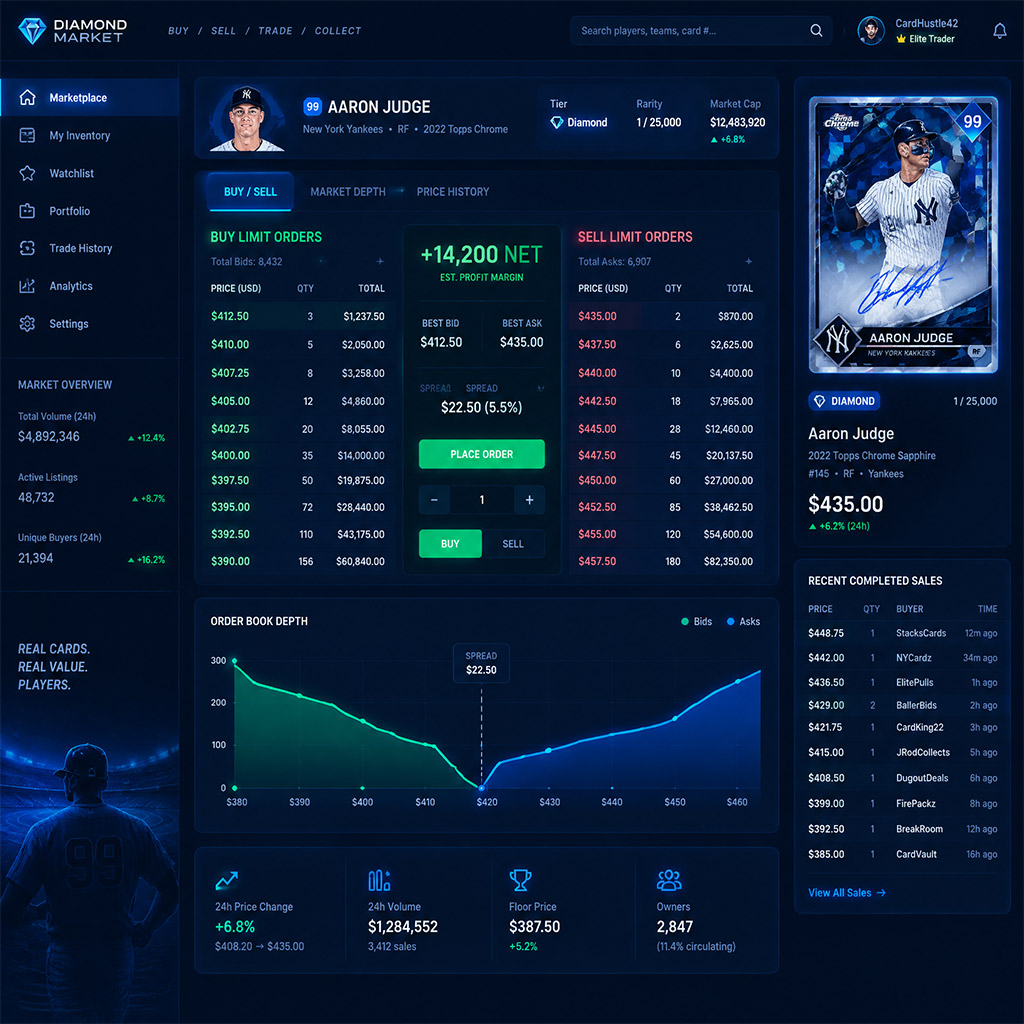
Target cards matching these operational criteria 7 to 10 days before an announced collection milestone:
- Low Pack Velocity: Cards from secondary rounds of retired packs that have stabilized near historic floor prices.
- Structural Scarcity: Series with fewer than 15 total cards in the live database, where any voucher requirement immediately absorbs circulating supply.
- Active Order Books: Consistent daily turnover ensuring you can exit positions without undercutting your own basis.
Break-Even Tax Calculation
The marketplace applies a non-negotiable 10% transaction tax on every completed sale. Never enter a position without knowing your target exit floor:
Break-Even Price = Purchase Price/0.90
Net Profit = (Sale Pric*0.90) - Purchase Price
A position acquired at 27,000 stubs requires an exit above 30,000 stubs just to break even. A completed sale at 39,000 stubs nets 35,100 stubs, delivering an 8,100-stub net margin per copy.
Realized Trade Ledger
Here is the recorded trade performance executed during the Zobrist market cycle:
| Asset / Series Position | Entry Price | Exit Price | Volume | Net Profit (Post-10% Tax) |
|---|---|---|---|---|
| Alfonso Soriano | 27,000 | 39,000 | Multiple | +8,100 per card |
| Chone Figgins | 47,000 | 68,000 | Multiple | +14,200 per card |
| Speculative Flashback Tier | 18,000 | 53,000 | 10 | +297,000 total |
| Ryan Walker | 22,000 | ~70,000 | 3 | +123,000 total |
| Randy Johnson | 96,000 | 139,000 | 1 | +29,100 total |
Selling into early volume generated roughly 560,000 stubs in total profit. Subtracting the 100,000 stubs spent clearing remaining collection bottlenecks left the account 460,000 stubs ahead after unlocking Zobrist.
Staggered Profit-Taking Framework
Never attempt to time the absolute price peak. Use a three-stage exit ladder to capture returns while protecting your downside:
Stage 1 (Pre-Drop Hype - 24 Hours Out): Liquidate 25% of your inventory to recover initial capital.
Stage 2 (Launch Surge - 0 to 90 Minutes In): Sell 50% directly into aggressive Buy Now market orders.
Stage 3 (Trailing Window - 2 to 6 Hours In): Offload the final 25% using competitive sell orders, exiting entirely once listing depth starts outpacing fill velocity.
Roster Integration: The Mickey Mantle Horizon
Ben Zobrist delivers rare defensive flexibility, covering second base, shortstop, third base, and both corner outfield slots without major fielding penalties. However, smart resource management treats Zobrist as a setup piece for the next major milestone: Mickey Mantle.
| Card Evaluation | Ben Zobrist (Voucher Reward) | Mickey Mantle (Next Tier Target) | Tactical Application |
|---|---|---|---|
| Defensive Coverage | 2B, SS, 3B, LF, RF | CF, LF, RF, 1B, 2B, 3B, SS | Both patch multiple lineup gaps, but Mantle carries switch-hitting power. |
| Contact vs. R / L | High / Balanced | 105 / 125 | Mantle neutralizes elite left-handed relievers in competitive formats. |
| Power vs. R / L | Moderate / Gap Power | 110 / 101 | Mantle provides home-run pressure on any difficulty level. |
| Longevity | Situational Swiss Army Knife | End-Game Core Anchor | Mantle can drop into your weakest infield position as better outfielders drop. |
Deploy Mantle wherever your roster is weakest, not automatically in center field. If you already run an elite defensive outfield, sliding Mantle into second base creates a massive offensive mismatch without sacrificing lineup integrity.
Completing Zobrist while keeping over 1,000,000 stubs liquid ensures you can target Mantle the day his requirements drop, without needing emergency pack-pull luck or fire-sale liquidations.
Five Non-Negotiable Marketplace Rules
1. Never Click Buy Now: Always open a custom Buy Order matching or leading the current bid. Bypassing the spread is a 10% to 25% convenience penalty that compounds across a full collection.
2. Never Buy Earnable Cards: If a card sits in an active program reward tree, wait. Buying it simply converts your future playtime into wasted stubs.
3. Verify Unsellable Inventory Before Submitting: The collection screen does not always prioritize no-sell cards over tradeable copies automatically. Double-check that your duplicate tradeable cards remain in your open inventory before locking a voucher.
4. Cap Speculation at 15% of Bankroll: Never overconcentrate your liquid stubs into a single player investment. Unannounced flash sales or sudden pack-odds boosts can halve a card's value instantly.
5. Protect a 30% Liquid Float: If finishing a collection leaves you with fewer than 20% to 30% of your total stub assets in liquid capital, pause. You need that cash reserve to flip cards and profit off upcoming content cycles.
FAQ (Frequently Asked Questions)
What is the cheapest way to complete the Ben Zobrist Collection?
Audit your binder first to lock all no-sell cards, skip Moonshot and Milestone, and buy only the remaining bottleneck cards (such as select Spotlight and Topps Now cards) using patience-driven Buy Orders rather than Buy Now listings.
Which vouchers should I skip for the Ben Zobrist Collection?
Skip the Moonshot and Milestone vouchers. Moonshot forces a time-consuming event grind, while Milestone contains cards you can earn naturally through free player programs without spending a single stub.
Can I complete Ben Zobrist without spending real money or buying stubs?
Yes. By unlocking program rewards, placing competitive marketplace buy orders, and selling duplicate investments into launch-day collection demand, you can comfortably finish Zobrist and end up with more stubs than when you started.
When is the best time to sell cards invested for collection demand?
Sell in phases: offload 25% of your inventory during the pre-release hype window, 50% within the first 90 minutes of the collection going live, and clear the final 25% over the next few hours before market volume cools down.
Why is Mickey Mantle considered a better long-term investment than Zobrist?
While Zobrist offers great defensive utility, Mantle brings elite switch-hitting power alongside multi-position eligibility (including the infield). This flexibility lets him stay in your starting nine across multiple competitive seasons as new cards release.

I’m Amara Okafor, a Nigerian Contributing Writer at GGWTB covering sports, racing, and driving games, alongside casual mobile titles. My guides focus on timing a pass, finding a braking point, and choosing upgrades that suit your playstyle. For shorter sessions, I keep the priorities clear: less menu-hopping, more time playing.
Most Popular Posts
- MLB The Show 26 Draft Cards Guide: Best Budget Picks, Tier List, and Must-Use Rewards
- MLB The Show 26 God Squad Guide: Best Lineup, 98 Tarik Skubal, Bullpen Picks, and Legend Tips
- MLB The Show 26 Hall of Fame Guide: 99 Hoffman, Best Spotlights & Chase Pack Value
- MLB The Show 26 All-Star Collection Guide: Fastest Way to Unlock 99 Yordan Alvarez
- Best MLB 26 God Squad: Ranked Lineup, Rotation, Bullpen, and Platoon Meta
- MLB The Show 26 Tier List: Best Diamond Dynasty Cards by Position
Popular Category Lists
- ARC Raiders / (345)
- Grow a Garden / (292)
- CoD: Black Ops 7 / (167)
- Star Citizen / (161)
- MLB 26 / (159)
- Monopoly Go / (152)
- ARK Survival Ascended / (126)
- Steal a Brainrot / (98)
- Blox Fruits / (74)
- Adopt Me / (73)
- Forza Horizon 6 / (72)
- Sailor Piece / (68)
- Grow a Garden 2 / (68)
- Diablo IV / (62)
- CoD: BLACK OPS 6 / (55)
- Path of Exile 2 / (48)
- Monster Hunter Wilds / (46)
- Aion 2 / (46)
- Windrose / (44)
- Donut SMP / (41)