


 0
0 Created: Sep 14,2026 | MLB 26
MLB The Show 26 Tier List: Best Diamond Dynasty Cards by Position

Jorge Posada and John Franco are the standout additions, while Josh Bell, Jesús Made, Dustin May, and Victor Martinez remain core God Squad options. Before spending Stubs, judge each card by difficulty, role, swing, defense, and matchup value—not its 99 overall rating.
These rankings cover cards reviewed through September 13, 2026. San Diego Studio's official updates confirm the releases of 99 OVR Subway Series Posada and Franco, along with August Lightning Jac Caglianone and Kris Bryant; detailed ratings below reflect the in-game card screens captured during the review period rather than permanent live values.
- How the Rankings Work
- Tier definitions
- Why Vision changes on higher difficulties
- Best Position Players
- Catcher: Posada is elite, Piazza is a specialist
- First base: Josh Bell provides the cleanest fit
- Middle infield: keep the incumbent unless the swing fits
- Outfield: secondary eligibility can be a trap
- Cards to Buy, Trial, and Skip
- Best Starting Pitchers
- Félix Hernández needs less predictable sequencing
- Sánchez has the safest new repertoire
- Protect Cavalli's outlier knuckle curve
- Best Relief Pitchers
- Franco is more than a screwball gimmick
- Senga beats Blackburn by a narrow margin
- Recommended God Squad Roles
- FAQ (Frequently Asked Questions)
- Who is the best catcher in MLB The Show 26?
- Is Jorge Posada worth the Stubs?
- Does Vision matter in MLB The Show 26?
- Who is the best new starting pitcher?
- Who is the best new relief pitcher?
How the Rankings Work
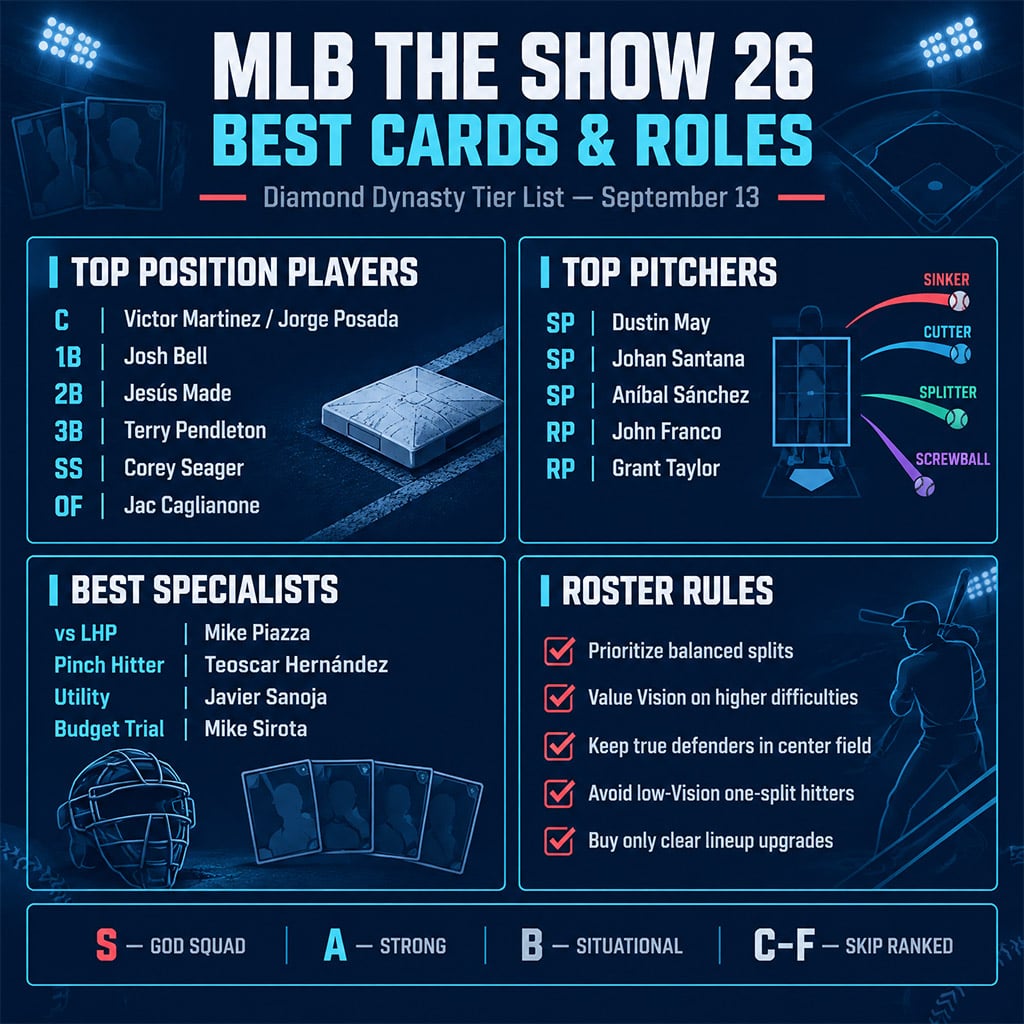
A high overall rating can hide a narrow platoon split, low Vision, poor reactions, or an unreliable pitch mix. We rank cards by how often their strengths survive competitive Ranked play.
Tier definitions
| Tier | Competitive Standard | Recommended Use |
|---|---|---|
| S | Best-in-slot or close to it | God Squad starter |
| A | Strong but replaceable | Ranked starter or premium specialist |
| B | Matchup-dependent | Events, theme teams, platoons |
| C | Behind the power curve | Missions and offline play |
| D/F | Severe competitive weakness | Avoid in serious Ranked games |
Decision: Buy an A-tier card only when it fills a defined need; replacing one A-tier player with another is usually a poor use of Stubs.
Why Vision changes on higher difficulties
On All-Star, strong PCI placement can cover a mediocre Vision rating. Hall of Fame and Legend leave less room for late decisions, defensive swings, and two-strike survival.
That is why Coby Mayo's 65 Vision and Lazaro Montes' 68 Vision outweigh their elite platoon power. They can punish favorable matchups, but neither deserves an everyday Ranked spot when complete hitters are readily available.
Best Position Players
The fastest way to improve a lineup is to target positions with a meaningful performance gap. Catcher received a genuine top-tier addition; second base, third base, and shortstop mostly gained alternatives rather than mandatory upgrades.
| Position | Best Current Option | Best New or Recent Option | Tier | Recommended Decision |
|---|---|---|---|---|
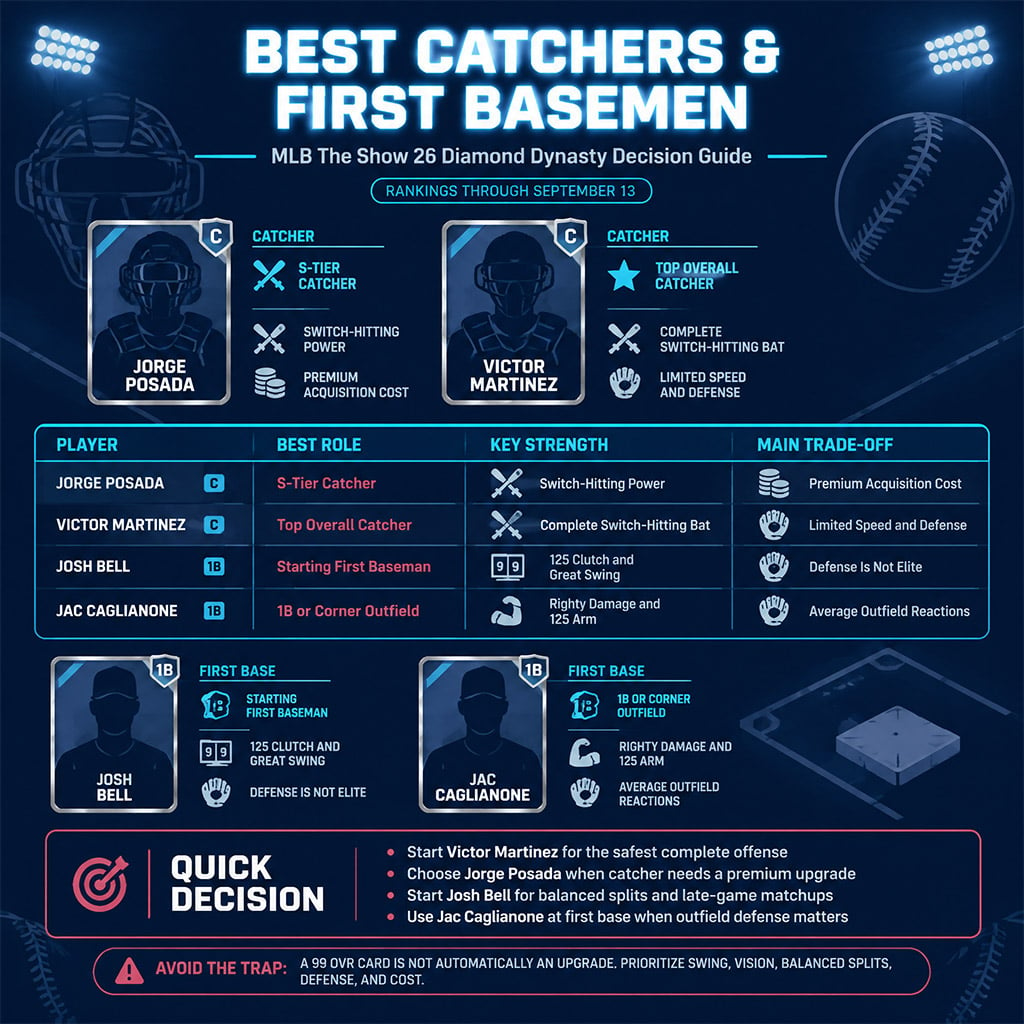
| Catcher | Victor Martinez | Jorge Posada | S | Buy Posada only if catcher needs a major upgrade |
| First Base | Josh Bell | Jac Caglianone | S/A | Start Bell; use Caglianone when righty damage matters most |
| Second Base | Jesús Made | José Altuve | S/A | Keep Made; Altuve is a contact-first alternative |
| Third Base | Established elite option | Terry Pendleton | A | Use Pendleton for switch-hitting and two-strike stability |
| Shortstop | Established elite option | Corey Seager | A | Choose Seager when offense matters more than elite range |
| Corner Outfield | Established S-tier outfielder | Chris Bryant or Caglianone | A | Keep both out of center unless roster construction forces it |
| Center Field | Premium natural center fielder | None from this group | — | Do not manufacture an upgrade with a weak secondary defender |
Decision: Posada changes the catcher market; the other recent position players mainly solve specific lineup problems.
Catcher: Posada is elite, Piazza is a specialist
Posada combines switch-hitting, strong offensive attributes, usable pop time, and valuable quirks. Victor Martinez retains the top spot by a narrow margin, but Posada is a legitimate S-tier starter rather than a novelty Chase card.
Here is the catch: Posada's acquisition cost matters. If you already own Martinez or Adley Rutschman, the gain may be too small to justify paying a Chase Pack premium.
Mike Piazza offers a cheaper tactical benefit. His reviewed card carries 120 contact and 118 power against left-handed pitching, plus the Pinch Hitter quirk; if his swing gives you inconsistent results, keep him on the bench and deploy him against a left-handed reliever.
Johnny Bench belongs behind the plate. Moving him to first base or an outfield corner wastes the defensive value that separates him from better hitters.
First base: Josh Bell provides the cleanest fit
Bell's switch-hitting, strong swing, and 125 Clutch stop opponents from manufacturing an easy bullpen advantage. He may lack the loudest attribute screen, but his profile works in more late-game situations than one-sided sluggers.
Caglianone is the stronger choice when you need maximum damage against right-handed pitching. His 125 arm suggests right field, yet average reactions can still concede extra bases; place him at first when your outfield already has three reliable defenders.
Skip Mayo and Montes for everyday Ranked play. A maxed split does not repair weak Vision and poor production against the opposite hand.
Middle infield: keep the incumbent unless the swing fits
Jesús Made remains our preferred second baseman because his swing plays above the card's menu presentation. José Altuve is the best recent challenger with 125 contact against both sides and 120 Clutch, but his weak arm and reactions make left field a poor use of his secondary eligibility.
Terry Pendleton offers a safer Hall of Fame profile than many higher-power third basemen. His reviewed ratings include 125 contact against righties, 115 against lefties, 109 Vision, and 120 Clutch, while switch-hitting protects him from bullpen matchup manipulation.
Corey Seager is the best recent offensive shortstop. Use him when you need a middle-order left-handed bat; avoid him when your stadium, pitching staff, or defensive approach demands maximum range and speed.
Tony Fernández presents the opposite trade-off. His contact, Vision, speed, and defense are excellent, but 61 power against righties and 72 against lefties make him a bottom-of-the-order table-setter rather than a run producer.
Outfield: secondary eligibility can be a trap
Chris Bryant and Caglianone can handle corner roles, but neither is the ideal answer in center. Reaction and route efficiency affect more plays than arm strength, especially in large outfields.
Mike Sirota is the underrated trial card. His swing performed better than his initial menu-based ranking suggested, so test him against inside velocity before paying for Chili Davis.
Davis is balanced and switch-hits, but he does not supply premium center-field defense or dominant power. A Chase card should produce a clear upgrade; Davis becomes poor value when you already own an established S-tier outfielder.
Use Teoscar Hernández for one job:
1. Keep him on the bench.
2. Insert him against a left-handed reliever.
3. Hunt an early-count fastball.
4. Replace him defensively if the game continues.
Starting him for nine innings exposes his fielding. One high-leverage plate appearance does not.
Cards to Buy, Trial, and Skip
Cost matters as much as tier placement. Separate clear upgrades from cards that merely look different.
| Action | Cards | Reason |
|---|---|---|
| Prioritize | Jorge Posada, Josh Bell, John Franco, Aníbal Sánchez | Clear starting or bullpen roles |
| Trial first | Mike Sirota, Cade Cavalli, Cooper Hjerpe, Mike Piazza | Swing or delivery strongly affects results |
| Use as specialists | Teoscar Hernández, Tony Fernández, Johnny Bench | Their value depends on role and matchup |
| Skip for Ranked | Coby Mayo, Lazaro Montes, Yoandy Morales | Vision or split weaknesses create predictable failure points |
Decision: Trial swing-dependent cards before buying premium alternatives; skip any expensive card that does not change your starting lineup or bench plan.
Best Starting Pitchers
Pitcher effectiveness declines when opponents learn the release and common sequence, even if the attributes never change. That familiarity penalty is why Félix Hernández no longer holds the top spot.
| Starting Pitcher | Tier | Primary Strength | Failure Point |
|---|---|---|---|
| Dustin May | S | Best current total package | Repeated exposure may reduce deception |
| Johan Santana | S | Top left-handed option | Poor sequencing makes him predictable |
| Pedro Martínez | S | Premium right-handed starter | Slightly behind Santana in current value |
| Félix Hernández | S | Proven mix and control | Ranked players recognize his release |
| Aníbal Sánchez | High A | Sinker, cutter, splitter, slider | Familiar motion and obvious tunnels |
| Cade Cavalli | A | Outlier knuckle curve with sinker/cutter base | The curve loses surprise value when spammed |
| Mike Mussina | A | Sinker, cutter, and changeup | No slider; reviewed card has 96 Clutch |
| Bryan Woo | A | Strong per-nine ratings | Slider and sweeper overlap |
| Ryan Johnson | B | Good hit-prevention ratings | Weak control |
| Martín Pérez | B | Useful movement profile | Low velocity reduces margin for error |
| Quinn Mathews | C | Sinker | Poor control |
| Jackson Kent | C | Serviceable budget repertoire | No defining competitive advantage |
Decision: Sánchez is the safer rotation addition; Cavalli offers more uncertainty but requires disciplined pitch usage.
Félix Hernández needs less predictable sequencing
Experienced opponents have seen Félix enough to recognize the standard inside-sinker and breaking-ball patterns. Keep him in the rotation, but stop opening every same-handed matchup with the same pitch.
Familiarity is a hidden rating.
Use first-pitch changeups, back-door breaking balls, and occasional elevated fastballs to disrupt hitters waiting for sinker movement. If opponents consistently take the off-speed pitch below the zone, steal an early strike rather than forcing another chase.
Sánchez has the safest new repertoire
Aníbal Sánchez covers the necessary movement directions with a sinker, cutter, splitter, slider, and four-seam fastball. The mix works only when you avoid reducing it to sinker inside and cutter away.
Use the splitter below the zone after establishing strikes at the knees. Mix in the back-door slider so hitters cannot eliminate the outer half when they have two strikes.
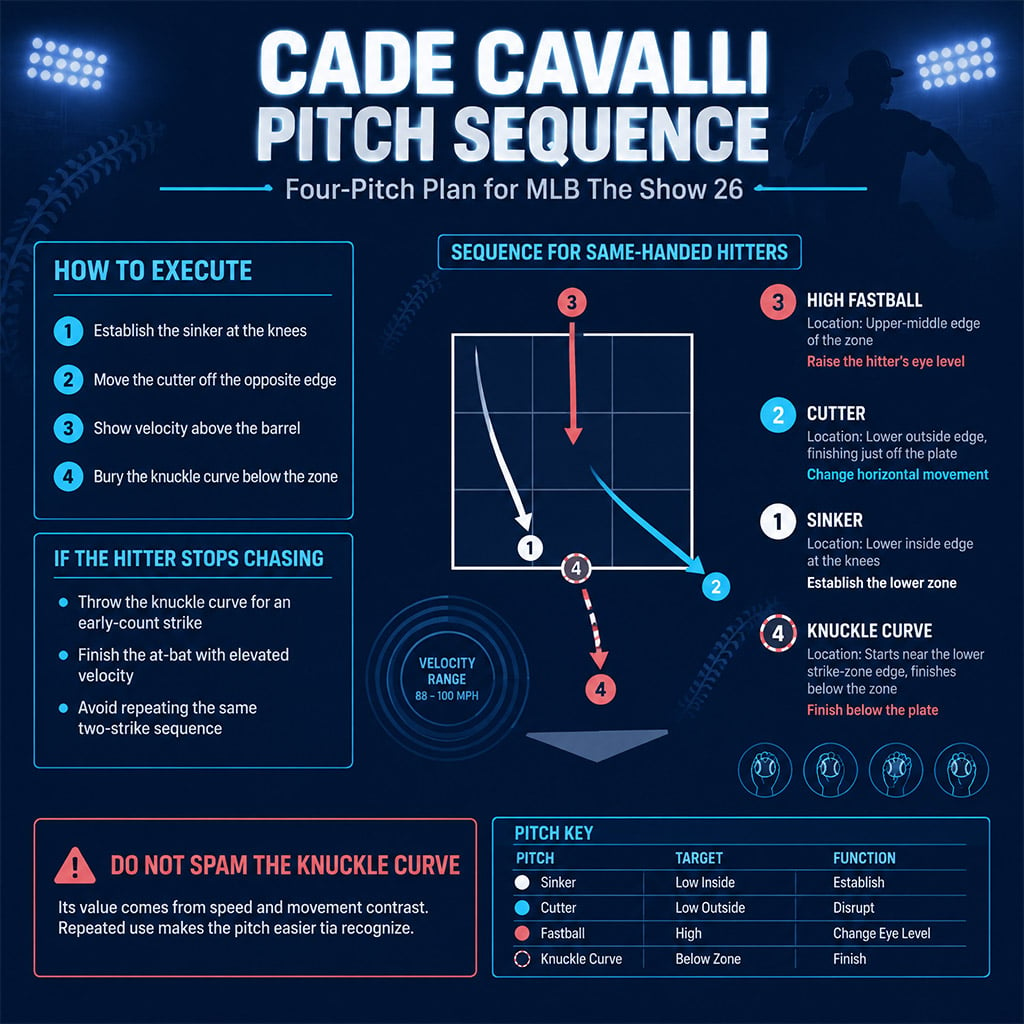
Protect Cavalli's outlier knuckle curve
Cavalli's unusual knuckle curve creates value through contrast, not volume. Repeated use gives the hitter enough looks to adjust.
Start with this sequence:
1. Establish the sinker at the knees.
2. Show the cutter off the opposite edge.
3. Change eye level with a high fastball.
4. Bury the knuckle curve below the zone.
If the opponent stops chasing, use the curve for an early-count strike and finish with velocity.
Best Relief Pitchers
John Franco is the best new bullpen addition because he can attack both sides without relying on one velocity band. Kodai Senga and Paul Blackburn improve bullpen depth, but neither clearly passes Ben Joyce.
| Reliever | Hand | Tier | Best Trait | When He Fails |
|---|---|---|---|---|
| John Franco | L | S | Screwball and complete speed separation | When the screwball becomes predictable |
| Grant Taylor | R | S | Top-end right-handed profile | Cost or acquisition restrictions |
| Will Dion | L | A/S | Delivery plays above menu expectations | Limited margin when location slips |
| Ben Joyce | R | High A | Outlier velocity and usable control | Strong hitters sit on the fastball |
| Kodai Senga | R | A | Forkball, cutter, sweeper, and sinker | No outlier velocity |
| Paul Blackburn | R | A | Sinker-cutter movement and strong hit prevention | Control can undermine the repertoire |
| Cooper Hjerpe | L | A | 62 stamina and an unusual left-handed look | No sinker and weaker control |
| Jordan Hicks | R | A | Raw velocity | Predictable fastball-heavy sequencing |
Decision: Add Franco first; use Joyce for velocity and Senga when opponents chase beneath the zone.
Franco is more than a screwball gimmick
The reviewed Franco card has maxed hits per nine against lefties and maxed strikeouts per nine against both sides. His screwball, sinker, slider, four-seam, and circle change cover distinct movement and velocity bands.
Tunnel the screwball with low sinkers, then throw the slider when right-handed hitters begin protecting the inner half. If you throw the screwball in every two-strike count, strong opponents will eliminate it.
Senga beats Blackburn by a narrow margin
Senga's forkball supplies the better finishing pitch. Blackburn relies more heavily on precise sinker-cutter placement, which becomes harder to sustain when his control slips.
Use Senga against opponents who handle fastballs but chase below the zone. Choose Joyce when the hitter cannot time premium velocity; raw speed already solves that matchup.
Recommended God Squad Roles
A strong roster assigns jobs instead of squeezing every expensive card into the starting nine.
| Role | Recommended Card | Reason |
|---|---|---|
| Starting Catcher | Victor Martinez or Jorge Posada | Elite switch-hitting offense |
| Starting First Baseman | Josh Bell | Balanced splits, strong swing, 125 Clutch |
| Starting Second Baseman | Jesús Made | Best tested hitting consistency |
| Starting Third Baseman | Terry Pendleton | Contact, Vision, Clutch, and switch-hitting |
| Offensive Shortstop | Corey Seager | Best recent offense-defense combination |
| Corner Outfielder | Jac Caglianone | Righty damage and 125 arm |
| Bench Bat vs. LHP | Mike Piazza | 120 contact and 118 power against lefties |
| Pinch Hitter | Teoscar Hernández | Pinch Hitter quirk and strong lefty split |
| Utility Player | Javier Sanoja | Speed, defense, and broad eligibility |
| Bullpen Priority | John Franco | Best complete new relief profile |
Decision: Buy only the card that improves a starting job or fills a specific bench, rotation, or bullpen assignment.
FAQ (Frequently Asked Questions)
Who is the best catcher in MLB The Show 26?
Victor Martinez ranks first, with Jorge Posada close behind. Posada is the better purchase when catcher is a clear weakness, but Martinez owners can save their Stubs for a larger upgrade elsewhere.
Is Jorge Posada worth the Stubs?
Posada is worth the cost for teams without an S-tier catcher. If you already start Martinez or Adley Rutschman, buy Posada only when his swing gives you a measurable improvement.
Does Vision matter in MLB The Show 26?
Vision matters most on Hall of Fame and Legend. Low-Vision hitters can still work on All-Star, but cards such as Coby Mayo and Lazaro Montes become too dependent on favorable matchups at higher difficulties.
Who is the best new starting pitcher?
Aníbal Sánchez is the safest recent rotation addition. Cade Cavalli has greater surprise value, but his outlier knuckle curve becomes ordinary when you overuse it.
Who is the best new relief pitcher?
John Franco is the best new reliever in this group. Mix his screwball with low sinkers and glove-side sliders rather than treating one unusual pitch as the entire strategy.

I’m Amara Okafor, a Nigerian Contributing Writer at GGWTB covering sports, racing, and driving games, alongside casual mobile titles. My guides focus on timing a pass, finding a braking point, and choosing upgrades that suit your playstyle. For shorter sessions, I keep the priorities clear: less menu-hopping, more time playing.

Most Popular Posts
- MLB The Show 26 Tier List: Best Diamond Dynasty Cards by Position
- MLB The Show 26 Hall of Fame Guide: 99 Hoffman, Best Spotlights & Chase Pack Value
- MLB The Show 26 Top 20 Endgame Cards Ranked for New Seasons
- MLB The Show 26 New Threads 2.0 Tier List Guide: Best Cards, Budget Picks, and Meta Fits
- MLB The Show 26 New 99 OVR Tier List: Best Cards Ranked
- MLB The Show 26 Ben Zobrist Collection Guide: Cheapest No-Money-Spent Route
Popular Category Lists
- ARC Raiders / (355)
- Grow a Garden / (294)
- CoD: Black Ops 7 / (167)
- Star Citizen / (163)
- MLB 26 / (159)
- Monopoly Go / (153)
- ARK Survival Ascended / (128)
- Steal a Brainrot / (99)
- Blox Fruits / (74)
- Adopt Me / (74)
- Forza Horizon 6 / (72)
- Sailor Piece / (68)
- Grow a Garden 2 / (68)
- Diablo IV / (62)
- CoD: BLACK OPS 6 / (55)
- Aion 2 / (53)
- Path of Exile 2 / (48)
- Monster Hunter Wilds / (46)
- Windrose / (44)
- COD: Modern Warfare 4 / (43)