



 0
0 Created: Mar 24,2026 | MLB 26
MLB The Show 26 Hitting Guide: Improve Timing, Read Pitches Earlier, and Hit More Consistently

If you want to improve your timing in MLB The Show 26, the biggest shift is learning to read the pitch earlier. Good hitters do not rely on reaction alone. They pick up speed clues, recognize pitch shape sooner, and practice in a way that transfers to Ranked Seasons, BR, and higher difficulties.
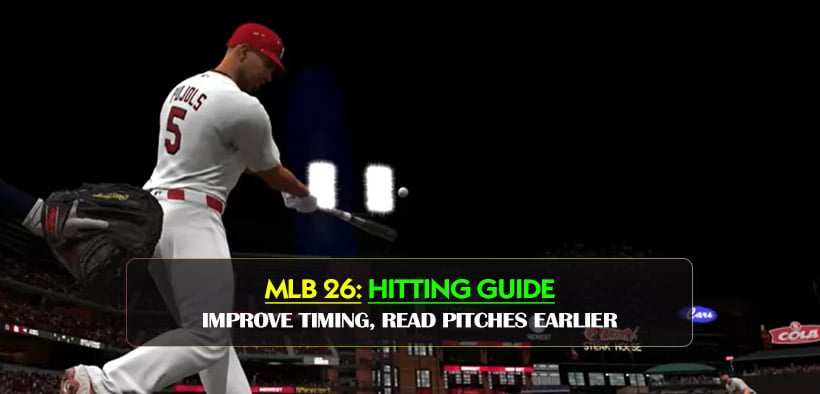
In our experience, timing becomes more stable when we stop treating hitting as pure reflex. Once you understand tempo, release cues, plate discipline, and setup, the game slows down in a very real way. Here's a cleaner, more practical guide to make that happen.
- Why Timing Matters More Than Most Players Think
- What better timing really looks like
- Read Pitches Earlier: Tempo First, Shape Second
- 1. Use hitter tempo to read speed differences
- 2. Use pitch shape when speeds are similar
- Why combining both works best
- The Best Practice Routine for Better Timing
- A simple pre-game routine
- Practice rules that actually work
- PCI, Camera, and Visual Setup
- PCI tips
- Best hitting camera views
- Plate Discipline: A Hidden Timing Booster
- Stadium and Equipment Choices
- Stadium choice
- Controller and monitor basics
- FAQ
- What is the fastest way to improve timing in MLB The Show 26?
- Does hitter stride really help identify pitches?
- What is the best camera for hitting?
- How long should batting practice be?
- Does a monitor matter in MLB The Show 26?
- Summary
Why Timing Matters More Than Most Players Think
Timing is not just about being early on a fastball. It affects almost everything:
- PCI quality
- foul-ball outcomes
- hard-hit consistency
- your ability to stay on offspeed pitches
If your timing is off, even decent PCI placement often will not save the swing.
What better timing really looks like
| Skill | What It Means | In-Game Result |
|---|---|---|
| Early pitch read | You identify speed sooner | Fewer panic swings |
| Better swing decisions | You stop chasing pitcher's pitches | More hitter's counts |
| Stable contact timing | You are not constantly late or out front | More hard contact |
This is why strong hitters look calmer. They are not guessing less because they are lucky. They are processing earlier.
Read Pitches Earlier: Tempo First, Shape Second
The fastest way to improve timing is to stop reading the pitch too late.
1. Use hitter tempo to read speed differences
Some hitters have a more obvious leg kick or stride. That animation can help reveal whether the incoming pitch is hard or slow.
In practical terms:
- Fastball: stride often syncs earlier and tighter
- Slow breaking ball: stride can look more delayed
- High leg-kick hitters: usually make this easier to see
This matters most when the pitcher has a large velocity gap.
2. Use pitch shape when speeds are similar
When a pitcher's cutter, sinker, splitter, or changeup all sit close in velocity, tempo alone becomes less useful. That is when we focus on release behavior and break path.
Look for:
- a flatter path on fastball-type pitches
- a slight rise-and-drop look on breaking stuff
- early divergence from the fastball lane
Why combining both works best
| Read Type | Best For | Weakness |
|---|---|---|
| Tempo / stride | Big speed differences | Less useful on tight velocity bands |
| Pitch shape | Similar-speed tunnels | Harder to learn at first |
| Combined read | Most competitive situations | Requires repetition |
From a high-level gameplay perspective, this is the real skill gap. Good hitters combine both reads instead of relying on one.
The Best Practice Routine for Better Timing
The most effective routine is short, focused, and repeatable. We have found that 5 to 10 minutes of custom practice before online play is enough to sharpen timing noticeably.
A simple pre-game routine
| Drill | Setup | Goal |
|---|---|---|
| Fastball vs curveball | Large speed gap | Learn tempo cues |
| Cutter vs splitter | Similar speeds | Learn pitch shape |
| Take-or-swing drill | Borderline strike/ball mix | Improve discipline |
| Higher-difficulty reps | One level above your mode | Make game speed feel slower |
Practice rules that actually work
- Practice one weakness at a time
- Use specific pitch pairings
- Go one difficulty higher than your normal mode
- Focus on taking bad pitches, not just swinging more
If you struggle with inside sinkers, then train inside sinkers. If you are late on velocity, then start with fastball-only reps. Specific work produces faster gains than random batting practice.
PCI, Camera, and Visual Setup
Your settings should make the ball easier to see, not the screen harder to process.
PCI tips
If you keep yanking the PCI past the ball, lower sensitivity a little. If you feel stuck and cannot reach velocity, increase it slightly.
| Problem | Adjustment | Why It Helps |
|---|---|---|
| PCI overshoots | Lower sensitivity | Improves control |
| Late to velocity | Raise sensitivity | Helps reach edge pitches |
| Screen feels cluttered | Simplify PCI | Improves ball tracking |
We usually recommend changing one setting at a time. That makes it much easier to tell what is helping.
Best hitting camera views
For most competitive players, the best options are:
1. Strike Zone
2. Strike Zone High
3. Strike Zone 2
The closer the view, the more pitch information you get. If Strike Zone feels cramped, move back one step instead of jumping to a far camera immediately.
Plate Discipline: A Hidden Timing Booster
A lot of timing issues begin with bad swing decisions. If you keep swinging at pitches you do not want, your timing will always feel unstable.
A better rule is simple:
- hunt one area
- take low-value pitches
- force the pitcher back into the zone
If you struggle with sliders away, stop offering at them just because they look tempting early. Taking that pitch gives you more control over the at-bat and usually leads to a better swing later in the count.
That is not passive hitting. It is efficient hitting.
Stadium and Equipment Choices
Small setup changes can make timing feel cleaner.
Stadium choice
Balanced minor league parks are usually better for competitive feedback than extreme high-offense stadiums.
| Option | Benefit | Risk |
|---|---|---|
| High-elevation stadium | More offense | Less honest swing feedback |
| Balanced minor league park | Cleaner results | Slightly fewer bailout homers |
| Large pro stadium | Immersive look | More visual clutter |
If your goal is improvement, choose the stadium that gives clearer feedback on swing quality.
Controller and monitor basics
From practical experience, the most important hardware upgrades are:
- a reliable low-latency controller
- a 120Hz gaming monitor
- a setup with low input lag and clear image quality
A premium setup is not mandatory, but a poor display can absolutely make fastball timing harder. For many players, a good 1440p 120Hz monitor is the best balance of clarity and responsiveness.
FAQ
What is the fastest way to improve timing in MLB The Show 26?
The fastest way is to combine custom practice, early pitch recognition, and better swing decisions. Focus on reading speed first, then pitch shape, and train one weakness at a time.
Does hitter stride really help identify pitches?
Yes, especially against pitchers with a big velocity gap. It is not perfect on every pitch, but it can give you an early clue that improves timing consistency.
What is the best camera for hitting?
For most players, Strike Zone is best. If it feels too close, use Strike Zone High or Strike Zone 2.
How long should batting practice be?
Usually 5 to 10 minutes is enough if the drills are focused and done before online play.
Does a monitor matter in MLB The Show 26?
Yes. A 120Hz low-input-lag monitor can make timing feel noticeably cleaner, especially against high velocity online.
Summary
The best way to improve timing in MLB The Show 26 is to read more information earlier and make fewer rushed swings. We do that by learning tempo cues, recognizing pitch shapes, using short custom practice sessions, tightening plate discipline, and choosing settings that make the ball easier to track.
The key takeaway is simple: better timing is not only reaction speed—it is earlier recognition plus smarter preparation. Once those pieces come together, hitting becomes more repeatable and a lot less random.

Most Popular Posts
- MLB The Show 26 God Squad Guide: Best Lineup, 98 Tarik Skubal, Bullpen Picks, and Legend Tips
- MLB The Show 26 Tier List: Best Diamond Dynasty Cards by Position
- MLB The Show 26 Hall of Fame Guide: 99 Hoffman, Best Spotlights & Chase Pack Value
- MLB The Show 26 Top 20 Endgame Cards Ranked for New Seasons
- MLB The Show 26 New Threads 2.0 Tier List Guide: Best Cards, Budget Picks, and Meta Fits
- MLB The Show 26 New 99 OVR Tier List: Best Cards Ranked
Popular Category Lists
- ARC Raiders / (354)
- Grow a Garden / (294)
- CoD: Black Ops 7 / (167)
- Star Citizen / (163)
- MLB 26 / (159)
- Monopoly Go / (153)
- ARK Survival Ascended / (128)
- Steal a Brainrot / (99)
- Blox Fruits / (74)
- Adopt Me / (74)
- Forza Horizon 6 / (72)
- Sailor Piece / (68)
- Grow a Garden 2 / (68)
- Diablo IV / (62)
- CoD: BLACK OPS 6 / (55)
- Aion 2 / (52)
- Path of Exile 2 / (48)
- Monster Hunter Wilds / (46)
- Windrose / (44)
- Maplestory Classic / (42)