


 0
0 Created: Apr 18,2026 | MLB 26
Best Way to Make Stubs in MLB The Show 26: Smart NMS Market Guides

Making stubs in MLB The Show 26 is less about finding one magic grind and more about using the market the right way. From our experience, Mini Seasons and program rewards are useful, but they only give us starting capital. The big jump happens when we take those MLB 26 stubs and invest before collections force demand into specific cards.
That is the real difference between slowly stacking stubs and reaching collections early without spending money. Here's the simple version: grind first, invest second, sell into hype before the market turns.
- Why Grinding Alone Is Not Enough
- The Best Stub Strategy Right Now
- Legends & Flashbacks
- Topps Now
- Thin-Series Cards
- How We Manage Risk
- Do not go all-in on one card
- Watch for flash sales
- Sell into the spike
- A Simple Stub Plan by Budget
- FAQ
- What is the best no money spent way to make stubs in MLB The Show 26?
- Are Topps Now cards worth buying?
- When should we sell our investments?
- Is this better than only playing Mini Seasons?
- Final Takeaway
Why Grinding Alone Is Not Enough
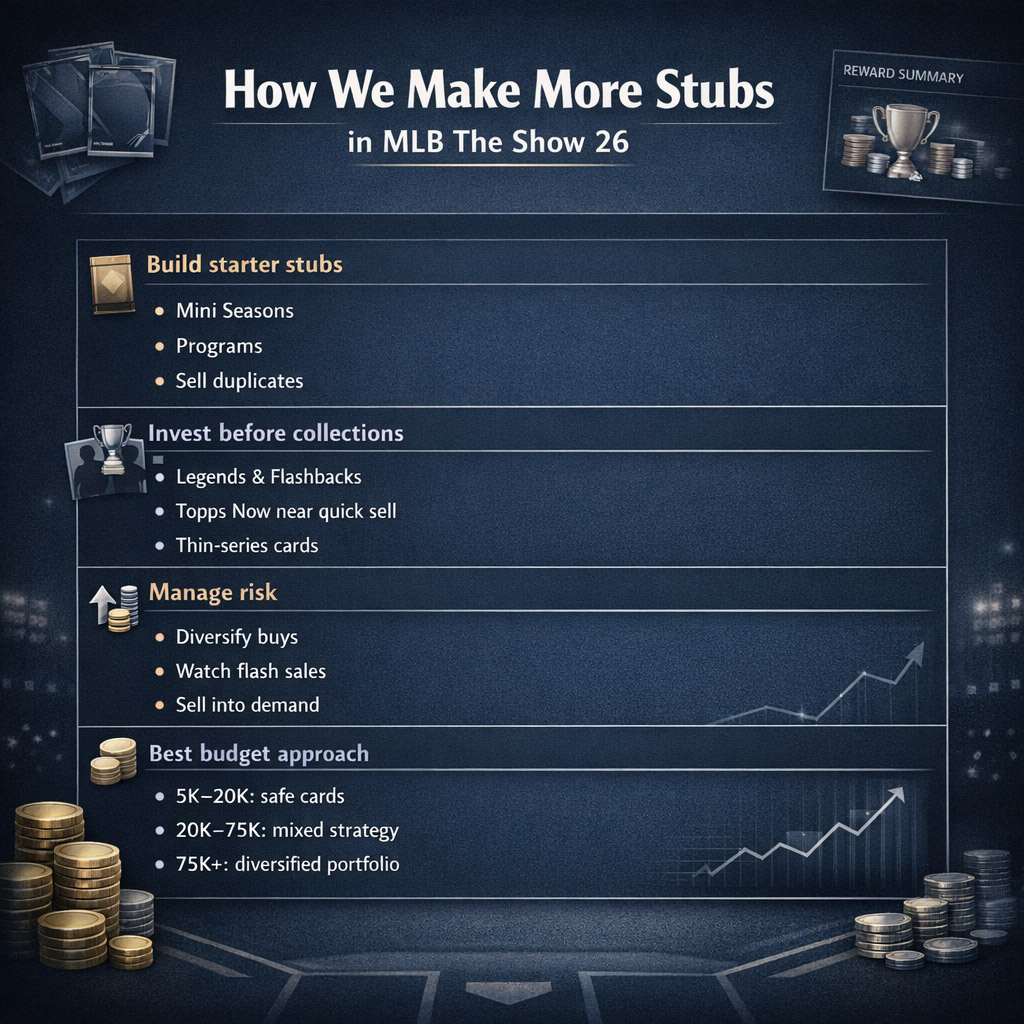
Grinding still matters. We all need a way to build the first 10K, 25K, or 50K stubs. The problem is that grinding by itself scales slowly.
What usually works better is:
- use gameplay rewards to build a bankroll,
- move that bankroll into cards with collection upside,
- then cash out when demand rises.
In past Diamond Dynasty cycles, this approach has consistently outperformed pure grinding for us, especially around big content drops. If you treat every stub as inventory instead of savings, your progress speeds up fast.
| Method | Best Use | Profit Speed |
|---|---|---|
| Mini Seasons / Programs | Build starter stubs | Medium |
| Card investing | Grow bankroll | High |
| Quick-sell floor cards | Safer long holds | Medium-High |
The point is not to stop grinding. The point is to make grinding feed a better stub system.
The Best Stub Strategy Right Now
The strongest method is usually investing in cards that players will suddenly need for collections.
Why does that work? Because demand changes overnight when a collection drops. A card that looks average today can become expensive tomorrow if it belongs to a thin series or comes from a low-supply pack.
We usually focus on three types of cards:
- Legends & Flashbacks cards with low supply
- Topps Now cards near quick sell
- Thin-series cards with very few alternatives
Legends & Flashbacks
This is one of the best places to make stubs before a major collection. Cards from Headliners, old choice packs, Weekend Classic rewards, or limited content drops often rise because supply is tight.
If you find a card that:
- comes from a limited source,
- has few substitutes in its series,
- and has not already fully spiked,
then that is usually where the value is.
Topps Now
Topps Now cards are one of the safest ways to park stubs.
If a card is sitting near quick sell, the downside is limited. If it gets tied into a future collection, the upside can be strong. We like these because they are simple, low-stress investments, especially for smaller bankrolls.
Thin-Series Cards
This is where a lot of the best value hides.
Sometimes the best investment is not the best player. It is the card that counts toward a series with almost no options. If players need that bucket for a voucher, price can jump hard even if the card itself is not popular in gameplay.
| Card Type | Why We Buy It | Risk Level |
|---|---|---|
| Legends & Flashbacks | Collection demand + low supply | Medium |
| Topps Now near quick sell | Limited downside | Low |
| Thin-series cards | Few alternatives in collections | Medium-High |
How We Manage Risk
This is the part many stub guides skip, and it matters just as much as picking the right cards.
Do not go all-in on one card
Even good ideas can fail if supply returns or the market shifts. We usually spread stubs across several cards instead of betting everything on one name.
Watch for flash sales
Flash sales can crush prices fast, especially for Legends & Flashbacks. If you notice SDS loading the store with extra supply, be more careful with expensive holds.
Sell into the spike
A lot of players hold too long. If a card jumps because the collection is live, that is often the moment to sell. Waiting for the absolute top sounds smart, but in practice it often gives profits back.
| Mistake | What Happens | Better Move |
|---|---|---|
| Buying after hype starts | Smaller profit margin | Buy before attention builds |
| Going all-in on one card | Higher damage if wrong | Diversify |
| Holding too long | Profit disappears on the drop | Sell into demand |
A Simple Stub Plan by Budget
You do not need a huge bankroll to use this strategy. You just need the right fit for your budget.
| Stub Budget | Best Approach |
|---|---|
| 5K–20K | Focus on Topps Now near quick sell |
| 20K–75K | Mix safe cards with 2–3 collection plays |
| 75K+ | Build a diversified investment pool |
If you are low on stubs, stay patient and protect your downside. If you already have a larger bankroll, you can be more aggressive with low-supply cards before major collection drops.
FAQ
What is the best no money spent way to make stubs in MLB The Show 26?
The best method is usually to grind for starting stubs and then invest ahead of collections. Grinding gives us capital. Investing is what multiplies it.
Are Topps Now cards worth buying?
Yes, especially near quick sell. They are one of the better low-risk options because the downside is limited and future collection demand can raise their price.
When should we sell our investments?
Usually when collection demand hits and prices spike. In most cases, selling into hype is safer than waiting too long.
Is this better than only playing Mini Seasons?
For long-term stub growth, yes. Mini Seasons are useful, but market investing scales much better once you have stubs to work with.
Final Takeaway
The best stub method in MLB The Show 26 is not just grinding more games. It is turning the stubs we earn into smart investments before the rest of the market catches up.
That means:
- build capital through gameplay,
- target cards with real collection value,
- protect yourself from obvious market risk,
- and sell when demand is highest.
That is how we make stubs more consistently, and more importantly, how we turn a small bankroll into collection progress without opening our wallet.
Most Popular Posts
- MLB The Show 26 Tier List: Best Diamond Dynasty Cards by Position
- MLB The Show 26 Top 20 Endgame Cards Ranked for New Seasons
- MLB The Show 26 New Threads 2.0 Tier List Guide: Best Cards, Budget Picks, and Meta Fits
- MLB The Show 26 New 99 OVR Tier List: Best Cards Ranked
- MLB The Show 26 Ben Zobrist Collection Guide: Cheapest No-Money-Spent Route
- MLB The Show 26 Best 8th Inning Cards: Carrigg, Donaldson & Griffey Ranked
Popular Category Lists
- ARC Raiders / (356)
- Grow a Garden / (295)
- CoD: Black Ops 7 / (167)
- Star Citizen / (163)
- MLB 26 / (159)
- Monopoly Go / (153)
- ARK Survival Ascended / (128)
- Steal a Brainrot / (99)
- Blox Fruits / (74)
- Adopt Me / (74)
- Forza Horizon 6 / (72)
- Sailor Piece / (68)
- Grow a Garden 2 / (68)
- Diablo IV / (62)
- CoD: BLACK OPS 6 / (55)
- Aion 2 / (54)
- Path of Exile 2 / (48)
- Monster Hunter Wilds / (46)
- Windrose / (44)
- COD: Modern Warfare 4 / (44)