


 0
0 Created: Apr 14,2026 | MLB 26
How to Fix Your MLB The Show 26 Team, Settings, and Collections?

A lot of players assume they need better reactions or better cards to improve in MLB The Show 26. Sometimes that's true. But in my experience, most players lose games for simpler reasons: bad pitching choices, bad settings, and scattered stub management.
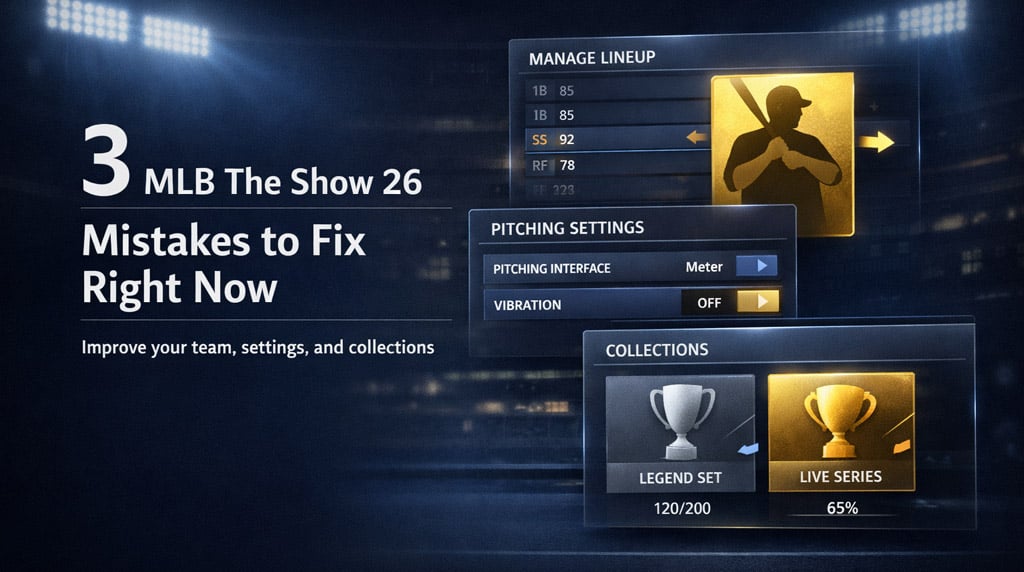
We've seen this over and over on mid-level accounts. A roster can look decent on paper, but if the rotation is weak, the bullpen is predictable, and the collections are all over the place, the account ends up playing below its real potential.
- 1. Fix Your Team Building First
- What to stop doing
- What to do instead
- 2. Fix Your Settings Before You Queue Again
- Settings that help immediately
- 3. Stop Splitting Your Stubs Across Too Many Collections
- The problem with scattered collections
- A better collection plan
- Quick Fix Checklist
- FAQ
- What should I fix first in MLB The Show 26?
- Is Pinpoint really better than Pulse?
- Do I need a lot of stubs to improve my team?
- Should I lock in cards early for collections?
- Final Takeaway
These are the three areas we should fix first if we want better results without wasting time or MLB 26 stubs.
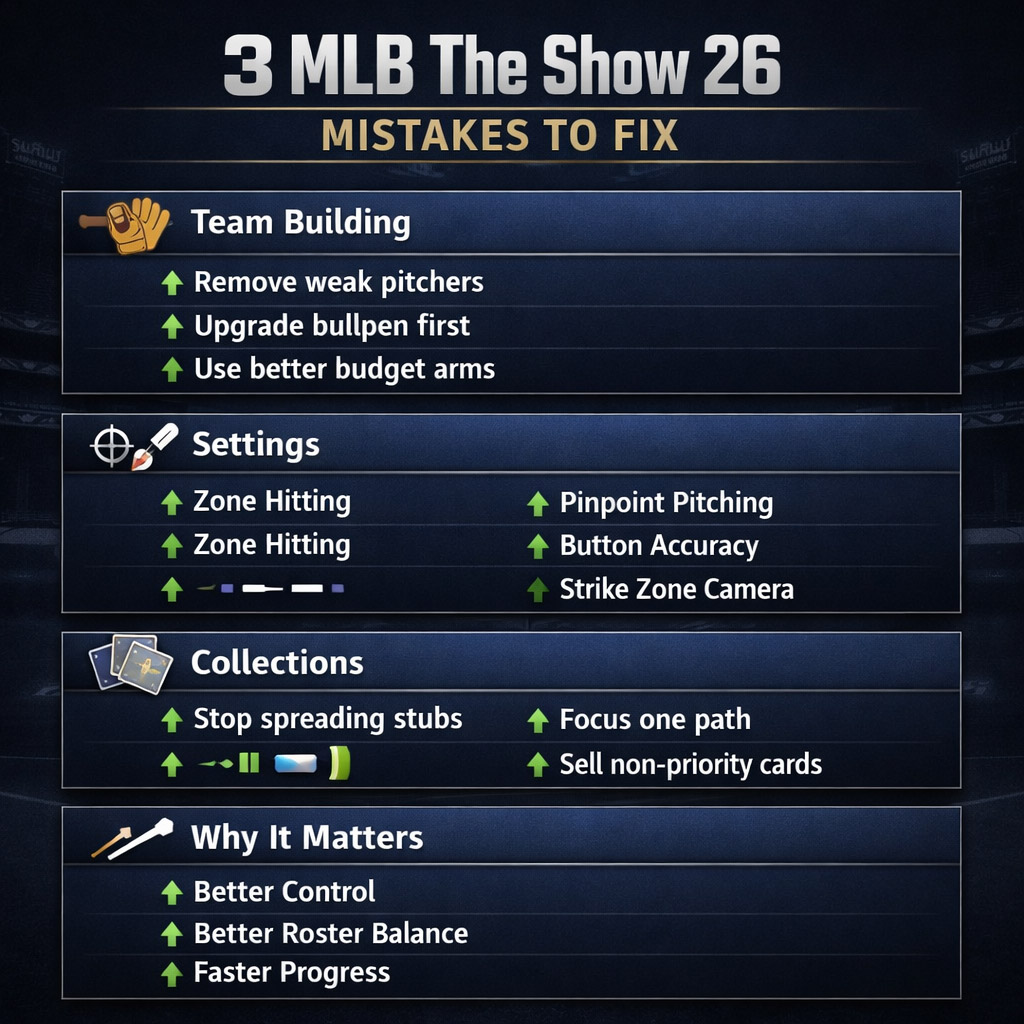
1. Fix Your Team Building First
This is the biggest gameplay issue for most players.
A lot of hitters are usable if you like their swing. Pitchers are different. If you're using starters with weak stuff or relievers with easy-to-read pitch mixes, better opponents will punish that quickly.
What to stop doing
| Problem | Why It Hurts |
|---|---|
| Using weak ranked pitchers | They get hit hard once players see them a few times |
| Keeping 3-pitch relievers | Easier for opponents to sit on one speed |
| Prioritizing favorites over fit | Makes the team less balanced |
What to do instead
| Focus Area | Better Approach |
|---|---|
| Rotation | Use pitchers with better control, deception, and pitch mix |
| Bullpen | Add relievers with stronger speed differential and movement |
| Defense | Use flexible players who still hold up in the field |
| Budget upgrades | Spend stubs where the gameplay impact is highest |
From experience, this is where smaller budget upgrades make the biggest difference. A smart 30k to 40k stub adjustment can improve a team far more than randomly buying one flashy bat.
2. Fix Your Settings Before You Queue Again
This is the easiest upgrade in the game because it costs nothing.
If your settings are working against you, even a good roster won't feel good. The most common problem is still players using control schemes that lower precision instead of improving it.
Settings that help immediately
| Setting | Best Option | Why It Matters |
|---|---|---|
| Hitting | Zone | Most control on swing placement |
| Pitching | Pinpoint | Better accuracy and pitch control |
| Throwing | Button Accuracy | More reliable defense |
| Throw Cancel | On | Lets you stop bad throws |
| Hitting Camera | Strike Zone / Strike Zone High / Strike Zone 2 | Better pitch recognition |
| Vibration | Off | Less distraction |
If you're still on Pulse pitching, that's a real problem. It may feel easier at first, but the loss of control shows up fast online. Pinpoint has a learning curve, but it is absolutely worth it if you want to play better consistently.
A simple rule: if you find that your pitches keep leaking over the plate or your defense feels random, your settings probably need work before your stick skills do.
3. Stop Splitting Your Stubs Across Too Many Collections
This is one of the most common account-management mistakes in MLB The Show 26.
A lot of players lock in random cards across Live Series, Legends, and program collections at the same time. It feels like progress, but usually it just traps stubs and delays useful rewards.
The problem with scattered collections
| Approach | Result |
|---|---|
| Partial progress everywhere | Slow rewards, low flexibility |
| Locking in random sellable cards | Stubs get stuck |
| Chasing multiple paths at once | Harder to finish anything meaningful |
A better collection plan
| If you want... | Then do this |
|---|---|
| Faster major rewards | Focus one division or one league at a time |
| More stub flexibility | Sell cards not tied to your current goal |
| Better roster progress | Finish one path before starting another |
This matters because timing matters. A reward that feels strong now may feel average in two or three weeks. If you spread your progress too thin, you often unlock cards after they've already lost a lot of value.
In practice, we should pick a lane. If we're chasing AL Live Series, commit to that. If we want NL rewards, sell cards that don't support that plan. The more focused the account is, the faster it improves.
Quick Fix Checklist
If you want the short version, start here:
| Priority | Action |
|---|---|
| 1 | Replace weak starters and relievers |
| 2 | Switch to Pinpoint and Button Accuracy |
| 3 | Use a better hitting camera |
| 4 | Stop locking in random collection cards |
| 5 | Focus your stubs on one clear goal |
These are simple fixes, but they have real impact. That's why they matter.
FAQ
What should I fix first in MLB The Show 26?
Start with settings, because they're free. After that, fix your pitching staff, then clean up your collections.
Is Pinpoint really better than Pulse?
Yes. Pinpoint gives you far more control, especially in ranked play.
Do I need a lot of stubs to improve my team?
No. Smarter spending usually matters more than bigger spending.
Should I lock in cards early for collections?
Only if that collection is your current priority. If not, keeping cards sellable gives you more flexibility.
Final Takeaway
If MLB The Show 26 feels harder than it should, the issue may not be your reactions. More often, it's the structure of the account.
A better pitching staff gives you a real chance to compete.
Better settings give you cleaner control.
Smarter collections keep your stubs moving in the right direction.
Fix those three things first, and the game usually starts to feel a lot more manageable—and a lot more fun.

Most Popular Posts
- MLB The Show 26 God Squad Guide: Best Lineup, 98 Tarik Skubal, Bullpen Picks, and Legend Tips
- MLB The Show 26 Tier List: Best Diamond Dynasty Cards by Position
- MLB The Show 26 Hall of Fame Guide: 99 Hoffman, Best Spotlights & Chase Pack Value
- MLB The Show 26 Top 20 Endgame Cards Ranked for New Seasons
- MLB The Show 26 New Threads 2.0 Tier List Guide: Best Cards, Budget Picks, and Meta Fits
- MLB The Show 26 New 99 OVR Tier List: Best Cards Ranked
Popular Category Lists
- ARC Raiders / (354)
- Grow a Garden / (294)
- CoD: Black Ops 7 / (167)
- Star Citizen / (163)
- MLB 26 / (159)
- Monopoly Go / (153)
- ARK Survival Ascended / (128)
- Steal a Brainrot / (99)
- Blox Fruits / (74)
- Adopt Me / (74)
- Forza Horizon 6 / (72)
- Sailor Piece / (68)
- Grow a Garden 2 / (68)
- Diablo IV / (62)
- CoD: BLACK OPS 6 / (55)
- Aion 2 / (52)
- Path of Exile 2 / (48)
- Monster Hunter Wilds / (46)
- Windrose / (44)
- Maplestory Classic / (42)