


 0
0 Created: Sep 27,2026 | Star Citizen
Star Citizen Best Quantum Drives: S1 to S3 Speed & Route Matrix

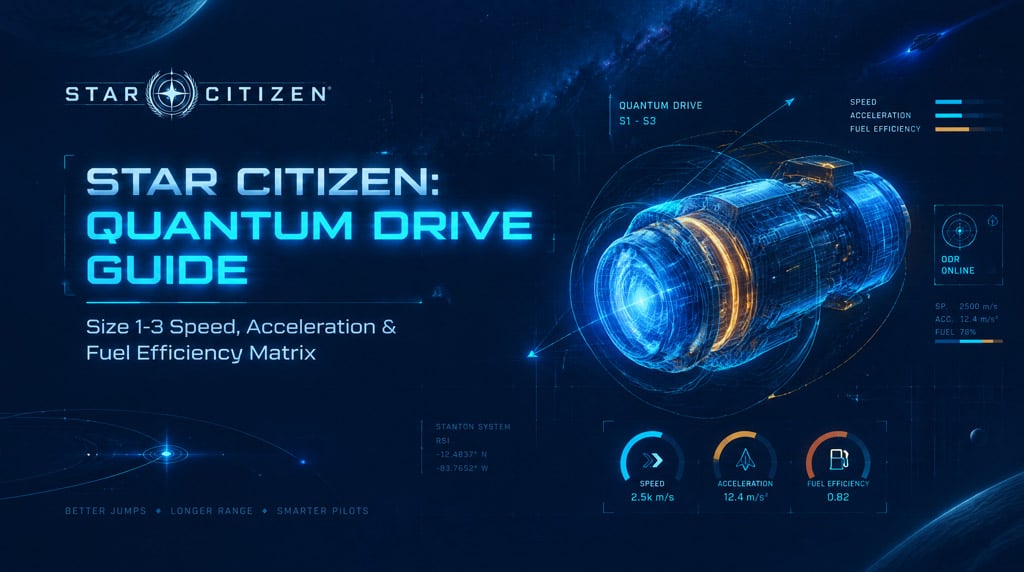
Raw top speed is a trap in quantum drive selection: fitting the highest Mm/s drive often slows down multi-hop runs and leaves ships stranded mid-system. True travel efficiency comes down to acceleration ramp rates, stage cooldowns, and avoiding the 5-to-10-minute turnaround penalty of a detour to a rest stop.
- Quantum Drive Mechanics: Acceleration vs. Top Speed
- Field Decision Matrix: Size 1 to Size 3 Breakdown
- Size 1: Atlas vs. Foxfire
- Size 2: Hemera vs. Sunfire
- Size 3: Erebus vs. TS-II and Agni
- When Are Crafted Drives Worth the Investment?
- Mission Range and Fuel Reserves
- FAQ (Frequently Asked Questions)
- What is the fastest stock quantum drive in each size?
- Why is Atlas preferred over Foxfire for everyday Size 1 travel?
- Does a higher quantum top speed always mean shorter travel times?
- How does fuel consumption change between military and civilian drives?
- When should a quantum drive upgrade be prioritized over shield or cooler upgrades?
Quantum Drive Mechanics: Acceleration vs. Top Speed
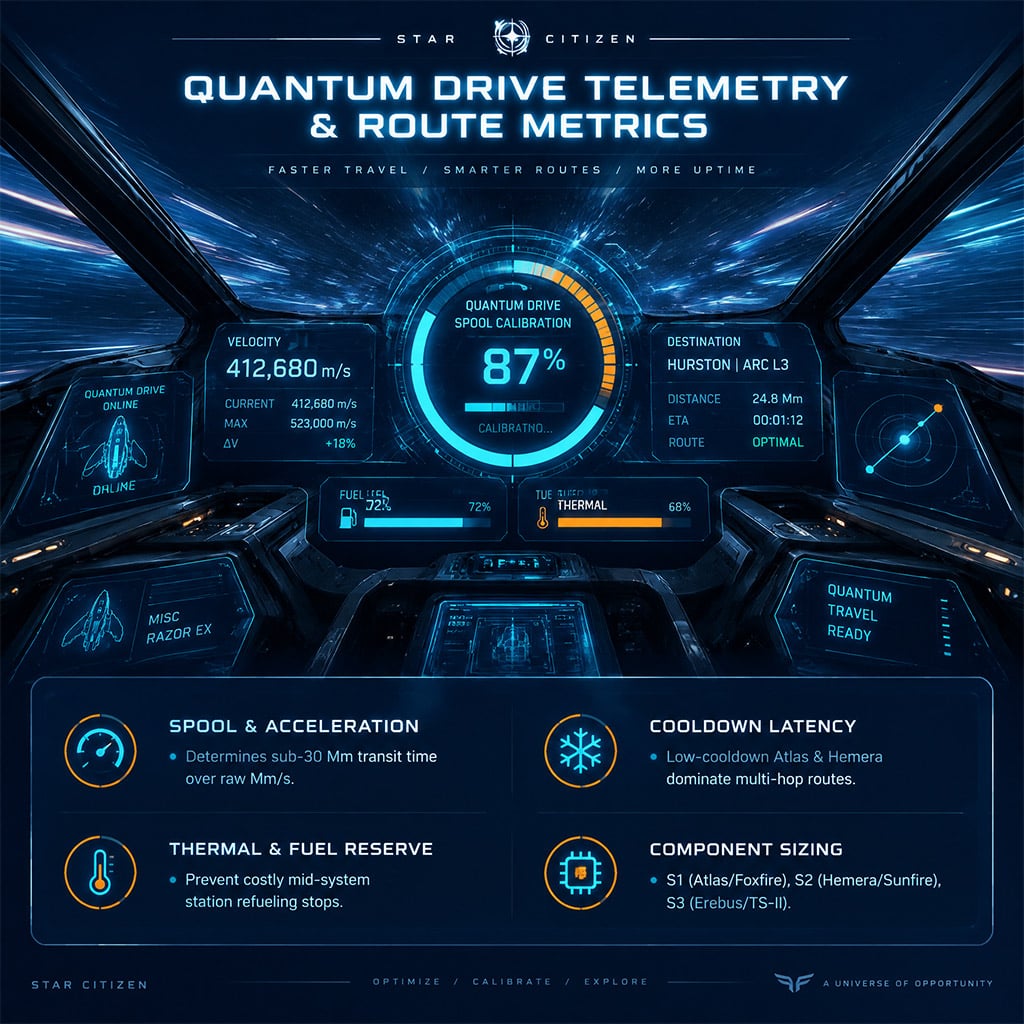
Quantum travel operates in two distinct phases: the acceleration ramp and max-velocity cruise. Drives rarely hit terminal velocity on jumps shorter than 20 to 30 million kilometers.
- Acceleration Curves Matter More on Local Hops: A drive with aggressive stage-one acceleration covers planet-to-moon distances faster than a drive with a higher top-end velocity that takes two minutes to spool and ramp up.
- Cooldown Limits Route Cycling: High-frequency traders and bounty hunters chaining multiple local jumps lose substantial time to cooldown cycles. Drives with low cooldowns turn around far quicker.
- Fuel Reserves Determine Real-World Time: Calculating pure transit time ignores fuel stops. Forcing an unneeded docking and refueling cycle instantly adds 5 to 8 minutes to total delivery time.
| Size | Primary Fit (Balanced/Everyday) | Max Speed Pick (Single Long Run) | Endurance/Eco Fit (Deep System Range) | Primary Trade-off |
|---|---|---|---|---|
| Size 1 | Atlas (259 Mm/s, 7.6s cooldown) | Foxfire (263 Mm/s, 11.9s cooldown) | Spectre (High fuel efficiency) | Atlas accelerates instantly on short legs; Foxfire edges ahead only past 35 Mm. |
| Size 2 | Hemera (326 Mm/s, 9.5s cooldown) | Sunfire (342 Mm/s, 14.9s cooldown) | Spicule / XL1 (Durability / Spool balance) | Hemera cuts turnaround latency; Sunfire sacrifices thermal overhead and cooldown speed. |
| Size 3 | Erebus (629 Mm/s, 12.6s cooldown) | Erebus (Top listed velocity) | Agni / TS-II (Heavy industrial economy) | Erebus demands deep fuel tanks; TS-II clears planet-to-lagrange hops faster due to ramp-up profiles. |
Field Decision Matrix: Size 1 to Size 3 Breakdown
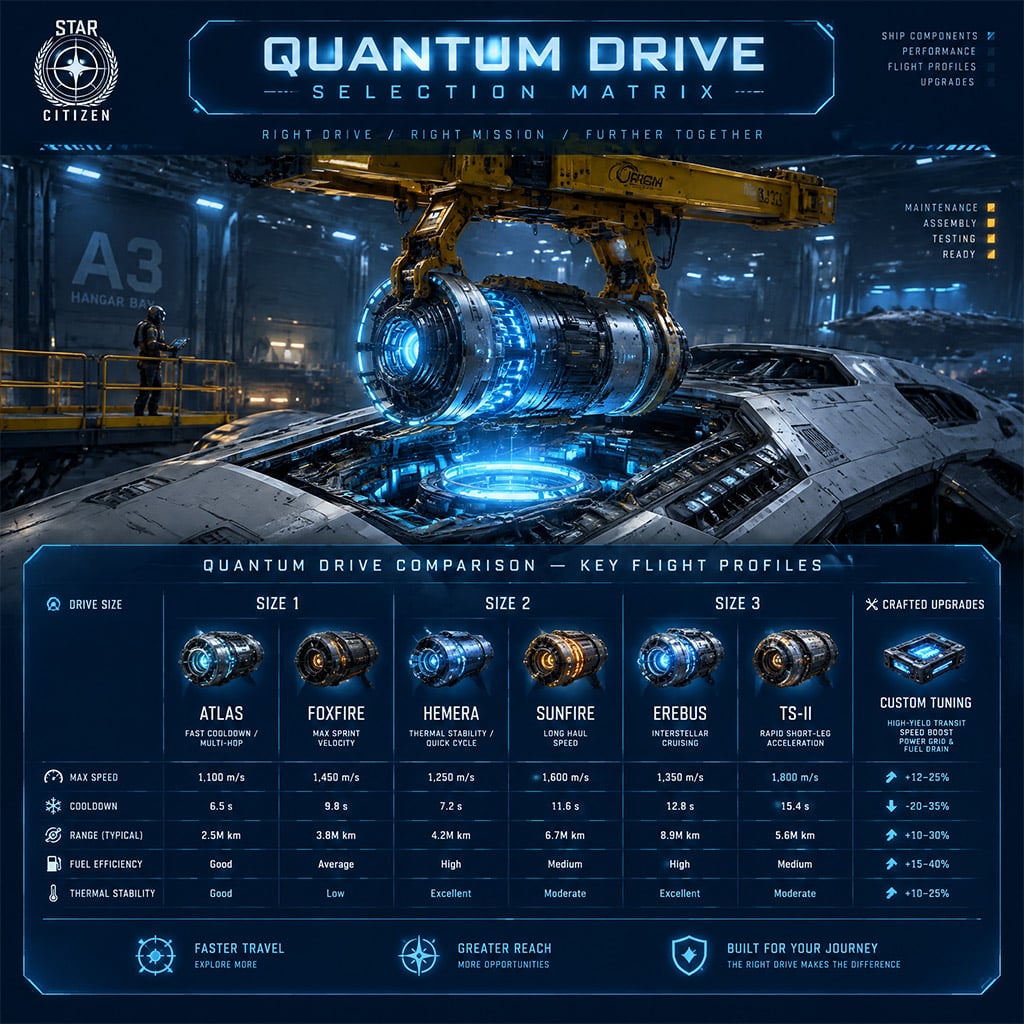
Size 1: Atlas vs. Foxfire
For light fighters, interceptors, and small couriers, Atlas remains the standard across major operational profiles. Foxfire delivers a marginal top-speed bump—logging roughly 2 to 9 seconds of savings across intermediate and long system runs.
Atlas gains back that lead whenever a route demands chained short hops. Foxfire's 11.9-second cooldown creates a 4.3-second latency penalty per hop. On multi-leg trade routes or distributed bounty chains, Atlas delivers a faster total turnaround while preserving better power stability.
Size 2: Hemera vs. Sunfire
Medium ships demand a balance between thermal efficiency and fuel consumption. Sunfire posts faster benchmark times across uninterrupted system-wide transits, but Hemera provides a decisive 9.5-second cooldown alongside lower heat draw.
If operating haulers or gunships across hot zones, Sunfire risks mid-jump thermal shutdowns under sustained strain unless supported by upgraded military-grade coolers. Hemera absorbs power-grid instability better and cycles faster between navigational waypoints.
Size 3: Erebus vs. TS-II and Agni
Size 3 drives define heavy transport runs. While Erebus reaches 629 Mm/s, empirical testing on short, direct hops places the stock TS-II ahead by roughly 17 seconds (2:39 vs. 2:56).
The TS-II features a steeper initial ramp curve, reaching its maximum effective operational profile before Erebus completes its stage-one build-up. Reserve Erebus for major cross-system hauling runs. For sub-capital ships moving within planetary clusters, TS-II or Agni offer more practical flight times and lower fuel burn.
When Are Crafted Drives Worth the Investment?
Crafting custom quantum drives changes component optimization by uncapping baseline limits, but raw material costs must be weighed against practical utility.
| Size | Max-Crafted Profile | Stock Baseline Comparison | Short Leg Difference | Long Transit Difference |
|---|---|---|---|---|
| Size 1 | Colossus (Crafted) | Foxfire (Stock) | -10s (2:12 vs 2:22) | -45s (8:14 vs 8:59) |
| Size 2 | Hurricane (Crafted) | Sunfire (Stock) | -5s (2:15 vs 2:20) | -33s (7:03 vs 7:36) |
| Size 3 | Agni (Crafted) | Erebus (Stock) | -7s (2:49 vs 2:56) | -18s (5:40 vs 5:58) |
Crafted drives reward specialized operations:
- Craft for Cross-System Haulers: High-tier crafted variants shave 30 to 45 seconds off full-length transit corridors, saving critical time over repeat multi-hour logistics sessions.
- Do Not Craft for Interceptor Patrols: Spending rare, high-purity resources solely to trim 5 seconds off an occasional moon-to-station hop offers zero operational return.
- Account for Power Surges: Handcrafted upgrades frequently boost drive draw. Pair high-spec crafted drives with low-latency power plants to prevent tripping shields during simultaneous engine spooling.
Mission Range and Fuel Reserves
A drive's listed theoretical transit time means nothing if its burn rate forces a refueling stop. Always keep these core rules in mind:
1. Calculate the Full Operational Loop: Confirm that round-trip routes can be completed on a single tank. A drive that arrives two minutes faster but requires an eight-minute station approach, docking sequence, and pad refueling costs net time.
2. Apply the 15% Reserve Margin: Interdictions, quantum dampening traps, and dogfights demand reserve quantum fuel. Burning down to empty leaves ships vulnerable to pirates and navigation stalls.
3. Verify Hull Tank Capacities: Recent vehicle rebalancing altered baseline quantum tank capacities across numerous hulls. Never copy loadouts across different chassis without checking current fuel limits in the mobiGlas loadout manager.
FAQ (Frequently Asked Questions)
What is the fastest stock quantum drive in each size?
Foxfire claims the highest listed cruising velocity for Size 1, Sunfire leads Size 2, and Erebus sits at the top for Size 3. However, listed cruising speeds only reflect sustained straight-line flight, not total elapsed time on short jumps where acceleration and spool rates dominate.
Why is Atlas preferred over Foxfire for everyday Size 1 travel?
Atlas features a 7.6-second cooldown compared to Foxfire's 11.9 seconds, making it vastly superior for multi-hop routes across planetary clusters. Foxfire only provides a marginal lead on isolated, direct jumps exceeding 30 million kilometers.
Does a higher quantum top speed always mean shorter travel times?
No. Drives spend significant time spooling and accelerating through Stage 1 before achieving maximum cruise velocity. On short legs, high-acceleration components like the TS-II reach peak efficiency faster and beat out drives with higher listed speeds like the Erebus.
How does fuel consumption change between military and civilian drives?
Military drives offer unmatched spool rates and acceleration curves but burn fuel rapidly, often cutting operational range by more than half compared to civilian options. Civilian and industrial drives prioritize fuel efficiency and stable thermal envelopes over raw sprint performance.
When should a quantum drive upgrade be prioritized over shield or cooler upgrades?
Upgrade your quantum drive first if ship operations center on freight hauling, data transport, or long-range mission chains where route speed governs income per hour. If operating combat-focused patrol craft, upgrade power plants and coolers first to prevent component cutouts while spooling under fire.

I’m Benjamin Walsh, an Australian Senior Copy Editor at GGWTB focused on survival crafting, open-world exploration, and extraction games. My guides weigh base locations, supply routes, and what deserves the last slot in your backpack. When editing, I look for skipped prerequisites and unclear directions—a useful guide shouldn’t send you across the map without the right tools.

Most Popular Posts
- Star Citizen 4.9 Ship Buying Guide: What to Buy, Skip, and Prioritize
- Star Citizen 4.9 Salvage Guide: Easy AUEC from Battaglia Ship in Distress + Golem Module Fix
- Star Citizen 4.9 Battaglia Contracts, Persistence Fixes, Best Loot, Scanning Changes, and Ship Rewards
- Star Citizen 4.9 Hull C Cargo Hauling Guide: Make Millions aUEC Without Autoload
- Star Citizen 4.9 Alleso Money Guide: Best Pyro Trade Route for Fast aUEC
- Star Citizen 4.9 NDB-30 Farming Guide: Free S3 Weapon Loot Loop
Popular Category Lists
- ARC Raiders / (351)
- Grow a Garden / (294)
- CoD: Black Ops 7 / (167)
- Star Citizen / (162)
- MLB 26 / (159)
- Monopoly Go / (152)
- ARK Survival Ascended / (128)
- Steal a Brainrot / (99)
- Blox Fruits / (74)
- Adopt Me / (74)
- Forza Horizon 6 / (72)
- Sailor Piece / (68)
- Grow a Garden 2 / (68)
- Diablo IV / (62)
- CoD: BLACK OPS 6 / (55)
- Aion 2 / (50)
- Path of Exile 2 / (48)
- Monster Hunter Wilds / (46)
- Windrose / (44)
- Donut SMP / (41)