


 0
0 Created: Dec 19,2025 | Grow a Garden
Why More and More People Becoming Disillusioned With Grow a Garden?

I've played a lot of live-service Roblox games where updates are supposed to feel like weekends at an amusement park: loud, chaotic, rewarding, and worth logging in early. Lately, Grow a Garden updates feel more like standing in line—then being told the best ride has a 2% chance to start every 10 minutes.
That vibe shift is why so many players are getting disappointed. It's not just one bad update. It's a pattern: weaker live moments, heavier timers, grind stacked on grind, and monetization that shows up exactly where the friction hurts most. Here's a structured breakdown of what's driving the frustration, what it means for the game's future, and what changes would actually move the needle.
- 1) The Mood Changed: From Live Event to Low-Energy Waiting Room
- 1.1 The admin abuse experience feels inconsistent (and often underwhelming)
- 1.2 Player sentiment is already telling you what's wrong
- 2) The Numbers Don't Lie: Update Peaks Are Shrinking Fast
- 2.1 Peak drop example: 1.6M → 860K
- 2.2 Why peak concurrency matters more than average players
- 3) Timers + Low Odds = AFK Simulator
- 3.1 The 10-minute gift cooldown is a pacing killer
- 3.2 The 2% rainbow gift problem: low probability + low volume
- 3.3 Stacking waits on top of waits (cooldown → hatch → growth)
- 4) Grind Is Fine—But Only If the Reward Is Worth It
- 4.1 The reindeer → Rudolph ritual is cool design with risky tuning
- 4.2 Inventory limits turn rewards into stress
- 5) Monetization Is Showing Up Where the Pain Is
- 5.1 Restocks, skips, streak recovery: the pay to unbreak feeling
- 5.2 Streak design is emotionally punishing
- 6) What I'd Change (Fast), If I Were Tuning the Next Two Updates
- 6.1 High-impact changes that don't break the economy
- 6.2 A better philosophy: Let me play longer, not wait longer
- FAQ
- 1) Is the game dying or just fluctuating?
- 2) Why do players care so much about admin abuses?
- 3) Aren't timers necessary to prevent people from finishing content too fast?
- 4) Is grind always bad?
- 5) What's the one change that would improve sentiment the fastest?
- Closing Thoughts
1) The Mood Changed: From Live Event to Low-Energy Waiting Room
The fastest way to lose a live-service audience is to make the big communal moments feel skippable.
1.1 The admin abuse experience feels inconsistent (and often underwhelming)
From my own time showing up for these sessions, the gap between what players expect and what happens has widened. When the first half of a session is slow—few events, lots of dead air, minimal wow moments—players don't think they're balancing it. They think this is a waste of time.
And here's the key:players don't judge admin events like a patch note. They judge them like a concert. If the opener is weak, you don't stick around for the headliner.
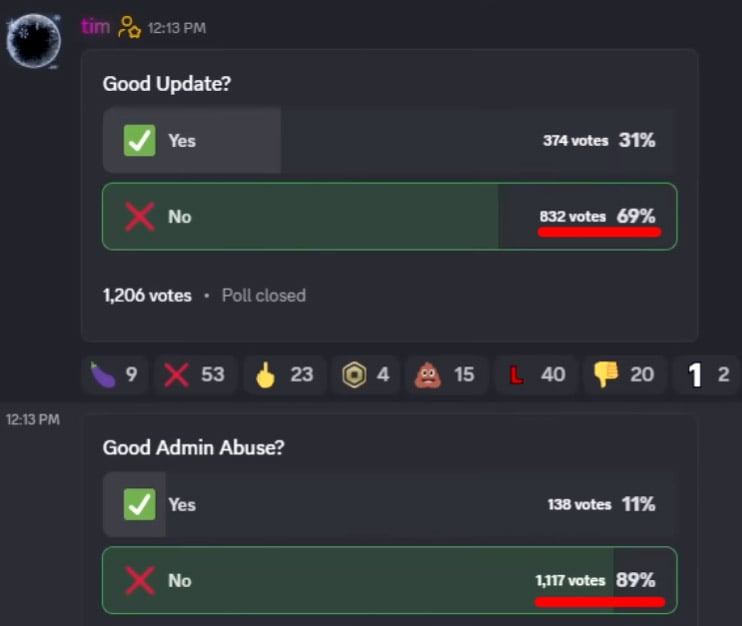
1.2 Player sentiment is already telling you what's wrong
Polls floating around the community consistently show low approval for admin abuse quality. When only a small minority says the admin event is good, that's not haters. That's product feedback.
What this means: the game's most social, most watchable moments—the ones that create clips, hype, and returning habits—aren't reliably delivering.
2) The Numbers Don't Lie: Update Peaks Are Shrinking Fast
A lot of games fluctuate. But when the update-weekend peak drops this hard, it's usually signaling a trust problem.
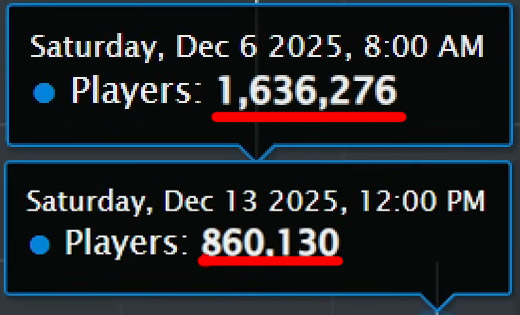
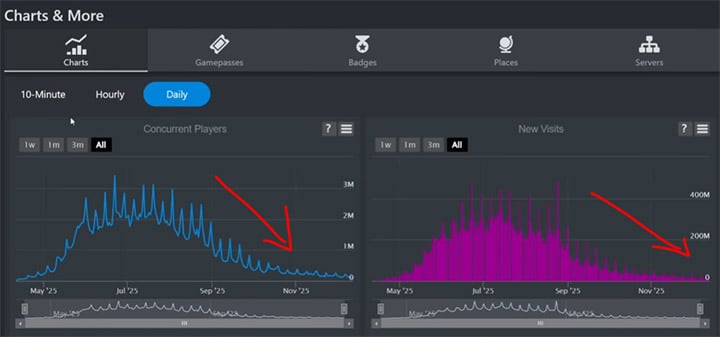
2.1 Peak drop example: 1.6M → 860K
Recent update peaks show a sharp decline:
- One weekend peak: ~1.6 million
- Next comparable peak: ~860,000 (nearly half)
That's not a minor dip. That's a people didn't bother to show up signal.
2.2 Why peak concurrency matters more than average players
Peak tells you whether your update is an event. Average tells you whether your game is a habit. When peaks shrink, creators cover you less, friends stop coordinating, and even good features land with less energy because fewer people are there to experience them together.
Here's a clean snapshot of the pattern players are feeling:
| Metric / Signal | What players see | What it usually indicates |
|---|---|---|
| Weekend peak nearly halved (e.g., 1.6M → 860K) | Update isn't worth it | Hype + trust erosion |
| Low admin event approval | It's boring now | Live content not delivering |
| More timers + low odds rewards | It's an AFK chore | Progress throttling replacing play |
3) Timers + Low Odds = AFK Simulator
The biggest design complaint isn't that rewards exist. It's that rewards are locked behind waiting, and then still rely on harsh RNG.
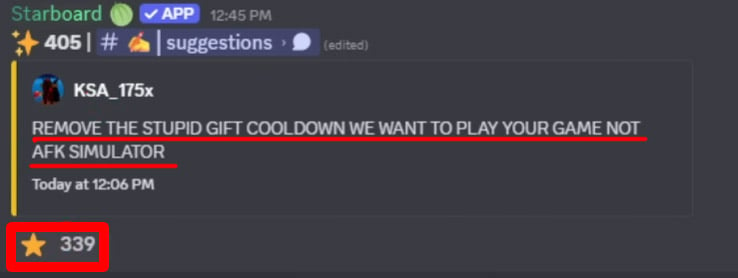
3.1 The 10-minute gift cooldown is a pacing killer
A 10-minute cooldown for a core event interaction creates a loop like this:
- Log in
- Click the thing
- Wait
- Repeat
- Hope you roll something good
If you notice your play session turns into setting a timer, then the game has shifted from gardening to checking in. And if you're busy, you'll simply stop checking in.
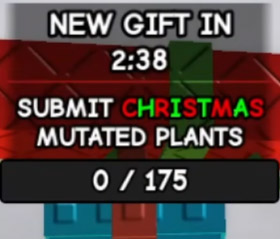
3.2 The 2% rainbow gift problem: low probability + low volume
A 2% high-tier reward rate can be fine in a fast loop. But here, the loop is slow: you only get a small number of attempts per hour because of the cooldown.
So the real experience becomes: I waited a long time to lose a coin flip I barely got to flip.
What this means: frustration isn't coming from losing RNG—it's coming from losing RNG slowly.
3.3 Stacking waits on top of waits (cooldown → hatch → growth)
Even when you do get the right egg/gift:
- you waited for the cooldown,
- then you hatch (RNG again),
- then you wait hours for pet results/progression (another delay).
If you find yourself thinking I finally got it, and now I'm gated again, that's the exact moment many players mentally unsubscribe.
4) Grind Is Fine—But Only If the Reward Is Worth It
I'm not anti-grind. I've maxed pets, chased limited-time mutations, and done the whole one more run routine. The issue is grind-to-reward ratio, especially when rewards get nerfed after players commit.
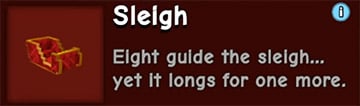
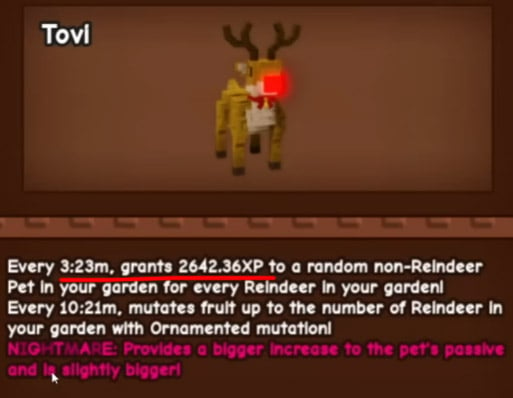
4.1 The reindeer → Rudolph ritual is cool design with risky tuning
Requiring eight level-100 reindeer to unlock a special pet is a strong aspirational goal. It gives the event identity.
But here's the catch: if the resulting pet gets nerfed hard, players feel like they grinded for a moving target.
- If you discover a major reward was reduced after you invested time, then you don't just lose power—you lose confidence in future goals.
- And if you lose confidence, you stop grinding, because the game no longer feels like a fair contract.
4.2 Inventory limits turn rewards into stress
Nothing kills I got something! faster than Your inventory is full.
Inventory pressure is a silent frustration multiplier:
- you're already dealing with cooldowns,
- you're already dealing with RNG,
- then the game blocks the payoff with space limits.
That's not difficulty. That's paperwork.
5) Monetization Is Showing Up Where the Pain Is
Most players can tolerate monetization when it sells convenience or cosmetics. It feels different when monetization sells relief from problems the design created.
5.1 Restocks, skips, streak recovery: the pay to unbreak feeling
When systems shift from:
Play to progress to Pay to skip friction
players interpret it as the game manufacturing friction.
Examples players repeatedly call out:
- Paid restocks
- Paid quest skips
- Paid repeat actions
- Paid streak recovery (especially brutal in time-limited events)
5.2 Streak design is emotionally punishing
A streak-based reward (like the gingerbread blossom path) can drive retention—until real life happens.
If you miss a day and your path is effectively dead unless you pay, then the game turns your schedule into a monetization surface.
What this means: players don't feel motivated. They feel held hostage, and they either pay resentfully or quit cleanly.
6) What I'd Change (Fast), If I Were Tuning the Next Two Updates
This is the part that matters: not just complaints, but fixes that preserve progression while bringing back fun.
6.1 High-impact changes that don't break the economy
| Problem | Player experience | Practical fix | Why it helps immediately |
|---|---|---|---|
| 10-minute gift cooldown | AFK simulator | Reduce to 1–2 minutes, or allow banking (store up to N claims) | Keeps engagement without flooding rewards |
| 2% top-tier reward with low attempts | I never see the good stuff | Add pity (e.g., guarantee after X opens) or token fragments toward a choice | Converts despair RNG into progress RNG |
| Admin events feel low-energy early | Not worth joining on time | Script a minimum event cadence (e.g., every 2–3 minutes), with a visible schedule | Makes the session feel alive and clip-worthy |
| Inventory is constantly full | Rewards become chores | Add event-based capacity quests + cheap upgrades | Removes friction where excitement should be |
| Streak loss forces payment | Miss a day = doomed | Add free streak shields (earned weekly), or a grace day | Protects retention without undermining monetization |
6.2 A better philosophy: Let me play longer, not wait longer
If you notice your best systems require players to not play (wait, AFK, check timers), then the game is competing against literally everything else on the internet—and losing.
But if you let players play at their own pace (even if rewards are capped intelligently), they'll create the content, hype, and momentum you can't buy.
FAQ
1) Is the game dying or just fluctuating?
It's not dead. But when update peaks drop sharply (example: ~1.6M → ~860K), that's more than normal variance. That's a warning that updates aren't pulling lapsed players back in.
2) Why do players care so much about admin abuses?
Because admin events are community anchors: they're when friends show up together, creators clip moments, and the game feels alive. If that moment is boring, the update feels smaller—even if the patch technically adds content.
3) Aren't timers necessary to prevent people from finishing content too fast?
Some timers are fine. The issue is long timers paired with low odds. If attempts are scarce and the best reward is rare, players feel blocked rather than paced.
4) Is grind always bad?
No. Grind works when:
- the reward is stable (not heavily nerfed after investment),
- progress is visible,
- and time spent feels like play, not waiting.
5) What's the one change that would improve sentiment the fastest?
Fix pacing: reduce the 10-minute cooldown (or add banking), and guarantee progress via pity/fragments. That single move turns AFK frustration into active progression.
Closing Thoughts
People aren't disappointed because they hate Grow a Garden. They're disappointed because they've seen how fun it can be when updates feel like events, rewards feel reachable, and time spent feels respected.
Right now, the game's friction points—slow cooldown loops, stacked RNG, inventory pressure, streak punishment, and monetization tied to relief—are louder than the magic. If you're a player, the moment you notice you're logging in to wait instead of logging in to play, that's your cue: the design has drifted. If you're a developer, that same moment is the best diagnostic tool you'll ever get, because it tells you exactly where the fun leaked out.
Most Popular Posts
- Grow a Garden Secret Badge Walkthrough: Carrot Weight & Puzzle Guide
- Grow a Garden Get Secret Seeds & Rare Pets Guides: DLC Codes + Trading Guide
- Grow a Garden Enfield Guide: Everfallen Roll Rules & Level Loss
- Grow a Garden Moon Harvest Part 4 Guide: Gear Odds, Reset Rewards, Cornling Strategy, New Seeds
- Grow a Garden: Beanpod Chest Farming and Elder Beanstalk Guides
- Grow a Garden Arctic Fox Guide: Best AFK Setup for Seeds, Gears, Eggs & Pet XP
Popular Category Lists
- ARC Raiders / (354)
- Grow a Garden / (294)
- CoD: Black Ops 7 / (167)
- Star Citizen / (163)
- MLB 26 / (159)
- Monopoly Go / (153)
- ARK Survival Ascended / (128)
- Steal a Brainrot / (99)
- Blox Fruits / (74)
- Adopt Me / (74)
- Forza Horizon 6 / (72)
- Sailor Piece / (68)
- Grow a Garden 2 / (68)
- Diablo IV / (62)
- CoD: BLACK OPS 6 / (55)
- Aion 2 / (53)
- Path of Exile 2 / (48)
- Monster Hunter Wilds / (46)
- Windrose / (44)
- COD: Modern Warfare 4 / (43)