



 0
0 Created: Oct 16,2026 | WoW Forever
WoW Forever Gold Guide: Leveling Income, Add-Ons, Farm Tests & Crafting Profit

To make gold in WoW Forever, start with income you can collect while leveling, then test whether a dedicated farm or craft actually pays more. Use the decisions and calculations below to protect essential spending, separate sold loot from speculative value, and reject losing conversions.

This is a decision and accounting guide, not a tested farm ranking. Blizzard describes profession updates in Forever, so legacy recipes, costs, and farming claims need current-version confirmation.
- Choose an Income Method That Fits Your Character
- Pick Your Next Action
- Protect Essential Spending
- Audit Gathering Routes Before You Rebuild Them
- Test Farms Using Collected Gold, Not Asking Prices
- Record a Repeatable Test
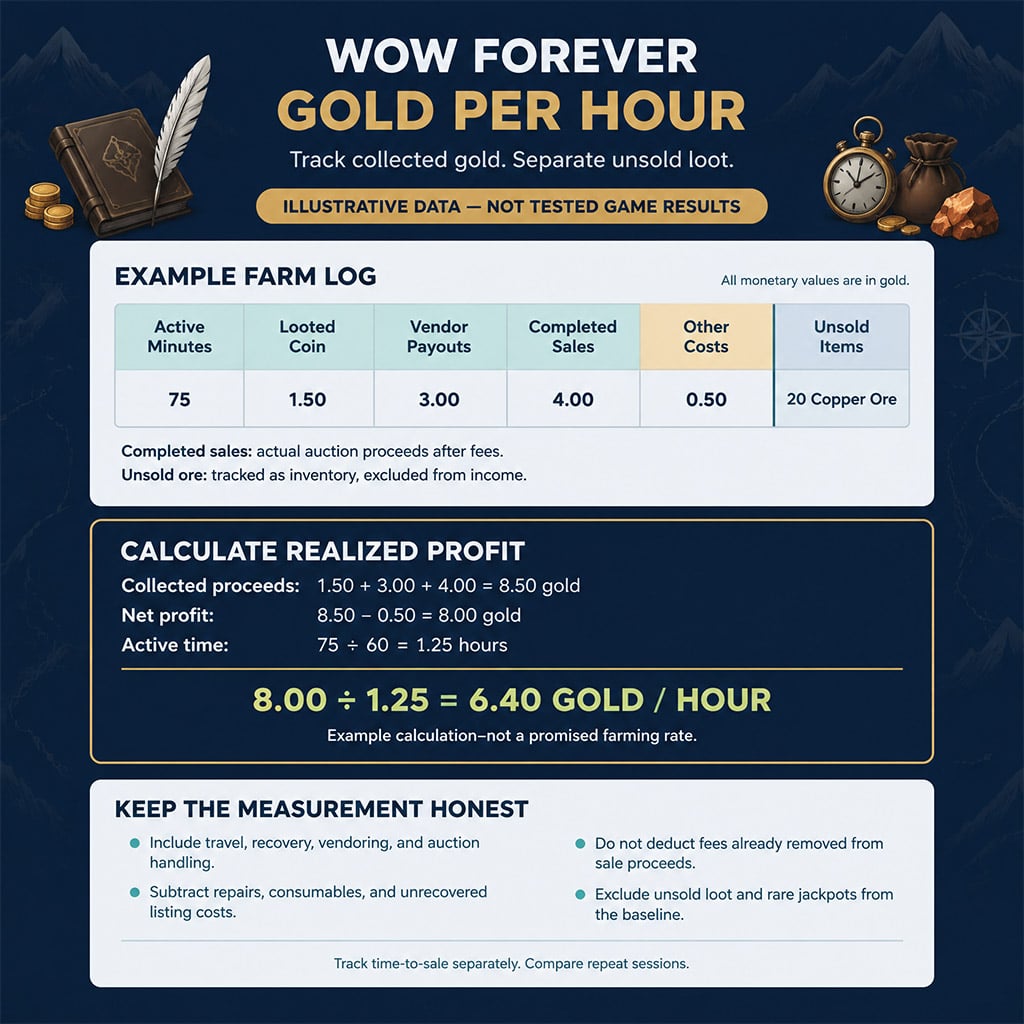
- Calculate Realized Gold per Hour
- Apply Clear Exit Conditions
- Add-Ons: Use Their Routes, Ignore Their Rankings
- Craft Only When Processing Beats Selling the Inputs
- Check Units Before Buying or Smelting
- Test a Vendor Shuffle Before Scaling
- Control Auction and Recipe Risk
- FAQ (Frequently Asked Questions)
- What is the best way to make gold while leveling in WoW Forever?
- How much gold should I reserve for a mount?
- Should I sell copper ore or smelt it into bars?
- How do I calculate gold per hour when auctions sell later?
- How much starting gold do I need for a vendor shuffle?
Choose an Income Method That Fits Your Character
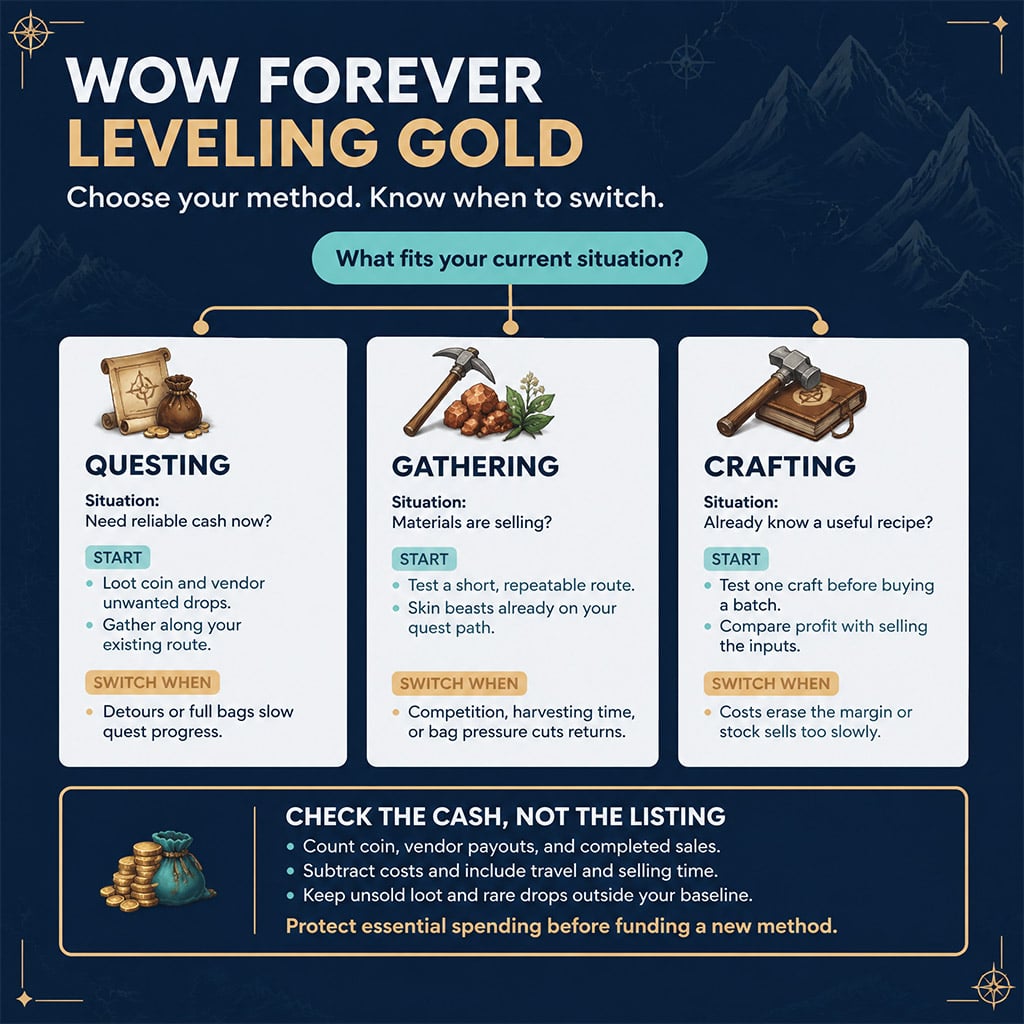
Start with the method that requires the least additional travel and spending. Move to dedicated farming only when your records show that it improves your earnings.
Pick Your Next Action
Use this table before committing to a route or buying materials.
| Your Situation | Start Here | Stop or Switch When |
|---|---|---|
| You are questing and need immediate cash | Loot coin, vendor unwanted drops, and gather along your existing route | Detours or full bags interrupt quest completion |
| You regularly kill skinnable beasts | Test skinning alongside normal questing | Harvesting time and bag pressure outweigh leather proceeds |
| Gathering materials are selling consistently | Test a short, repeatable route | Competition pushes completed-sale income below your questing baseline |
| You already know a relevant recipe | Compare crafting proceeds with selling the inputs | The craft earns less after costs or leaves slow-selling stock |
| You need money for an essential purchase | Favor coin and vendor payouts | The plan depends on a rare drop or unsold auction listings |
A rare pet listing is not a cash balance. Choose predictable proceeds when a purchase deadline matters.
Protect Essential Spending
Set aside the cost of your next essential purchase, plus repairs and consumables. Read current trainer and vendor prices rather than importing a fixed mount budget from another version.
Buy upgrades when they remove a measured bottleneck:
- Weapon or combat upgrade: You spend excessive time killing enemies or recovering between pulls.
- Larger bags: Full inventory repeatedly forces premature town trips.
- Profession training: You can immediately gather useful materials or make a profitable item.
- Temporary gear: The cost is justified by fewer deaths or faster progression—not merely a higher stat total.
For bag replacements, divide purchase price minus actual resale proceeds by the number of added slots. If you cannot recover anything from the old bag, the entire new purchase is your cash cost.
Audit Gathering Routes Before You Rebuild Them
Route guides fail when they reflect a snapshot from one or two characters. Audit the routes you already use, and rebuild only the sections that keep failing.
Run this loop on each route:
1. Log: Record every node position, respawn time, and empty spot on one full pass.
2. Repeat: Walk the same route a second time. A spot that is empty twice is a real gap. A spot that is empty once may just reflect respawn timing.
3. Rebuild: Replace only the sections that failed both passes.
4. Confirm: Check that the shorter route hits the same nodes without manual map checks.
Relocated nodes cost more than low density. A slow node wastes seconds, while an empty stretch wastes an entire loop. A short route you memorize usually beats a denser route you keep correcting.
When not to do this: If you only play a few hours a week, auditing more than one route costs more time than it returns in gold.
Takeaway: Audit the three routes you use most. That returns more gold than mapping the whole zone.
Test Farms Using Collected Gold, Not Asking Prices
A useful farm test includes travel, competition, recovery, vendoring, and auction handling. A timer that measures combat alone overstates the return.
Record a Repeatable Test
Run the same route several times under comparable conditions. Keep these details with each result:
| Record | What to Capture | Why It Matters |
|---|---|---|
| Test conditions | Date, build, realm, character level, class, professions | Makes the result version-specific and repeatable |
| Active time | Travel, farming, recovery, selling, and auction handling | Prevents combat-only hourly claims |
| Guaranteed proceeds | Looted coin and actual vendor payouts | Establishes the cash floor |
| Auction proceeds | Money received from completed sales | Separates demand from optimistic listings |
| Costs and interruptions | Repairs, consumables, lost listing fees, deaths, contested spawns | Reveals whether the route survives normal play |
Keep unsold inventory separate. It may become income later, but it is not earned gold yet.
Calculate Realized Gold per Hour
For a settled batch, use:
Realized Gold per Active Hour = Total Active Minutes/Looted Coin+Vendor Payouts+Completed Auction Proceeds−Other Costs/60
Use auction proceeds after fees and do not deduct the same fee twice. Add any later selling or relisting time to the batch's active minutes.
Report elapsed selling time separately: a batch earning gold after several days is less useful for an immediate purchase than one paying out today.
Apply Clear Exit Conditions
- Crowded gathering route: Compare materials collected per active minute across different sessions before blaming spawn changes.
- Rare-drop farm: Exclude jackpot loot from the baseline. Keep farming only if ordinary drops justify the time.
- Slow-selling materials: Reduce batch size rather than accumulating inventory at an untested asking price.
- Frequent deaths or recovery: Recalculate after changing gear or tactics; otherwise compare with a safer route.
Do not combine results from different builds or substantially different character setups into one headline rate.
Add-Ons: Use Their Routes, Ignore Their Rankings
Add-ons can help you find routes, but their profit features depend on price data. Trust the route lists only after you walk them, and do not act on profit rankings until pricing works.
| Component | Risk | Action |
|---|---|---|
| Route and zone lists | High | Walk each route and log what you find |
| Item and recipe data | Medium | Compare against in-game tooltips |
| Profit rankings | High | Ignore them until price data is reliable |
A profit ranking built on missing prices looks precise but tells you nothing. Keep your own price notes, and use the add-on's route list as a checklist.
Takeaway: Verify every route by walking it, and rely on your own price notes.
Craft Only When Processing Beats Selling the Inputs
Crafting has two separate hurdles: it must cover its costs, and it must beat the alternative use of its materials.
Check Units Before Buying or Smelting
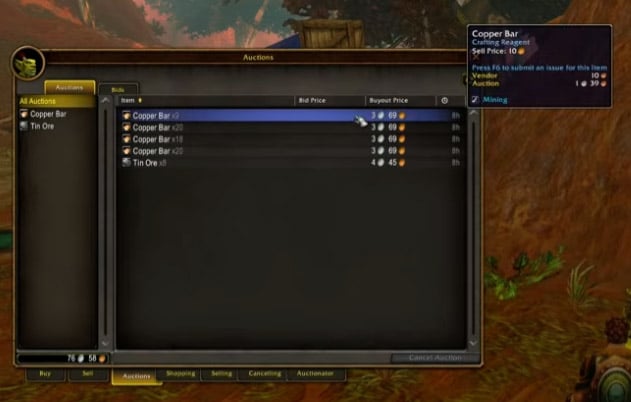
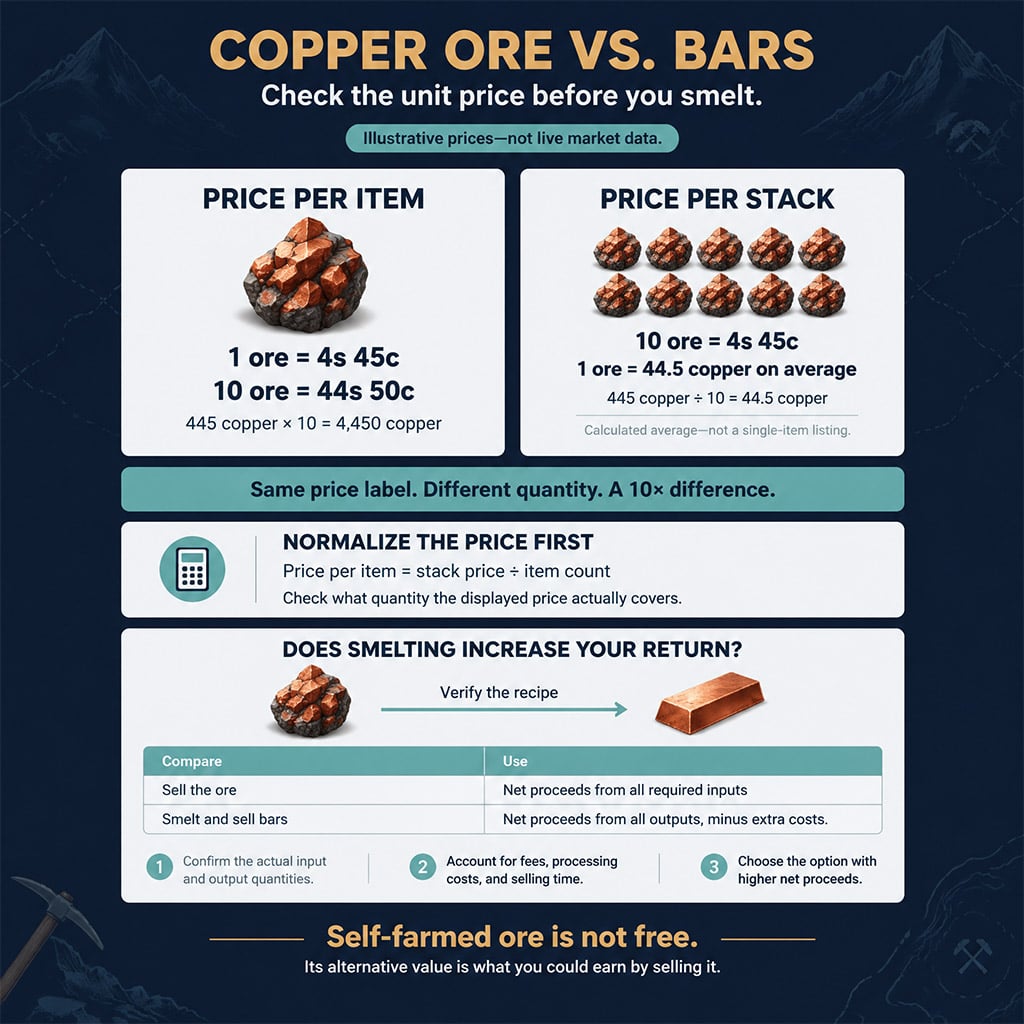
The following figures are arithmetic examples, not current Forever prices or farm results. They show how stack pricing changes the same haul.
| Example | Calculation | Gross Proceeds |
|---|---|---|
| 58 bars at 139 copper each; eight stacks of ore at 445 copper per stack | 58 × 139 + 8 × 445 = 11,622 copper | 1 gold, 16 silver, 22 copper |
| 58 bars at 139 copper each; 80 ore at 445 copper each | 58 × 139 + 80 × 445 = 43,662 copper | 4 gold, 36 silver, 62 copper |
The difference is entirely per stack versus per item. Neither result establishes gold per hour without a timed collection record.
Before smelting, compare the net sale value of the recipe's actual output quantity with the net sale value of all required ore. Do not assume every conversion produces one bar from one ore.
Test a Vendor Shuffle Before Scaling
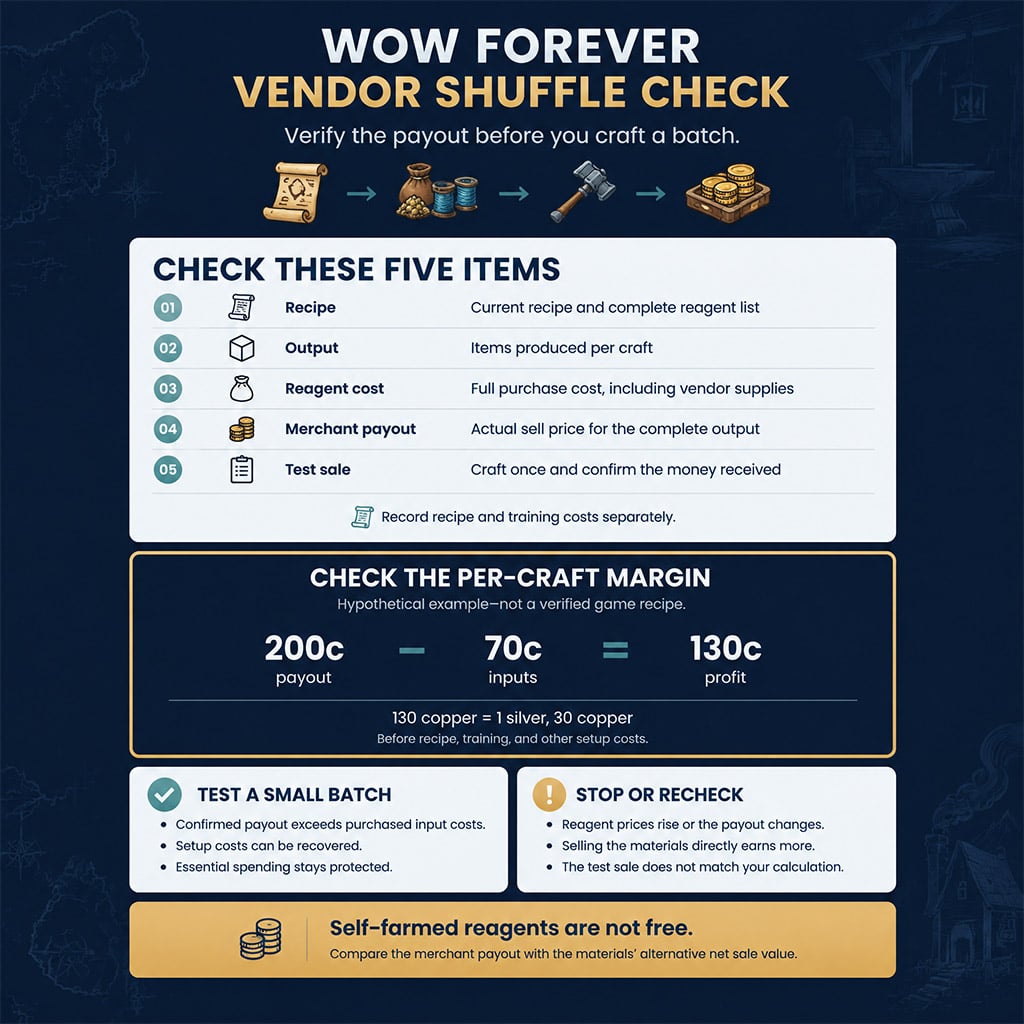
A vendor shuffle turns purchased or gathered inputs into an item sold to a merchant. It works only when the merchant payout exceeds the relevant costs.
Before crafting a batch:
1. Confirm the current recipe, output quantity, and complete material list.
2. Check the crafted item's actual merchant sell price.
3. Include purchased reagents and unavoidable training or recipe costs.
4. Craft one item, then confirm the payout.
5. Compare that payout with selling the same inputs directly.
For purchased inputs:
Vendor Profit per Craft=Merchant Payout−Total Input Purchase Cost
For gathered inputs, compare the payout with their realistic alternative net proceeds. Self-farmed materials are not free.
A hypothetical 200-copper payout and 70-copper input cost yield 130 copper, or 1 silver, 30 copper—not 1 gold, 30 silver. Training costs remain outside that per-craft figure and still need repayment.
Control Auction and Recipe Risk
For auction crafting, calculate:
Net Cash Profit=Actual Sale Proceeds After Fees−Purchased Inputs−Other Unrecovered Costs
Use actual transaction records rather than assumed auction percentages. Count lost listing costs, but do not treat recoverable deposits as permanent expenses.
Before buying a recipe, divide its cost by the realistic net profit per sale. A hypothetical 500-gold recipe earning 5 gold per sold item needs 100 sales to recover the recipe purchase alone.
Skip the recipe when that volume would tie up essential cash, require implausible demand, or force price cuts that erase the projected margin.
FAQ (Frequently Asked Questions)
What is the best way to make gold while leveling in WoW Forever?
Start with coin, vendor loot, and gathering that fits your existing quest route. Choose a dedicated farm only after comparable tests show higher realized income without unacceptable deaths, travel, or competition.
How much gold should I reserve for a mount?
Check the current riding trainer and mount vendor, then reserve the amount your character actually needs. Add a repair and consumable buffer rather than relying on a fixed budget copied from another version.
Should I sell copper ore or smelt it into bars?
Compare net proceeds for the complete conversion: all ore consumed versus all bars produced. Sell the ore when processing returns less after costs and selling effort.
How do I calculate gold per hour when auctions sell later?
Keep the farm's time and inventory in one batch record, then update proceeds as sales complete. Include later auction-handling time in active hours and report time-to-sale separately; unsold stock does not count as realized income.
How much starting gold do I need for a vendor shuffle?
You need enough spare cash for one confirmed test craft without touching essential reserves. Scale only after checking the actual payout, full input cost, and whether selling the materials directly would earn more.

I’m Priya Raman, an Indian Content Strategist at GGWTB covering fantasy MMORPGs, classic online games, and guild-focused play. I plan coverage around class roles, group coordination, and long-term character growth. A strong solo build is only part of the picture—I focus on what you bring to a party and which investments stay useful as your guild takes on tougher content.

Most Popular Posts
- WoW Forever Level 30 Beta Guide: Respec Rules & Fast Leveling Routes
- WoW Forever Main Class Guide: Choose by Playstyle, Not Beta Hype
- WoW Forever Beta Best Classes: Leveling, DPS and Tank Main Picks
- WoW Forever Best Class Choosing Guide: Leveling, PvE and PvP Picks Compared
- WoW Forever Best Addons: Essential Setup, Load Fixes & Config Guides
- WoW Forever Gold Guide: Leveling Income, Add-Ons, Farm Tests & Crafting Profit
Popular Category Lists
- ARC Raiders / (350)
- Grow a Garden / (294)
- CoD: Black Ops 7 / (167)
- Star Citizen / (162)
- MLB 26 / (159)
- Monopoly Go / (152)
- ARK Survival Ascended / (127)
- Steal a Brainrot / (99)
- Blox Fruits / (74)
- Adopt Me / (74)
- Forza Horizon 6 / (72)
- Sailor Piece / (68)
- Grow a Garden 2 / (68)
- Diablo IV / (62)
- CoD: BLACK OPS 6 / (55)
- Aion 2 / (50)
- Path of Exile 2 / (48)
- Monster Hunter Wilds / (46)
- Windrose / (44)
- Donut SMP / (41)