


 0
0 Created: Apr 29,2026 | ARK Survival Ascended
Is the Megaloceros Worth Using as a Primary Mount in ARK Survival Ascended?

The Megaloceros is easy to overlook in ARK. At first, it looks like a fast deer that mainly exists to farm thatch. But after using one seriously as a daily mount, we can say this: a good male Megaloceros is far better than its reputation suggests.
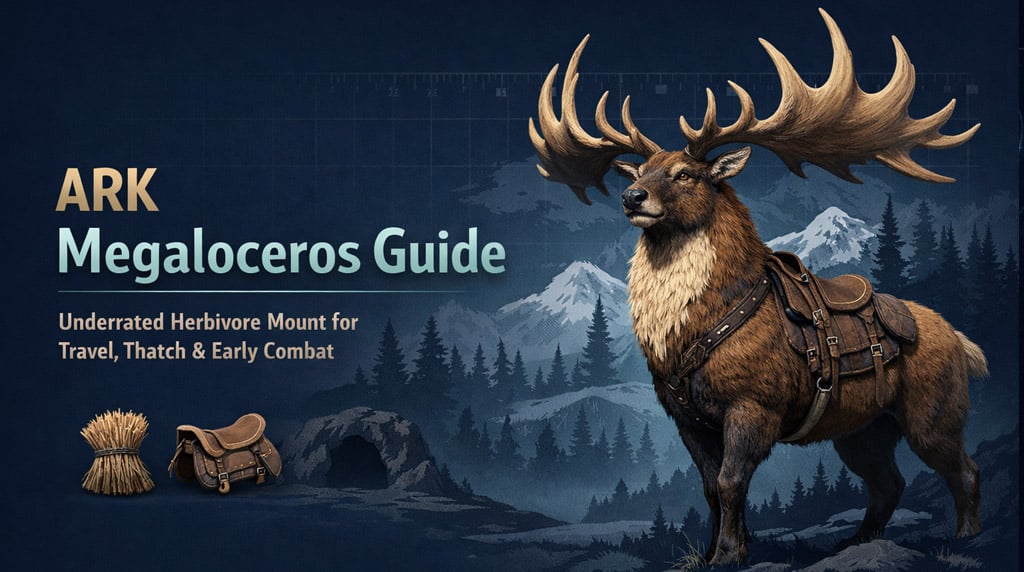
It is not a boss killer, and it will not replace top-tier mounts like a Thylacoleo, Shadowmane, Baryonyx, or Rex. Still, for early-to-mid game survival, travel, thatch farming, light combat, and even some cave runs, the Megaloceros can carry more weight than most players expect.
- Quick Verdict: Is the Megaloceros Viable?
- Male vs Female Megaloceros
- Why the Megaloceros Is Better Than People Think
- Taming Tips
- Best Stats for a Primary Mount
- Combat Performance
- Thatch Farming: Its Best Job
- Mobility and Map Travel
- Mounted Weapons and Antler Problems
- Caving With a Megaloceros
- Biggest Weaknesses
- Best Use Cases
- Recommended Build
- FAQ
- Is the Megaloceros good in ARK?
- Can the Megaloceros be a primary mount?
- Can female Megaloceros attack?
- What is the Megaloceros best at?
- Is the Megaloceros good for caves?
- What stats should I level on a Megaloceros?
- Does the Megaloceros take fall damage?
- Is the Megaloceros better than a Sabertooth?
- Summary
The key detail is simple: use a male Megaloceros. Females are fast, but they cannot attack. If we are talking about a real primary mount, the male is the one that matters.
Quick Verdict: Is the Megaloceros Viable?
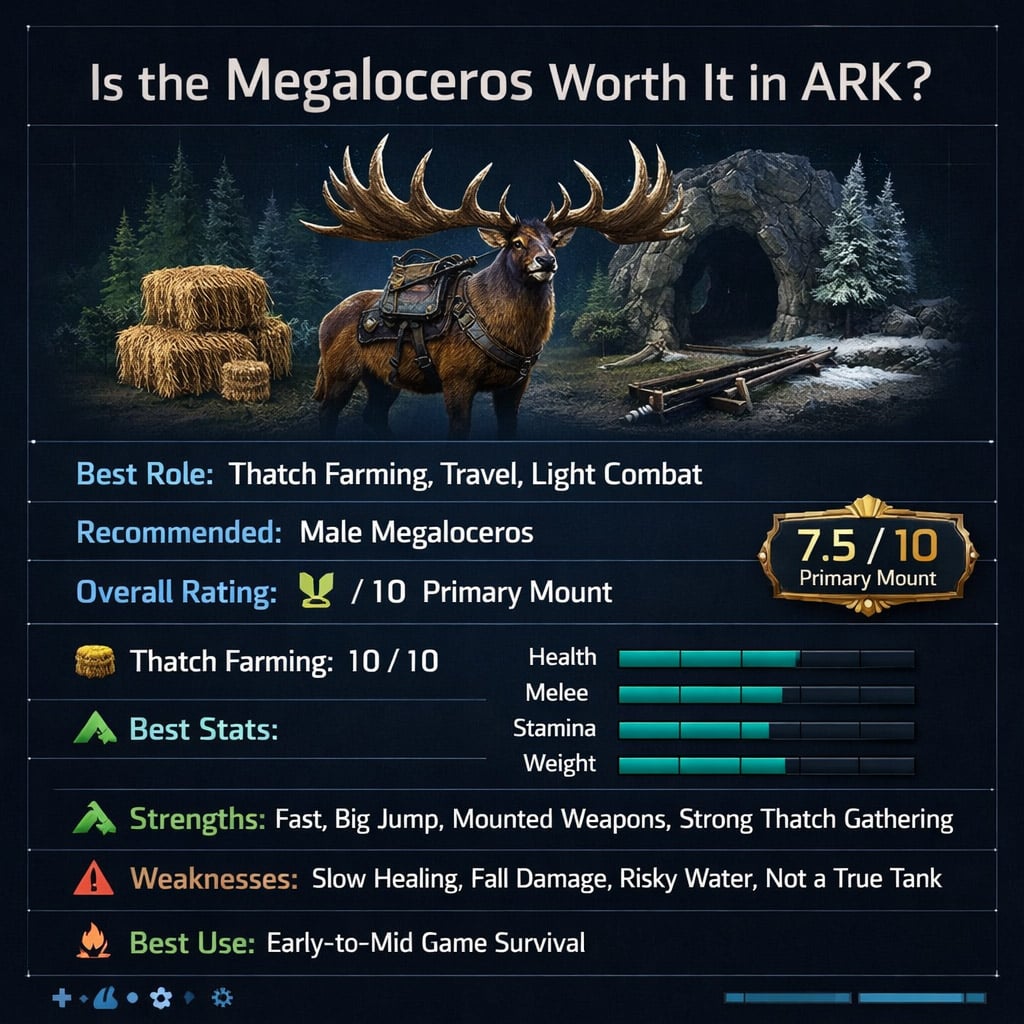
Yes, the Megaloceros is viable as a primary mount, especially before you have stronger predators or advanced travel creatures.
| Role | Rating | Notes |
|---|---|---|
| Early-game travel | 8/10 | Fast, agile, and easy to control |
| Combat | 7/10 | Good reach, but not a heavy tank |
| Thatch farming | 10/10 | One of the best thatch gatherers in ARK |
| Caving | 7/10 | Works well in some caves with careful play |
| Long fights | 6/10 | Slow healing is its biggest weakness |
| Overall primary mount value | 7.5/10 | Strong if you understand its limits |
The Megaloceros shines when we use it as a mobile utility fighter, not as a creature that face-tanks everything. If you play smart, it feels surprisingly reliable.
Male vs Female Megaloceros
This is the first thing to get right. A lot of players tame one, test it briefly, and miss the gender difference.
| Type | Can Attack? | Best Use |
|---|---|---|
| Male Megaloceros | Yes | Combat, thatch farming, caves, daily riding |
| Female Megaloceros | No | Fast travel and scouting |
The male has antlers and can attack. The female moves well, but because it has no attack, it is not a good main survival mount.
If you want a Megaloceros for actual progression, tame a high-level male.
Why the Megaloceros Is Better Than People Think
The male Megaloceros has a wide antler attack with better reach than expected. It can hit enemies in front of it, clip smaller creatures around its sides, and deal with some annoying targets better than many early mounts.
From practical use, its biggest strengths are:
- Fast movement
- Large jump
- Good slope climbing
- Excellent thatch gathering
- Mounted weapon use
- Decent combat reach
- Useful cave performance in the right caves
That mix matters. A Raptor may be faster in some situations, a Sabertooth may be more common for caves, and a Dire Wolf may hit hard in packs. But the Megaloceros brings farming, movement, and combat together in one clean package.
| Mount | Strength | Weakness |
|---|---|---|
| Raptor | Fast early combat | Fragile |
| Sabertooth | Good cave utility | Less flexible outside caves |
| Dire Wolf | Strong damage, no saddle needed | Better in packs |
| Megaloceros | Mobility, thatch, mounted weapons | Slow healing, fall damage |
This is why it feels underrated. It does not dominate one combat category, but it solves several everyday problems at once.
Taming Tips
The Megaloceros saddle unlocks at level 30, so you can use it fairly early. The harder part is finding one safely.
Megaloceros often spawn in dangerous areas like:
- Snow biomes
- Redwood forests
- Highland-style zones on some maps
The good news: Megaloceros can be trapped with bolas. That makes taming much easier if you clear the area first.
| Taming Step | What to Do |
|---|---|
| 1 | Find a male Megaloceros |
| 2 | Clear nearby predators |
| 3 | Bola it before it runs |
| 4 | Knock it out with tranq arrows or darts |
| 5 | Feed berries, crops, or kibble |
| 6 | Guard the tame until finished |
For early players, the safest move is to look near the edge of the redwoods or snow biome rather than pushing deep inside. If you find a high-level male in a semi-safe area, that is a great tame opportunity.
Best Stats for a Primary Mount
If we want the Megaloceros to work as a real daily mount, we should not build it like a pure farmer. It needs enough health to survive mistakes.
| Stat | Recommended Target | Why It Matters |
|---|---|---|
| Health | 4,000–5,000+ | Makes it safer for combat and caves |
| Melee Damage | 300%+ | Improves fighting and tree clearing |
| Stamina | 800–1,000+ | Helps with travel, jumping, and escapes |
| Weight | 500+ | Useful for thatch farming |
| Movement Speed | Optional | Already fast enough for most use |
For most players, the best leveling order is:
1. Health
2. Melee damage
3. Stamina
4. Weight
If you notice your Megaloceros winning fights but taking too long to recover afterward, add more health and avoid chain-fighting. If it feels safe but slow at killing, then start pushing melee.
Combat Performance
The Megaloceros is better in combat than its deer mount appearance suggests. Its antler swing has solid reach, and it can handle many small and medium threats.
It performs well against:
- Raptors
- Dilos
- Compies
- Terror Birds, if not swarmed
- Araneo
- Scorpions
- Titanoboas
- Ankylosaurus
- Some low-flying or awkward enemies
It struggles against:
- Rexes
- Spinos
- Alpha creatures
- Large wolf packs
- Thylacoleo ambushes
- Deep-water predators
| Fight Type | Megaloceros Result |
|---|---|
| Small predators | Good |
| Medium land creatures | Usually manageable |
| Cave insects/snakes | Good with backpedaling |
| Large carnivores | Avoid |
| Alphas | Avoid unless heavily prepared |
The safest combat style is simple: keep enemies in front of you and backpedal while attacking. Because the attack has good reach and some pushback, this works especially well against cave enemies and smaller predators.
Thatch Farming: Its Best Job
This is where the Megaloceros is genuinely excellent. It is one of the best thatch gatherers in ARK because it harvests trees quickly while moving fast.
Even better, it does not waste time harvesting bushes. That means your inventory fills with the resource you actually came for.
| Resource | Performance |
|---|---|
| Thatch | Excellent |
| Wood | Poor |
| Berries | Does not gather |
| Travel farming | Excellent |
The best method is to run through dense tree areas while attacking. You can collect a huge amount of thatch quickly, especially if you level some weight or keep storage nearby.
If your base needs thatch for building, crafting, or bulk projects, the Megaloceros earns its place even if you never use it as a combat mount.
Mobility and Map Travel
The Megaloceros feels great to ride. It has a big jump, good speed, and surprisingly solid hill climbing.
That said, the jump can get you into trouble. It takes real fall damage, so launching yourself off cliffs is a quick way to turn a useful mount into a sad campfire story.
| Terrain Situation | Advice |
|---|---|
| Hills | Climb at an angle |
| Forests | Excellent movement |
| Cliffs | Slow down and descend carefully |
| Rivers | Cross only when safe |
| Ocean/deep water | Avoid |
Its swimming is acceptable for short crossings, but we would not trust it around sharks, especially alpha sharks. Treat water as a risk zone, not a travel route.
Mounted Weapons and Antler Problems
One underrated feature is that you can use weapons while riding a Megaloceros. This makes it useful for taming, defending yourself, or shooting from a safer position.
The downside is that the male's antlers can sometimes block your view or interfere with shots. It is not constant, but it is noticeable.
| Setup | Shooting Comfort |
|---|---|
| Default male antlers | Sometimes awkward |
| Cosmetic antler skins | Usually cleaner |
| Female Megaloceros | Clear view, but no attack |
If you plan to use it as a mounted taming platform, practice your aim before relying on it in a dangerous area.
Caving With a Megaloceros
The Megaloceros can work in several caves, especially ones where it fits comfortably and enemies come at you from the front.
Its best cave tactic is to move slowly, pull small groups, and attack while backing up.
| Cave Factor | Performance |
|---|---|
| Small enemy groups | Good |
| Spiders and scorpions | Good |
| Snakes | Manageable |
| Flying enemies | Better than expected |
| Big swarms | Risky |
| Long cave runs without healing | Risky |
The main issue is healing. The Megaloceros does not regenerate health quickly, so if you take too much damage early in a cave, the rest of the run becomes dangerous.
Sweet Vegetable Cakes can help, but they are expensive early. If your server or map gives you access to reliable healing support, the Megaloceros becomes much stronger for extended cave use.
Biggest Weaknesses
The Megaloceros is good, but it has real limits.
| Weakness | Why It Matters |
|---|---|
| Slow healing | Bad for long fights or repeated cave pulls |
| Fall damage | Big jump can punish careless movement |
| Dangerous spawn areas | Harder to tame early |
| Antlers affect aiming | Mounted shooting can feel awkward |
| Not a true tank | Cannot brawl with major predators |
| Poor water safety | Sharks and deep water are dangerous |
These weaknesses are manageable, but only if we respect them. The Megaloceros becomes much worse when used recklessly.
Best Use Cases
The Megaloceros is at its best when used as a practical daily mount.
| Use Case | Recommendation |
|---|---|
| Early-to-mid game travel | Great |
| Thatch farming | Excellent |
| Mounted taming support | Good |
| Light combat | Good |
| Cave runs | Good in the right caves |
| Boss fights | Not recommended |
| Alpha hunting | Not recommended |
| Ocean travel | Not recommended |
If you need one creature that can farm thatch, move quickly, fight smaller threats, and help with basic exploration, the Megaloceros is a strong pick.
Recommended Build
For a serious primary mount, we would build it like this:
| Build Choice | Recommendation |
|---|---|
| Gender | Male |
| Level | Highest safe tame possible |
| Main stat | Health |
| Second stat | Melee damage |
| Utility stats | Stamina and weight |
| Saddle | Best armor saddle available |
| Healing | Sweet Vegetable Cakes if available |
| Playstyle | Fast skirmisher, not face-tank |
A well-leveled male with around 4,000–5,000 health, decent melee, and enough stamina feels much better than most players expect. It will not replace your strongest late-game creatures, but it can absolutely carry early and mid-game progression.
FAQ
Is the Megaloceros good in ARK?
Yes. The male Megaloceros is a strong early-to-mid game utility mount. It is fast, gathers thatch extremely well, can fight smaller threats, and lets you use weapons while mounted.
Can the Megaloceros be a primary mount?
Yes, but mainly in early-to-mid game. It works well if you level health first, avoid major predators, and manage its slow healing.
Can female Megaloceros attack?
No. Female Megaloceros cannot attack. They are useful for fast travel, but not for combat.
What is the Megaloceros best at?
Its best role is thatch farming. It is one of the best thatch gatherers in ARK because it can harvest trees quickly while moving at high speed.
Is the Megaloceros good for caves?
It can be good in caves where it fits. Its attack reach works well against spiders, scorpions, snakes, and small enemies. The main risk is taking too much damage without a reliable way to heal.
What stats should I level on a Megaloceros?
Level health first, then melee damage, then stamina and weight. For a primary mount, aim for around 4,000–5,000 health if possible.
Does the Megaloceros take fall damage?
Yes. It takes noticeable fall damage, so avoid jumping off cliffs or sprinting blindly over uneven terrain.
Is the Megaloceros better than a Sabertooth?
Not always. The Sabertooth is better for some cave and resource roles, but the Megaloceros is more flexible for thatch farming, travel, mounted weapons, and general utility.
Summary
The Megaloceros is absolutely underrated in ARK. A male Megaloceros gives us speed, excellent thatch farming, useful combat reach, mounted weapon access, and solid cave potential in one creature.
Its main flaws are slow healing, fall damage, awkward antlers when shooting, and poor matchups against large predators. But those are manageable if we use it as a fast utility fighter instead of a front-line tank.
For early-to-mid game, we would rate the Megaloceros around 7.5/10 as a primary mount. For thatch farming, it is easily 10/10. If you find a high-level male and build it properly, it is much more than a deer for thatch — it is one of the most useful herbivore mounts you can tame before the stronger late-game options take over.


The GGWTB Editorial Team features 10 full-time gaming editors and 23 specialist contributors, delivering hands-on tested walkthroughs, easter egg breakdowns, and game updates.
LUKE — who spearheads our in-depth ARK Survival Ascended, COD: Modern Warfare 4 guides, and patch notes—every guide is rigorously verified on live servers for accuracy.

Most Popular Posts
- ARK: Survival Ascended Bjarnheim Farming Guide: Element, Pearls, Metal & Boss Routes
- ARK: Survival Ascended Lumina Dinos Guide: Spawn Locations, Taming Steps & Umbra Synergy
- ARK: Survival Ascended Giant Queen Bees: Find and Tame in Genesis 1
- ARK Survival Ascended Magmasaur Guide: Egg Theft, Raising, and Metal Farming Tips
- ARK Astraeos Artifact Locations: 13 Caves, Routes, and Prep
- ARK Survival Ascended Megachelon: Genesis Ocean Taming Guides
Popular Category Lists
- ARC Raiders / (354)
- Grow a Garden / (294)
- CoD: Black Ops 7 / (167)
- Star Citizen / (163)
- MLB 26 / (159)
- Monopoly Go / (153)
- ARK Survival Ascended / (128)
- Steal a Brainrot / (99)
- Blox Fruits / (74)
- Adopt Me / (74)
- Forza Horizon 6 / (72)
- Sailor Piece / (68)
- Grow a Garden 2 / (68)
- Diablo IV / (62)
- CoD: BLACK OPS 6 / (55)
- Aion 2 / (52)
- Path of Exile 2 / (48)
- Monster Hunter Wilds / (46)
- Windrose / (44)
- Maplestory Classic / (42)