


 0
0 Created: Mar 8,2026 | Rust
Rust March 2026 Update Guide: Scientist Nerfs, Deep Sea Changes, and Boat Meta Shifts

Here's a practical breakdown of the Rust March 2026 update, with the focus where it matters: Deep Sea is now harder to reach, easier to survive, and much more tactical once you're inside. At the same time, boat gameplay got a serious quality-of-life pass, which means the naval meta is no longer just about mobility—it's about setup, defense, and recovery.
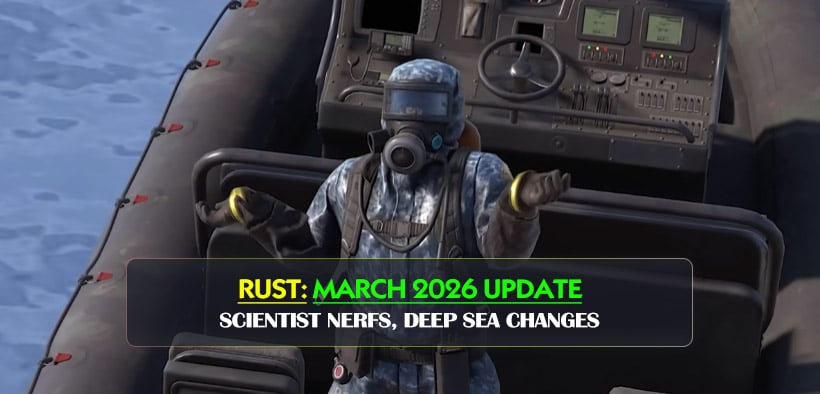
For most of us, the biggest changes are simple. RIB access to Deep Sea is gone, scientist damage is finally working properly against armor, smoke grenades now have real PvE value, and boats can support far more utility than before. That combination slows down early abuse while giving prepared players more control. Let's unpack what changed, why it matters, and how we should play around it.
- Core Patch Changes That Matter Most
- Fast overview
- Deep Sea and Scientist Changes: What We Should Do Differently
- RIB removal is a real meta shift
- Scientist nerf: not flashy, but extremely important
- Smoke grenades are now a serious Deep Sea tool
- Spawn logic is less predictable now
- Boat QoL Changes and the New Naval Meta
- Static boat-building stations are a huge recovery buff
- 650m view distance changes how ocean fights start
- Slight ADS sway on boats matters more than it looks
- Cannon users are much tougher now
- Boat Building, Farming, and Trap Utility
- More deployables on boats changes long-session play
- Small planters on boats are more useful than they sound
- Building snap behavior is a little unusual
- Wallpaper support and cosmetic utility
- Sinking, Damage, and Structural Targeting
- Damage is now more localized
- New Boxes DLC and Store Value
- The big feature is dynamic visual fill
- Value comparison
- FAQ
- Is Deep Sea worth running after the March 2026 update?
- Did scientists get nerfed hard?
- Are smoke grenades now mandatory for Deep Sea?
- What is the biggest naval meta change outside Deep Sea?
- Are trap boats going to be a problem?
- Is the new boxes DLC worth buying?
- Summary
Core Patch Changes That Matter Most
This update looks like a QoL patch on the surface, but in practice it reshapes how we approach Deep Sea, ocean travel, and boat fights.
Fast overview
Below is a condensed look at the headline changes and their practical impact.
| Change | What Changed | Why It Matters | Practical Take |
|---|---|---|---|
| Deep Sea access | RIB can no longer enter | Removes the easiest entry method | Build your own boat plan earlier |
| PT boat | Still works for Deep Sea travel | Strong option, but harder to secure | Valuable if your team controls ocean routes |
| Scientist armor fix | Armor reduction now works correctly | PvE feels fairer and more predictable | Hazmat/armor matters again |
| Smoke vs scientists | Scientists do not shoot through smoke | Gives us controlled entry windows | Carry smoke for island pushes |
| Deep Sea spawn logic | Random map-side spawn, random wipe timing | Harder to camp and pre-stage | Scout more, assume less |
| Deep Sea respawn | Roughly 1.5 to 2.5 hours | Better pacing, less certainty | Plan patrol loops, not fixed timers |
| Static boat stations | Added inside Deep Sea | Recovery option if stranded | Huge survival buff for solo/small groups |
| Deep Sea view distance | Increased to 650m | Earlier contact detection | Spot threats and disengage sooner |
| Boat ADS sway | Slight sway while aiming on boats | Lowers beam consistency | Short bursts beat ego peeks |
| Cannon resistance | 50% damage reduction while mounted | Cannon plays are safer | Heavy armor cannon users are stronger |
| Boat deployables | Electrical items allowed, turrets blocked | More utility, still somewhat restrained | Traps and farming are now realistic |
| Planters on boats | Small planters allowed, large blocked | Enables sustainable ocean setups | Great for long sessions and niche bases |
Deep Sea and Scientist Changes: What We Should Do Differently
This is where the update has the biggest gameplay impact. Deep Sea isn't dead, but it is less abusable and more skill-driven.
RIB removal is a real meta shift
We should treat the RIB restriction as the most important balance change in the patch.
Before, a RIB gave players a very efficient route into Deep Sea with low setup cost and strong flexibility. That was convenient, but it also compressed the risk-reward curve too much. Now, because we must build or secure a more appropriate boat, the trip carries more planning cost.
That means:
- early Deep Sea rushes are slower
- teams need better logistics
- solo and duo players are punished less by instant chain-contest behavior
- map control matters more than spawn memorization
If you built your wipe around quick offshore contests, this patch hits that style directly.
Scientist nerf: not flashy, but extremely important
The scientist change is one of those fixes that sounds small until you play it.
Previously, scientists were effectively bypassing the expected armor mitigation. Reports from players and testing around the patch indicate that instead of receiving the intended 30% damage reduction, armored players were only seeing something closer to 5% in those encounters. Now that this is fixed, the difference in survivability is significant.
Here's what that means in practice:
| Scenario | Before | Now | What We Do |
|---|---|---|---|
| Hazmat vs scientists | Felt much weaker than expected | More in line with intended defense | Hazmat runs are more viable |
| Mixed armor kits | Low payoff against Deep Sea PvE | Proper mitigation returns | Bring real armor if you can |
| Solo peeks | Often overly punishing | Still dangerous, but fairer | Play cover and heal timing |
| Team pushes | Attrition was brutal | More manageable with coordination | Re-clear confidently |
From our perspective, this doesn't make scientists easy. It makes them consistent. That matters because consistent PvE can be planned around.
Smoke grenades are now a serious Deep Sea tool
This is one of the smartest tactical additions in the patch.
Scientists reportedly do not shoot through smoke unless they regain visual contact. So smoke is no longer just a gimmick or a niche disengage item; it becomes a genuine tool for:
- crossing exposed angles
- buying revive windows
- resetting line of sight
- isolating one side of an island fight
- recovering from bad entries
If you find that your team keeps losing the first contact on Deep Sea, bring smoke before bringing more ego. We should think of smoke as an entry utility item, not dead inventory space.
Spawn logic is less predictable now
Deep Sea can now spawn on different sides of the map, and the post-clear timer sits around 1.5 to 2.5 hours. On wipe, the first appearance is also random.
Why is that healthy?
Because fixed content becomes camped content. Once a monument or event becomes too scriptable, stronger groups stop playing it and start owning its schedule. This patch pushes Deep Sea back toward active scouting.
If you're used to old timing habits, adjust to this loop instead:
1. patrol likely lanes
2. watch map-side rotations
3. stage fuel and repair materials
4. expect contest only after visual confirmation, not memory
That change alone raises the skill ceiling for ocean teams.
Boat QoL Changes and the New Naval Meta
The second half of this update is all about boats becoming more livable, more customizable, and more dangerous in layered ways.
Static boat-building stations are a huge recovery buff
This is easy to underestimate.
If you get stranded in Deep Sea, static boat-building stations now give you a path back into the game. For solos and small groups, that is massive. In prior versions, a stranded run often meant the content was effectively over. Now there is at least a comeback route.
From experience, recovery options change player behavior more than raw loot buffs do. People take smarter risks when they know a failed extraction is not automatically a hard reset.
650m view distance changes how ocean fights start
A Deep Sea visibility increase to 650 meters means engagement timing changes before shots are even fired.
We should expect:
- more early spotting
- fewer surprise close-range interceptions
- more disengages
- more long-angle tracking of PT boats and raiders
- more value from disciplined routeing
If you usually sail lazily in a straight line, this patch punishes that. Detection starts earlier, so positioning mistakes also start earlier.
Slight ADS sway on boats matters more than it looks
The boat ADS nerf is small, but small aim instability often has a large effect in Rust because many players depend on rhythm and confidence.
This doesn't mean boat PvP is ruined. It means:
- full-auto sprays are less forgiving
- precision peeks become less consistent
- burst discipline becomes stronger
- stable positioning matters more
If you notice your opening shots suddenly feel off, this is likely why.
Cannon users are much tougher now
Players mounted on cannons now get 50% damage reduction. That is not a cosmetic buff; it's a real survivability shift.
In practice, this encourages:
- dedicated cannon roles
- heavier armor on artillery players
- more deliberate boat-to-boat siege setups
- stronger pressure from prepared teams
We should expect cannon pressure to become more common in organized groups. If you run naval fights often, plan around that with focus fire, movement disruption, or denial before they settle in.
Boat Building, Farming, and Trap Utility
This section is where the patch turns from balance into lifestyle improvement.
More deployables on boats changes long-session play
You can now place many electrical items on boats, though auto turrets are blocked. That's an important limit, because turret boats would be absurdly oppressive. Still, shotgun traps and flame traps being allowed creates a new layer of close-defense utility.
Here's the practical view:
| Boat Addition | Allowed? | Value | Risk / Limitation |
|---|---|---|---|
| Electrical items | Yes | Utility and customization | Power/setup still required |
| Auto turrets | No | Prevents extreme abuse | Good restriction |
| Shotgun traps | Yes | Strong anti-board defense | Potentially overtuned |
| Flame traps | Yes | Area denial in tight spaces | Dangerous in close quarters |
| Water catcher | Yes | Long-range sustain | Mostly QoL, but useful |
| Small planters | Yes | Mobile farming potential | Limited scale |
| Large planter | No | Stops full farm boat abuse | Fair restriction |
The broad takeaway is that boats are becoming semi-livable platforms, not just transport.
Small planters on boats are more useful than they sound
This will not replace real farming bases, but it absolutely helps for:
- teas and utility crops on long ocean sessions
- niche survival setups
- roleplay-heavy or nomad-style runs
- small group sustain
If you enjoy self-contained gameplay loops, this is one of the most underrated changes in the patch.
Building snap behavior is a little unusual
A notable quirk here is that some placements appear to snap by default, while holding Shift can switch into freer placement behavior—the reverse of what many players expect.
That matters because bad placement on a moving or cramped boat is expensive. If you find snapping feels wrong, don't assume it's user error; test the placement modifier first.
Wallpaper support and cosmetic utility
Paid wallpaper now works on boats as well. This won't change combat outcomes, obviously, but it does improve visual organization and identity on mobile bases. In team play, small visual cues can still help with fast reading of compartments and storage zones.
Sinking, Damage, and Structural Targeting
One of the more technical but meaningful changes is how boat parts now take damage.
Damage is now more localized
Previously, hitting certain parts of a boat could cause the whole structure to feel like it was taking shared punishment. Now, individual parts take damage more independently.
This means targeted destruction matters more.
For us, that creates two immediate tactical consequences:
1. precision hits gain value
2. repair priorities become clearer
If you board or pressure enemy boats often, start identifying which section gives the best return when destroyed. And if your own boat is under attack, you'll need to read damage state faster instead of assuming the whole craft is collapsing evenly.
That's a subtle but healthy skill increase.
New Boxes DLC and Store Value
This part is less about combat and more about whether the new content is worth caring about.
The big feature is dynamic visual fill
The upcoming boxes DLC reportedly includes a broad set of rustic storage skins, but the standout detail is this: boxes visually fill based on the items inside them, not only based on the box label.
That's good design. It creates stronger visual feedback and makes storage feel more alive.
For example:
- a food-labeled box can still visually show stone if stone is what you put inside
- the visual state changes with contents, not just category theme
- storage rooms gain readability and personality
Value comparison
Below is the practical value assessment.
| DLC / Skin Type | Main Appeal | Utility | Value Judgment |
|---|---|---|---|
| New Boxes DLC | Dynamic filled visuals, many variants | Medium practical, high cosmetic clarity | Strong if priced reasonably |
| Neon boxes | High visibility and style | Good for quick sorting | Still useful, but more niche now |
| Graffiti boxes | Creative customization | Mostly cosmetic | Depends on taste |
| Cyanotype-style tagged boxes | Clean labeling aesthetic | Good organization | Competes directly with new set |
If pricing lands around the common DLC band many players expect, the box count and dynamic fill feature make this pack look competitive.
FAQ
Here are the most common practical questions players will ask after this patch.
Is Deep Sea worth running after the March 2026 update?
Yes, but the approach is different. It is less free to access and more fair to fight inside. If you prepare a proper boat, bring smoke, and respect spawn uncertainty, Deep Sea remains valuable.
Did scientists get nerfed hard?
Not in the sense of becoming weak. The big change is that armor now works correctly, which removes the feeling that they were cheating the damage model. They are still dangerous, just no longer overtuned in the same way.
Are smoke grenades now mandatory for Deep Sea?
For serious runs, they are close to mandatory. If you discover that open entries keep getting punished, smoke is one of the cleanest fixes available.
What is the biggest naval meta change outside Deep Sea?
Boat utility. The ability to place more functional objects on boats, plus cannon survivability improvements, means naval gameplay has more depth than before.
Are trap boats going to be a problem?
Potentially, yes. Since shotgun traps and flame traps are allowed, close-quarters boarding and careless looting become more dangerous. We should assume some players will abuse this immediately.
Is the new boxes DLC worth buying?
If you care about base organization, visual variety, and dynamic storage aesthetics, it looks promising. If you only care about competitive advantage, it is optional.
Summary
This March 2026 update pushes Rust in a healthier direction for ocean content. Deep Sea is less exploitable, scientist combat is more honest, and boats are far more useful as actual gameplay platforms. That combination rewards preparation over shortcuts.

Most Popular Posts
- Rust Next Twitch Drops Event - Round 42 Homebrewed 3 (August 10)
- Rust Workbench Upgrades Guide: Best Upgrades, Slot Limits, and What to Use First
- Best Rust Settings for PvP and FPS in 2026: Optimization Guide
- Rust Apartment Raid Guide: Master Key, Room Value, Costs & Best Targets
- Rust Best Weapons Rankings: Economy, and Combat Tactics
- Rust Console 2025 Arctic Update: Research Base, Snowmobiles, Polar Bears, AI
Popular Category Lists
- ARC Raiders / (354)
- Grow a Garden / (294)
- CoD: Black Ops 7 / (167)
- Star Citizen / (163)
- MLB 26 / (159)
- Monopoly Go / (153)
- ARK Survival Ascended / (128)
- Steal a Brainrot / (99)
- Blox Fruits / (74)
- Adopt Me / (74)
- Forza Horizon 6 / (72)
- Sailor Piece / (68)
- Grow a Garden 2 / (68)
- Diablo IV / (62)
- CoD: BLACK OPS 6 / (55)
- Aion 2 / (52)
- Path of Exile 2 / (48)
- Monster Hunter Wilds / (46)
- Windrose / (44)
- Maplestory Classic / (42)