



 0
0GGWTB Editorial Team - AISLING
Created: Apr 30,2026 | ARK Survival Ascended

GGWTB Editorial Team - AISLING
Flint feels easy to get in Ark Survival Ascended until we start crafting Sparkpowder, Gunpowder, arrows, ammo, and industrial materials in bulk. At that point, picking at rocks by hand stops being fine and starts feeling like punishment with extra steps.

After testing the main Flint farming options across normal and boosted settings, the best method depends on what we need: speed, consistency, or yield per rock. For most players, the top three choices are Fasolasuchus, Ankylosaurus, and Mantis.
Fasolasuchus is the fastest for bulk Flint, Anky is the most reliable, and Mantis is great if we can manage its weight problem.
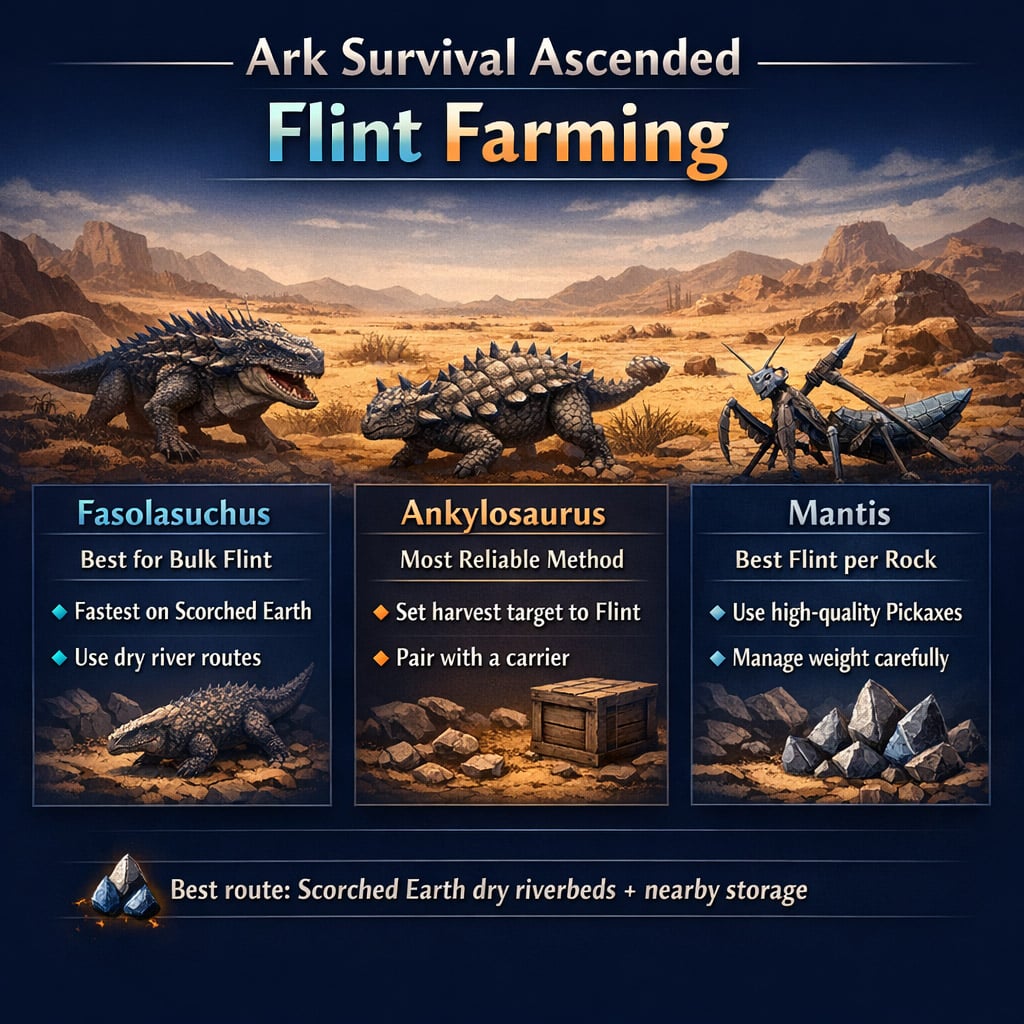
Each Ark Survival Ascended creature has a different role. The mistake many players make is choosing only by gather amount per hit. In real farming, we also need to think about weight, travel time, unloading, and how easy the route is to repeat.
| Creature | Best For | Strength | Weakness |
|---|---|---|---|
| Fasolasuchus | Bulk Flint farming | Very fast rock clearing | Needs frequent unloading |
| Ankylosaurus | Reliable everyday farming | Easy, steady, auto-harvest option | Slower than Fasolasuchus |
| Mantis | High yield per rock | Strong with good pickaxes | Gets overweight fast |
| Metal Pick | Early game | Easy to access | Too slow for bulk farming |
If we are farming casually, Anky is enough. If we are stocking a base or tribe, Fasolasuchus usually wins.
The Fasolasuchus is the best choice when we want a lot of Flint quickly, especially on Scorched Earth. Its underground movement lets it smash through rocks while moving, so we spend less time stopping and swinging.
This matters because Flint farming is not only about how much one rock gives. It is about how many rocks we can clear per minute.
When the Fasolasuchus moves underground, it breaks many Flint-producing rocks on contact. The yield per rock may not always beat a perfect Mantis setup, but the speed makes up for it.
In actual farming runs, this method can fill inventories very quickly, especially in dense rock areas. On official-like settings, we will need to unload often, but the farming pace is still excellent.
| Stat / Setup | Recommendation |
|---|---|
| Weight | Level this heavily for longer runs |
| Stamina | Enough to stay underground comfortably |
| Route | Dry riverbeds and dense rock fields |
| Storage | Place storage nearby or bring a carrier |
| Map | Scorched Earth is ideal |
If you notice your Fasolasuchus filling up too quickly, place storage near your farming path. The creature is usually not the problem—the unloading system is.
The Ankylosaurus is still one of the best Flint farmers because it is simple, dependable, and easier to use than the more specialized options.
For many players, this will be the first serious Flint farming tame. It does not require fancy movement, and it works well with a carrier creature.
To make the Anky more efficient, set its harvesting behavior to target Flint. This helps it focus on the resource we actually need instead of wasting time on less useful gathering.
| Setting | Recommended Option |
|---|---|
| Auto Harvest | On |
| Target Resource | Flint |
| Main Stats | Melee and Weight |
| Support Creature | Karkinos, Quetzal, or another high-weight carrier |
If your Anky is not swinging, move it closer to the rocks. Auto-harvest can be picky and may only trigger when the Anky is very near the node.
The Anky may not be the fastest, but it is consistent. With a carrier, we can move through Scorched Earth rock fields and let the Anky collect Flint steadily.
This is the best method if we want something low-stress and repeatable.
The Mantis can gather a huge amount of Flint when equipped with good pickaxes. With high melee damage, imprint bonuses, and quality tools, it can outperform many creatures per rock.
The issue is weight. A Mantis fills up fast, and once it is encumbered, the farming pace drops hard.
| Good Situation | Why It Works |
|---|---|
| Farming near base | Easy unloading |
| Using high-quality pickaxes | Better Flint yield |
| Short farming sessions | Weight is less annoying |
| Support tame nearby | Solves carry limit |
If we already have a strong Mantis and good picks, it is excellent for quick Flint runs. If we are trying to farm a massive stockpile, Fasolasuchus or Anky usually feels smoother.
For most players, Scorched Earth is the best map for Flint farming. The rocks are everywhere, and dry riverbeds are especially useful because they create long, easy routes with dense rock spawns.
| Location Type | Why It's Good | Best Creature |
|---|---|---|
| Dry Riverbeds | Dense rocks, easy routes | Fasolasuchus |
| Open Desert Rock Fields | Lots of rocks, fewer obstacles | Fasolasuchus / Anky |
| Mountain Edges | Good rock density | Anky / Mantis |
| Near Base | Fast unloading | Mantis / Anky |
A good route matters more than most players think. If we are constantly searching for rocks, our Flint per minute drops. A repeatable path is always better.
For efficient farming, we want to solve three problems: gathering speed, weight, and unloading.
| Goal | Best Option |
|---|---|
| Fastest Flint | Fasolasuchus |
| Safest Method | Ankylosaurus |
| Highest Yield Per Rock | Mantis |
| Early Game Farming | Metal Pick |
| Best Long-Term Setup | Fasolasuchus + nearby storage |
The strongest overall setup is a Fasolasuchus on Scorched Earth with storage placed near a dry river route. For players without a Fasolasuchus, an Anky with a carrier is the next best option.
Small mistakes can make Flint farming feel much slower than it should.
| Mistake | Better Fix |
|---|---|
| Farming without storage nearby | Place boxes or dedicated storage near the route |
| Ignoring weight | Level weight or bring a carrier |
| Using Mantis for long routes | Use Fasolasuchus or Anky instead |
| Not setting Anky to Flint | Adjust harvest settings first |
| Farming random rocks | Use a repeatable Scorched Earth route |
If you feel like Flint farming is slow, check the loop. Most of the time, the real issue is not the creature—it is travel time and unloading.
The Fasolasuchus is usually the best creature for bulk Flint farming because it clears rocks extremely fast while moving underground.
Yes. The Ankylosaurus is one of the most reliable Flint farmers, especially when set to target Flint and paired with a carrier creature.
The Mantis can gather more Flint per rock, especially with strong pickaxes, but the Anky is usually easier to manage for longer farming runs.
Scorched Earth dry riverbeds are one of the best Flint farming spots because they have dense rock spawns and easy travel paths.
For most Flint farmers, level melee and weight first. Add stamina if the creature needs it for longer routes, especially Fasolasuchus.
The best Flint farming method depends on our stage of progression.
Use a Metal Pick only in the early game. Move to an Ankylosaurus as soon as possible for steady farming. Use a Mantis if we want high Flint per rock and have storage nearby. Once we have access to a Fasolasuchus, it becomes the best choice for serious bulk Flint farming.
For the smoothest results, farm on Scorched Earth, follow dry river routes, and keep storage close. When gathering speed, weight control, and unloading all work together, Flint becomes one of the easiest resources to stockpile in Ark Survival Ascended.
The GGWTB Editorial Team features 10 full-time gaming editors and 23 specialist contributors, delivering hands-on tested walkthroughs, easter egg breakdowns, and game updates.
Aisling — who spearheads our in-depth Monopoly Go, ARK Survival Ascended, Forza Horizon 6, Subnautica 2, Diablo IV guides, and patch notes—every guide is rigorously verified on live servers for accuracy.


Prepare for the ARK Survival Ascended Enigmasaur launch on November 6, 2026. Master the form-matching taming loop, ability retention rules, and cryo-prep strategy.

Learn the reported Magmasaur cryopod breeding trick, fix common failures, and check compatibility before moving breeders. Start with one eligible pair.

Compare Therizino and Mantis farming setups, avoid misleading yield claims, and measure Element per minute before spending resources on a replacement.

Follow Gargantar's taming cycle, prepare exact feeding sources, and troubleshoot swallowing, gear demands, and keratin rounds before risking valuable equipment.

Separate verified ARK patch mechanics from speculative leaks. Real data on the Therizinosaurus jump, Giga TLC status, and breeding baseline survival prep.

Check which DLC unlocks Cerberax and Gargantar, then follow the taming sequence for each. Includes prep checklists, failure points and a quick-reference table.

We use cookies to ensure website functionality and enhance your experience. Click "Accept All" to consent, or "Customize" to manage your preferences. See our Privacy Policy.


