


 0
0 Created: Feb 5,2026 | Grow a Garden
Grow a Garden: Can it Come Back in 2026?

The weird thing about dead game discourse is that it often ignores the middle. Going from a reported 22.3 million peak CCU to ~40–50K average players looks like a cliff, but it's also the story of a live-service economy that got hit by exploits, confusing progression resets, and trust erosion—all while the game tried to out-update its own design. Let's unpack what likely happened, what it means for you as a player, and whether 2026 still has room for a comeback.
We'll tackle this in four parts: what changed, why it caused a freefall, what dying actually means here, and what a realistic comeback path looks like.
- 1. What Actually Changed For Grow a Garden?
- 1.1 Exploits Create Cheaters
- 1.2 Turning Off Social Features
- 1.3 Ascension & Rebirth
- 1.4 Weekly Updates
- 2. Trust Is the Real Currency
- 2.1 Monetization Drift
- 2.2 Reputation Shocks
- 3. Is It Dying?
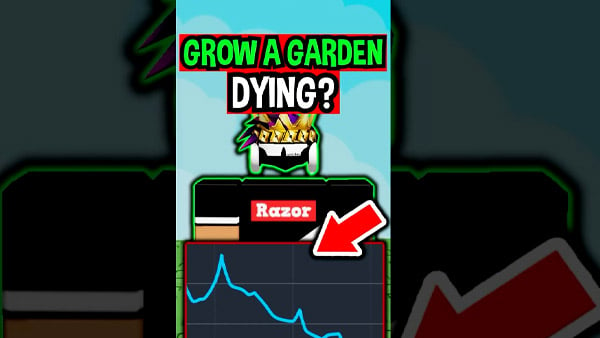
- 3.1 A Big Drop
- 3.2 Health Signals
- 4. Can Grow a Garden Make a Comeback in 2026?
- 4.1 The Comeback Playbook
- 4.2 A Plausible Timeline
- FAQ
- 1) Online Player Is Low - Doesn't That Mean It's Dead?
- 2) What Was The Single Biggest Reason For The Falloff?
- 3) If The Devs Already fixed Ascension Later, Why Didn't Players Return?
- 4) What Would Convince Us To Invest Time Again In 2026?
- 5) Could A big Studio Acquisition Help Or Hurt?
- Final Takeaways
1. What Actually Changed For Grow a Garden?
1.1 Exploits Create Cheaters
When a game's economy is built around rarity (pets, seeds, mutations), duplication exploits don't merely add extra items. They destroy pricing truth.
- Cause: Duplication of high-impact pets (e.g., raccoon/kitsune-type mechanics that copy/steal/mutate value).
- Mechanism: Duplicated power tools → faster farming → more currency minted → prices inflate → normal play feels pointless.
- Result: New or returning players see a wall: I'm behind by months and the ladder got taller.
From our experience in Roblox economies (and other grind loops like simulators), once the player base believes the rich got rich via bugs, you get a second-order effect that's even worse than inflation: legitimacy collapse. People don't quit because numbers are high; they quit because progress feels illegitimate.
1.2 Turning Off Social Features
Disabling pet gifting/trading (or tightening it) is often the correct security response. But emotionally, it reads as:
We're all paying for exploiters.
- If you notice your friend can't help you catch up anymore, then your return motivation drops.
- If you can't safely trade without fear of dupes/rollbacks, then the economy becomes a minefield.
1.3 Ascension & Rebirth
A prestige/reset system can work as a currency sink. The problem is presentation and payoff. If players think they're converting a trillion into one coin, but the UI actually means all currency for one coin, then the system feels like a scam—even if later patched.
That perception matters because progression games rely on a simple promise: Time spent equals permanent meaning. If that promise breaks once, many players won't test it again.
1.4 Weekly Updates
Fast updates are a growth hack—until they become a design debt factory.
- More systems added quickly → more bugs → more balance holes → more exploits.
- More items/pets → more power creep → more you must gamble/monetize to keep up.
If you've played any long-running Roblox hit, you've seen this pattern: the game doesn't run out of content, it runs out of coherence.
2. Trust Is the Real Currency
2.1 Monetization Drift
Rare hatch rates and premium eggs don't automatically kill a game. But if the best progress comes from RNG, it changes the vibe:
- A chill loop becomes a did you roll the 0.08% yet? loop.
- Players who don't pay feel like tourists in someone else's flex museum.
If you find yourself logging in only for shop timers, stock pings, or egg rolls, then the core fantasy (gardening) has already been replaced by a compulsion loop.
2.2 Reputation Shocks
Whether criticism is fully fair or not, community perception around owners/management can accelerate decline. In practice, players don't read patch notes like legal documents—they follow a simpler heuristic:
Do we trust the people steering the game? If the answer becomes no, every change is interpreted as greed, and every bug feels intentional.
3. Is It Dying?
3.1 A Big Drop
A fall from viral peak is normal. Peaks are marketing events; retention is design.
What matters is whether the game can keep:
- Stable mid-core retention (players returning weekly),
- A fair economy (new players can climb),
- A clear roadmap (people know why to return).
3.2 Health Signals
If you're deciding whether to invest time again, watch for:
| Signal you can observe | If it improves, it means… | If it stays bad, it means… |
|---|---|---|
| Fewer rollback stories / duping rumors | Exploit surface is shrinking | Economy may never feel clean |
| Clear in-game messaging on resets/currency | Devs learned from the ascension confusion | Another trust hit is likely |
| New-player catch-up tools (quests, caps, scaled boosts) | They want growth beyond whales | The game will keep bleeding newcomers |
| Monetization aligns with cosmetics/QoL | Pay-to-progress pressure is easing | RNG spending remains the main ladder |
| Update cadence slows but gets deeper | Quality is being prioritized | Treadmill mode continues |
4. Can Grow a Garden Make a Comeback in 2026?
A comeback doesn't mean returning to 22M peak; that was a once-in-a-cycle viral wave. A successful 2026 comeback means rebuilding trust and making progression feel fair again.
4.1 The Comeback Playbook
Here's a realistic recovery plan we'd expect from a team that wants long-term stability:
| Pillar | What to change | Why it works | What you should look for |
|---|---|---|---|
| Economy integrity | Unique IDs per pet/item, trade validation, duping detection, public ban waves | Makes wealth believable again | Transparent enforcement + fewer black-market items |
| Inflation control | Better sinks than forced resets (crafting, upgrades, cosmetics, limited-time sinks) | Keeps progress meaningful | You can spend currency without losing identity |
| Rebirth/Ascension redesign | Clear UI, previewed rewards, opt-in tiers, no gotcha conversions | Prevents I got scammed moments | Tooltips, confirmation screens, reward calculators |
| Onboarding/catch-up | Starter packs via play (not pay), scaling quests, weekly goals | Converts curiosity into retention | New players can reach fun within 30–60 minutes |
| Content direction | Fewer systems, more depth (gardening first) | Restores the original fantasy | Updates that improve farming, not just add bigger pets |
| Monetization reset | Shift value to cosmetics/QoL; cap pay-to-progress | Reduces resentment and churn | Fewer must-buy offers, more earnable alternatives |
4.2 A Plausible Timeline
- 1> Phase 1 (0–2 months):Security + economy cleanup | If you see strong enforcement and a calmer market, then returning becomes less risky.
- 2> Phase 2 (2–5 months): Progression clarity + new-player ramp | If early progression feels smooth, then friends can join without you apologizing for the grind.
- 3> Phase 3 (5–12 months): Identity rebuild (gardening-focused depth) | If the core loop is fun without timers and RNG pressure, then the game can retain a stable base.
FAQ
1) Online Player Is Low - Doesn't That Mean It's Dead?
Not automatically. In Roblox terms, tens of thousands of concurrent/active players can still support frequent servers, an economy, and updates. The real question is whether the number is stable and whether new players can still climb without feeling cheated.
2) What Was The Single Biggest Reason For The Falloff?
The fastest accelerant is usually economy legitimacy. Once duplication/black-market stories dominate, honest progression feels pointless, and even great content can't compete with distrust.
3) If The Devs Already fixed Ascension Later, Why Didn't Players Return?
Because progression games run on confidence. If you reset once and regret it, you don't re-test the system—you leave. A patch fixes math; it doesn't instantly fix the feeling of being tricked.
4) What Would Convince Us To Invest Time Again In 2026?
If you notice:
- (1) visible anti-exploit enforcement,
- (2) clear progression UI with previews,
- (3) catch-up systems that don't require spending, and
- (4) updates that deepen gardening rather than inflate pet spectacle
Then the game is signaling a real rebuild.
5) Could A big Studio Acquisition Help Or Hurt?
Either. It helps if it brings security engineering, QA, and disciplined roadmaps. It hurts if it pushes aggressive monetization and content bloat. Watch what changes first: integrity tools (good sign) or store expansion (red flag).
Final Takeaways
Grow a Garden's drop makes sense once we treat it like a live economy: exploits and confusing resets don't just annoy players—they break the trust contract that grind-based games depend on.
A 2026 comeback is still on the table, but it won't come from louder events or bigger pets. It comes from making progress feel legitimate again, making resets transparent and optional, and returning the spotlight to the relaxing garden loop that pulled everyone in at the start.
Most Popular Posts
- Grow a Garden Clam Event Guide: Tide Tokens, Coastal Eggs & Best Summer Update 2 Strategy
- Grow a Garden Planting Trick Guide: Best Tomato Method, High Tide Radar Leak, Rewards
- Grow a Garden Secret Badge Walkthrough: Carrot Weight & Puzzle Guide
- Grow a Garden Get Secret Seeds & Rare Pets Guides: DLC Codes + Trading Guide
- Grow a Garden Moon Harvest Part 4 Guide: Gear Odds, Reset Rewards, Cornling Strategy, New Seeds
- Grow a Garden Enfield Guide: Everfallen Roll Rules & Level Loss
Popular Category Lists
- ARC Raiders / (343)
- Grow a Garden / (292)
- CoD: Black Ops 7 / (167)
- Star Citizen / (160)
- MLB 26 / (159)
- Monopoly Go / (152)
- ARK Survival Ascended / (126)
- Steal a Brainrot / (98)
- Blox Fruits / (74)
- Adopt Me / (73)
- Forza Horizon 6 / (72)
- Sailor Piece / (68)
- Grow a Garden 2 / (68)
- Diablo IV / (62)
- CoD: BLACK OPS 6 / (55)
- Path of Exile 2 / (48)
- Monster Hunter Wilds / (46)
- Aion 2 / (45)
- Windrose / (44)
- Donut SMP / (41)