



 0
0 Created: Nov 6,2025 | Grow a Garden
How to Hatching Grow a Garden Egg Fast: Rhino vs Bald Eagle Pets

You have heard the claim that Rhino is unbeatable because it halves hatch time on contact. It sounds incredible until you compare it side by side with Bald Eagle under controlled conditions. I ran repeatable tests with identical eggs, synchronized activations, and cooldown accelerators to answer the only question that matters to your timeline: which pet hatches eggs faster, reliably, and across your whole garden. Here is the clear breakdown, why it works, and the exact setups to copy.
Mechanics That Decide the Outcome
Understanding how each passive really functions explains the results you see.
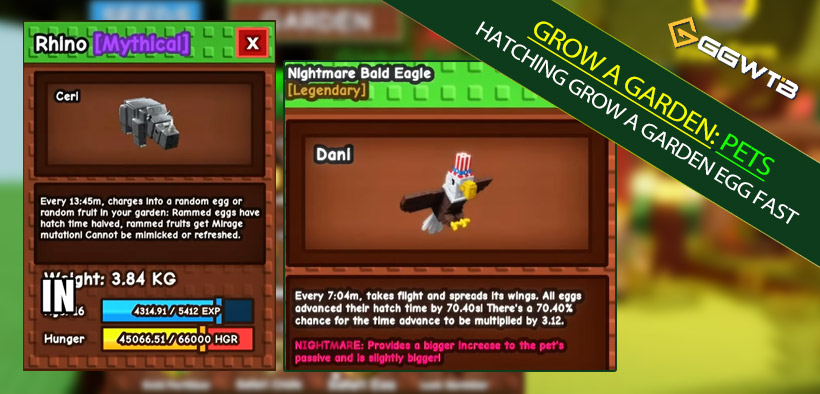
Rhino every 12 minutes targets a random egg or fruit.
If it hits an egg, that egg's remaining time is cut in half.
If it hits a fruit, it gives a Mirage mutation with no hatch-time gain that cycle.
The passive cannot be mimicked or refreshed by other Grow a Garden pets, and external cooldown shaves do not advance it.
It also requires crops in the garden; with no plants, it does not activate.
Bald Eagle every 7 minutes applies a global advance of 70 seconds to all eggs, with a 70 percent chance to triple the advance to 210 seconds.
It affects every egg at once and works well with cooldown accelerators like Titanic Wasp or Semi-Titanic Peacock, and with multiplier methods such as the Elephant method plus Nightmare or Rainbow mutations.
What this means
- - Rhino offers a high ceiling on a single target but is coin-flip random. A miss into fruit wastes 12 minutes.
- - Bald Eagle applies low-variance, garden-wide pressure that scales with more eggs and longer sessions.
Setup for Fair, Repeatable Results
I aligned eggs, timings, and synergies so outcomes are comparable and reproducible.
- - Egg type Safari egg at about 4 hours 10 minutes baseline per run.
- - Rhino run with five Rhinos, a medium toy for passive boost, crops planted to avoid passive stalls, and no cooldown cheese because Peacock and Wasp do not affect Rhino's passive.
- - Bald Eagle run with seven Bald Eagles, Titanic Wasp for periodic cooldown acceleration, Peacock also viable, and the Elephant method with Nightmare mutation to enable higher effective multipliers.
Controls
- - Multiple repetitions with the same egg type.
- - Synchronized activation windows.
- - Logs for Rhino hits and misses and for total seconds shaved by Bald Eagles.
Results in Practice
This is how the difference feels on your clock.
Rhino explosive when lucky, punishing when not
- - A hit halves the remaining time on a single egg and feels amazing.
- - Random targeting means some cycles hit eggs while others slam fruit for zero hatch value over a 12-minute window.
- - Synergy pitfalls include Peacock and Wasp not advancing the Rhino passive and the need for crops, or it never fires.
- - If you hatch one or two eggs and accept variance, Rhino can deliver jackpot moments. If you want predictable throughput or hatch multiple eggs, the randomness becomes a bottleneck.
Bald Eagle consistent and scalable
- - Every seven minutes all eggs advance by 70 seconds with a 70 percent chance of a 210 second advance.
- - With seven Eagles plus cooldown acceleration you see frequent garden-wide trims. Probability stacking makes triple events common in aggregate.
- - With the Elephant method and Nightmare mutation during synergy windows we observed effective six times equivalents across proc clusters.
- - With multiple eggs, Bald Eagle scales cleanly. Even on a single egg, long-session averages tend to outperform a streaky Rhino.
Pocket Math You Can Reuse
Translate feel into numbers you can plan around.
- Rhino expected value per 12-minute cycle in a mixed garden
If egg hit chance is roughly 50 percent, a hit on a 4h10m egg saves about 2h05m once, but misses give zero that cycle. With five Rhinos, independent randomness creates spiky outcomes with sessions that feel either godlike or stalled.
- Bald Eagle expected value per Eagle per 7 minutes
Expected seconds removed per egg equals 0.3 times 70 plus 0.7 times 210 which is 161 seconds. With N Eagles that is about 161 times N seconds per egg per seven minutes before multipliers. Cooldown acceleration and multiplier methods raise realized averages during burst windows, which is how you reach effective six times spikes across combined procs.
Implications
- - Single-target halving is huge on a hit, but randomness and non-synergy lower average throughput.
- - Global, stackable, low-variance trims win in multi-egg and long-session play.
Recommended Builds
Use these if you want faster hatches with minimal babysitting.
- Multi-egg speedrun
- Core five to seven Bald Eagles
- Accelerator Titanic Wasp or Semi-Titanic Peacock
- Method Elephant method plus Nightmare mutation
- Garden keep multiple eggs active and crops planted for overall compatibility
- Why stable global pressure that scales with egg count and time online
- Solo-egg high roll
- Core three to five Rhinos
- Garden ensure crops are planted to avoid passive stalls
- Support toys can boost passive frequency but do not fix targeting or cooldown immunity
- Why a high ceiling when charges line up with acceptance of drought periods
- Hybrid safety net
- Mix one to two Rhinos for occasional halves plus four to five Bald Eagles for baseline trims
- Rule keep at least four Eagles as your floor
- Why maintain a high average pace with the option for highlight spikes
FAQ
- Why do Peacock or Wasp not help Rhino
Rhino's charge is a special passive that is not advanced by external cooldown reductions. It is designed to be non-mimickable to prevent abuse.
- My Rhino did not charge for a long time. Is it a bug
Usually there are no crops planted. Rhino requires plants in the garden to activate.
- How many Bald Eagles are enough
Five is a clear inflection point. Seven with cooldown support feels very smooth.
- Does Bald Eagle help only one egg
It affects all eggs simultaneously. That coverage is its main advantage.
- Can Bald Eagle go beyond 3x
The base tick is 70 seconds with a 70 percent chance to triple to 210 seconds. With the Elephant method plus Nightmare and proper stacking, garden-level effective advances can spike higher across combined procs, producing observed six times equivalents.
- Early game budget plan
Start with three to four Bald Eagles plus one cooldown accelerator and keep two to three eggs active. Add the Elephant method and mutations later.
Summary
If your goal is fast and reliable egg hatching during real sessions, Bald Eagle is the current best choice. It trims every timer on a predictable beat, scales with each additional egg, and synergizes with cooldown accelerators and multiplier methods. Rhino is thrilling when it halves the right egg, but randomness, plant dependency, and cooldown immunity make it a specialist rather than a workhorse. Use Bald Eagles as your foundation and add one or two Rhinos only if you enjoy occasional jackpot moments and can tolerate dry spells.

Most Popular Posts
- Grow a Garden Secret Badge Walkthrough: Carrot Weight & Puzzle Guide
- Grow a Garden Get Secret Seeds & Rare Pets Guides: DLC Codes + Trading Guide
- Grow a Garden Enfield Guide: Everfallen Roll Rules & Level Loss
- Grow a Garden Moon Harvest Part 4 Guide: Gear Odds, Reset Rewards, Cornling Strategy, New Seeds
- Grow a Garden: Beanpod Chest Farming and Elder Beanstalk Guides
- Grow a Garden Arctic Fox Guide: Best AFK Setup for Seeds, Gears, Eggs & Pet XP
Popular Category Lists
- ARC Raiders / (351)
- Grow a Garden / (294)
- CoD: Black Ops 7 / (167)
- Star Citizen / (162)
- MLB 26 / (159)
- Monopoly Go / (152)
- ARK Survival Ascended / (128)
- Steal a Brainrot / (99)
- Blox Fruits / (74)
- Adopt Me / (74)
- Forza Horizon 6 / (72)
- Sailor Piece / (68)
- Grow a Garden 2 / (68)
- Diablo IV / (62)
- CoD: BLACK OPS 6 / (55)
- Aion 2 / (50)
- Path of Exile 2 / (48)
- Monster Hunter Wilds / (46)
- Windrose / (44)
- Donut SMP / (41)