



 0
0 Created: Aug 31,2026 | Maplestory Classic
MapleStory Classic Bossing Guide: How Dash, Teleport & Flash Jump Change Survival

Old Maple bossing had one question: do you have enough HP to survive the hit? MapleStory Classic is asking a different one: can you move before the hit lands?
Every class now carries a mobility tool — dash, flip, teleport, or flash jump. That single change breaks the old survival loop and replaces it with something harder to fake: pattern reading.
- Why Mobility Changes the Entire Bossing Loop
- The Old Loop: Bossing as an HP Exam
- The New Loop: Movement Is a Defensive Stat
- How Each Mobility Skill Actually Performs in a Boss Fight
- Dash: Pre-Position, Don't Tank
- Teleport: Precision Over Panic
- Flash Jump: Know Where You Land
- HP Washing Is Gone. Bossing Gets Harder to Fake
- Why HP Washing Was Such a Big Deal
- What Boss Damage Looks Like Without HP Washing
- Potion Cooldowns and Cleric Nerfs Break the Old Safety Net
- New Survival Priorities
- Potion Management: Old Habit vs. New Rule
- Boss Design Is Shifting Toward Original Content Like Forgotten Hollow
- Likely Boss Pattern Types
- How to Actually Play This: A Practical Bossing Loop
- Step 1: Learn Your Exact Movement Distance
- Step 2: Treat Mobility Like a Defensive Cooldown
- Step 3: Support Range, Not Stack Range
- Step 4: Stop Attacking During Lethal Patterns
- What This Means for Each Class Role
- Mages and Thieves Still Dodge Best
- Warriors Get the Biggest Upgrade
- Ranged Classes Still Need to Move
- FAQ
- Does mobility for every class make MapleStory Classic easier?
- Is HP washing completely irrelevant now?
- Are Clerics still worth bringing?
- How do we use Elixirs and Power Elixirs with cooldowns active?
- Move With Intent
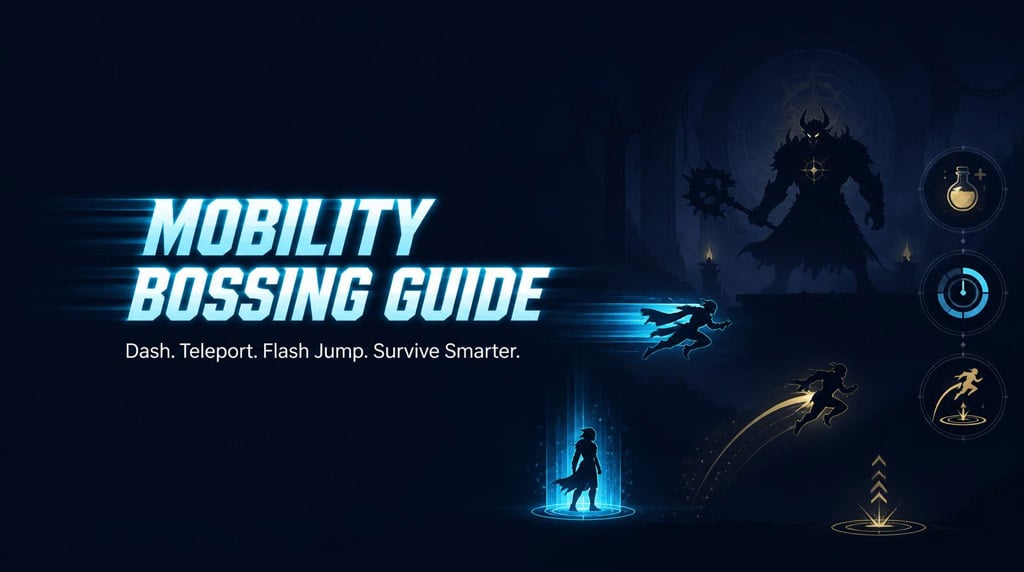
Here's what that means in practice. HP washing is gone. Cleric healing is nerfed. Elixirs and Power Elixirs now run on cooldowns. If you still play like it's the old stat-check era, the new bossing meta will punish you fast.
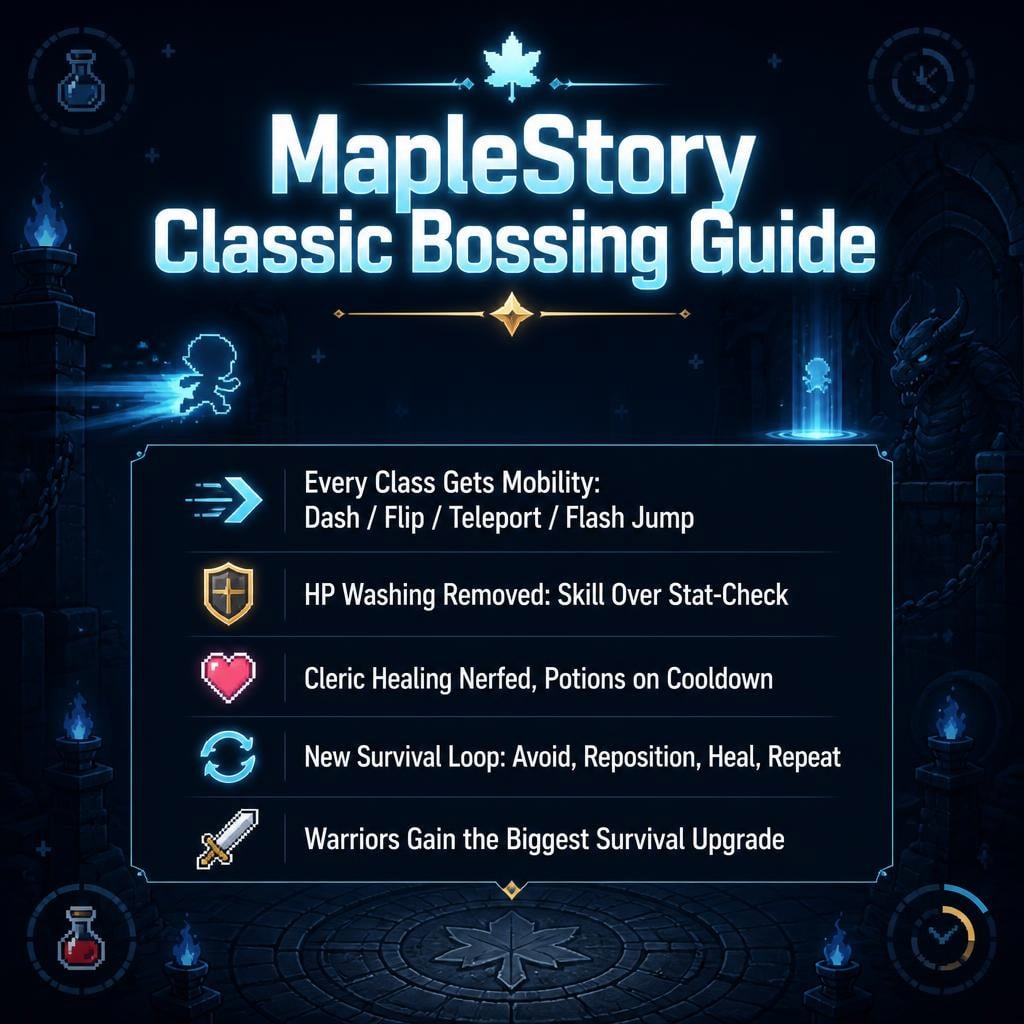
Why Mobility Changes the Entire Bossing Loop
Pain point: Old bossing didn't care how skilled you were. It cared whether your HP total cleared an invisible line.
Strategy: Give every class a way to dodge, and unavoidable one-shots stop being the design default.
Execution: Bosses can now build attacks around spacing and timing instead of raw damage thresholds.
Result: Skill starts to outweigh stat-padding.
The Old Loop: Bossing as an HP Exam
The classic loop looked like this:
1. Enter the fight.
2. Eat unavoidable damage.
3. Survive only if HP cleared the threshold.
4. Get topped off by a Cleric.
5. Repeat until the boss dies.
If your HP fell short, none of your mechanical skill mattered. You could know the boss perfectly and still get deleted by one hit. HP washing wasn't optimization — it was an entry fee.
The New Loop: Movement Is a Defensive Stat
If every class can dash, flip, teleport, or flash jump, bosses no longer need brutal HP checks to feel threatening. They can lean on spacing, timing, and platform control instead.
Here's the catch: easier entry does not mean easier fights. Expect cleaner execution requirements, not softer bosses.
How Each Mobility Skill Actually Performs in a Boss Fight
Not every movement tool solves the same problem. Treat your mobility skill like a panic button, and you'll burn it exactly when you need it most.
| Mobility Type | Best Use Case | Main Strength | Main Weakness | Bossing Impact |
|---|---|---|---|---|
| Dash | Horizontal repositioning | Fast ground movement | Weak vertical control | Dodges line attacks, repositions behind boss |
| Flip | Short evasive burst | Quick displacement | Needs precise timing | Beats close-range strikes and small hitboxes |
| Teleport | Instant repositioning | High control, high safety | Shorter range | Escapes targeted attacks cleanly |
| Flash Jump | Long aerial movement | Massive range | Easy to overshoot | Crosses arenas, dodges wide patterns |
Takeaway: mobility gives every class options, but it doesn't erase class identity. Mages and thieves still dodge cleanest — warriors, archers, and pirates just stop being helpless.
Dash: Pre-Position, Don't Tank
If your class dashes, your best defense happens before the danger appears, not after you're already boxed in.
Use dash to:
- Move behind the boss before a frontal cleave.
- Clear ground-based warning zones.
- Return to healing range after dodging.
Do not greed. Squeeze in one extra hit with your dash, and it won't be ready for the retaliation.
Teleport: Precision Over Panic
Teleport is the most controlled defensive tool in the game. If you're playing a mage-style class, it lets you shift through danger zones without abandoning your position entirely.
The risk is overconfidence. Teleport bails you out of bad spacing — and that safety net tempts you into standing where no other class would risk it.
Flash Jump: Know Where You Land
Flash jump buys distance fast. In a tight arena, too much distance becomes its own problem.
If you flash jump across the map and land outside healing range, you'll survive hit one and die to hit two — especially now that Cleric healing is weaker and potions run on cooldowns. Know your landing before you jump.
HP Washing Is Gone. Bossing Gets Harder to Fake
Pain point: HP washing gated boss access behind months of prep, not present-moment skill.
Strategy: Remove the threshold, and access depends on gear, level, and execution instead.
Execution: Boss damage becomes deliberate — avoidable big hits, moderate chip damage, and recovery windows.
Result: A death is now traceable to a mistake, not a missing stat.
Why HP Washing Was Such a Big Deal
If your class couldn't survive a key attack, you needed more HP — full stop. Fail to plan for it early, and your character felt permanently boxed in. This hit hardest for players who:
- Started without deep game knowledge.
- Picked fragile classes.
- Bossed casually.
- Never planned stats around late-game thresholds.
What Boss Damage Looks Like Without HP Washing
Expect a modernized damage profile:
1. Avoidable heavy hits that reward movement.
2. Moderate chip damage you can't fully dodge.
3. Arena hazards that force repositioning.
4. Combo patterns that punish panic movement.
5. Recovery windows where you heal and resume.
Why does this matter? Because now, if you die, you can name the mistake — bad positioning, late reaction, wasted potion, or standing too far from support.
Potion Cooldowns and Cleric Nerfs Break the Old Safety Net
Pain point: Old Maple let you tank a hit and instantly reset with a potion or a Priest.
Strategy: Nerf Cleric healing and put cooldowns on Elixirs and Power Elixirs.
Execution: Every hit now has lasting consequences — you may not be full HP before the next pattern arrives.
Result: Discipline beats inventory-spamming.
New Survival Priorities
Old Maple rewarded raw HP. Classic World rewards movement discipline. Think in this order:
1. Avoid the hit entirely.
2. If avoidance fails, reposition to reduce follow-up risk.
3. Heal only when it won't be wasted.
4. Stay near support without stacking dangerously.
5. Save mobility for lethal or overlapping patterns.
Potion Management: Old Habit vs. New Rule
Cooldowns turn potion spam into a liability. This table shows the shift.
| Situation | Old Maple Habit | Classic World Adjustment | Practical Rule |
|---|---|---|---|
| Taking one large hit | Instant Elixir | Check incoming pattern first | Heal after reaching safety |
| Standing near Cleric | Expect full recovery | Treat healing as support | Dodge first, heal second |
| Multiple chip hits | Potion through it | Avoid repeat mistakes | Move out before healing |
| Panic at low HP | Spam strongest potion | Cooldown may block it | Use mobility before potion |
| Boss burst phase | Tank while attacking | Prioritize survival window | Stop attacking during lethal patterns |
Takeaway: a player who dodges three medium hits will outperform a player who tanks everything and hopes the inventory saves them.
Boss Design Is Shifting Toward Original Content Like Forgotten Hollow
Official teasers point to new enemy types tied to what looks like original content — possibly Forgotten Hollow. That matters because original zones let developers build encounters for the new mobility rules instead of retrofitting old bosses.
Expect boss kits built around:
- Mobility-aware attack timing.
- Lower reliance on HP-washing thresholds.
- Potion cooldowns baked into balance.
- Meaningful party positioning.
When we ran comparable movement-heavy fights in modern MapleStory, the difference was immediate: lasers, delayed explosions, rotating safe zones, and timed bursts all work cleanly in a 2D arena. Classic World doesn't need to become full modern Maple to borrow that design logic.
Likely Boss Pattern Types
1. Telegraphed ground attacks — move out before impact.
2. Frontal cleaves — dash or teleport behind the boss.
3. Platform danger zones — rotate positions instead of camping.
4. Delayed projectiles — punish tunnel vision, reward patience.
5. Combo patterns — one attack forces movement, the next punishes a bad landing.
Pattern five matters most. If bosses chain attacks around mobility, the real skill test isn't dodging one hit — it's landing somewhere that keeps you safe from the next one.
How to Actually Play This: A Practical Bossing Loop
Pain point: Old damage-dealer habits get you killed under the new rules.
Strategy: Build three habits — pre-positioning, cooldown awareness, damage restraint.
Execution: Drill movement distance in regular maps before you take it into a boss room.
Result: Fewer panic deaths, more consistent DPS uptime.
Step 1: Learn Your Exact Movement Distance
Practice until the distance is automatic:
1. Stand at the edge of an enemy's attack range.
2. Fire your mobility skill once.
3. Note exactly where you land.
4. Repeat until you can predict it blind.
5. Drill stopping near platforms, ropes, and ledges.
Why does this matter for bossing? Panic movement kills more players than the boss does. Dodge one hit, overshoot the platform, land in a second hazard — and your potion cooldown won't bail you out.
Step 2: Treat Mobility Like a Defensive Cooldown
Do not burn your movement skill because it feels good. Save it for confirmed danger:
- Walk for minor adjustments.
- Mobility for confirmed attacks.
- Best mobility option saved for chained patterns.
If you keep taking damage right after dodging, you're using mobility too early or landing in a predictable danger zone.
Step 3: Support Range, Not Stack Range
Clerics still matter — nerfed healing isn't zero healing. But if the whole party stacks on the healer, one area attack turns into a party wipe. Stay close enough for support, far enough to avoid chain damage.
Step 4: Stop Attacking During Lethal Patterns
This sounds obvious until the boss sits at 2% HP. Do not greed. Losing two seconds of DPS beats losing the run. The best players aren't the ones with the highest theoretical damage — they're the ones still alive to deal it.
What This Means for Each Class Role
Every class getting mobility doesn't flatten the hierarchy. It sets a survival floor while class strengths still separate the field.
Mages and Thieves Still Dodge Best
Teleport and agile movement keep these classes on top for reactive bossing. Their real challenge is discipline — great mobility tempts aggressive positioning, and one delayed pattern punishes the overreach.
Warriors Get the Biggest Upgrade
Warriors used to suffer from short reach and clunky repositioning. Any mobility tool is a direct survival upgrade — sticking to bosses during movement phases, escaping close-range danger, and cutting healer dependency.
Ranged Classes Still Need to Move
Archers feel safer at range, but boss arenas rarely let anyone stand still forever. If platform hazards or delayed projectiles show up, ranged players rotate too — without retreating so far they lose healing range or trap themselves against a wall.
FAQ
Does mobility for every class make MapleStory Classic easier?
No — it makes bossing fairer, not easier. If every class can dodge, bosses can run more complex patterns without relying on unavoidable one-shots. That raises the skill ceiling; survival now depends on timing and awareness, not a hidden HP number.
Is HP washing completely irrelevant now?
For Classic World's direction, yes — as a required system. Boss access depends less on hidden thresholds and more on gear, level, and execution. HP still matters; it just no longer decides whether your character can participate at all.
Are Clerics still worth bringing?
Yes, but their role shifted. They're no longer a full-HP reset button — they're part of a broader survival plan. Dodge first, heal second.
How do we use Elixirs and Power Elixirs with cooldowns active?
Deliberately. If a cooldown is live, panic-spamming won't save you. Heal right after a pattern resolves, in the recovery window — never while standing inside the next attack.
Move With Intent
MapleStory Classic's bossing loop is shifting from HP checks toward pattern reading, potion discipline, and clean positioning. Master your movement distance, cut the greed during lethal windows, and respect your potion cooldown like it's a real resource — because it is.
Every clean dodge and every controlled landing is what separates a smooth clear from a wipe once Classic World's new bosses start testing whether you can do more than stand still and trade hits.

Most Popular Posts
- MapleStory Classic World CBT2: The No-BS Guide to 3rd Job, Orbis, and Class Reworks
- MapleStory Classic World Early Best Maps, PQ, and Party Spot): The No-BS 1-30 Leveling Guide
- Maplestory Classic Closed Beta #2: 3rd Job Skills, Class Reworks & What to Test First
- MapleStory Classic Early Leveling Guide: Best Maps, Fastest Route, Real Player Tips
- MapleStory Classic World Release Date Guide: Launch Date, Founder Access
- MapleStory Classic World Priest Guide: Skills, Nerfs and Holy Arrow build
Popular Category Lists
- ARC Raiders / (345)
- Grow a Garden / (292)
- CoD: Black Ops 7 / (167)
- Star Citizen / (161)
- MLB 26 / (159)
- Monopoly Go / (152)
- ARK Survival Ascended / (126)
- Steal a Brainrot / (98)
- Blox Fruits / (74)
- Adopt Me / (73)
- Forza Horizon 6 / (72)
- Sailor Piece / (68)
- Grow a Garden 2 / (68)
- Diablo IV / (62)
- CoD: BLACK OPS 6 / (55)
- Path of Exile 2 / (48)
- Monster Hunter Wilds / (46)
- Aion 2 / (46)
- Windrose / (44)
- Donut SMP / (41)