


 0
0 Created: Sep 14,2026 | Maplestory Classic
MapleStory Classic Meso Guide: Farm, Save, and Merch for Fast Profit

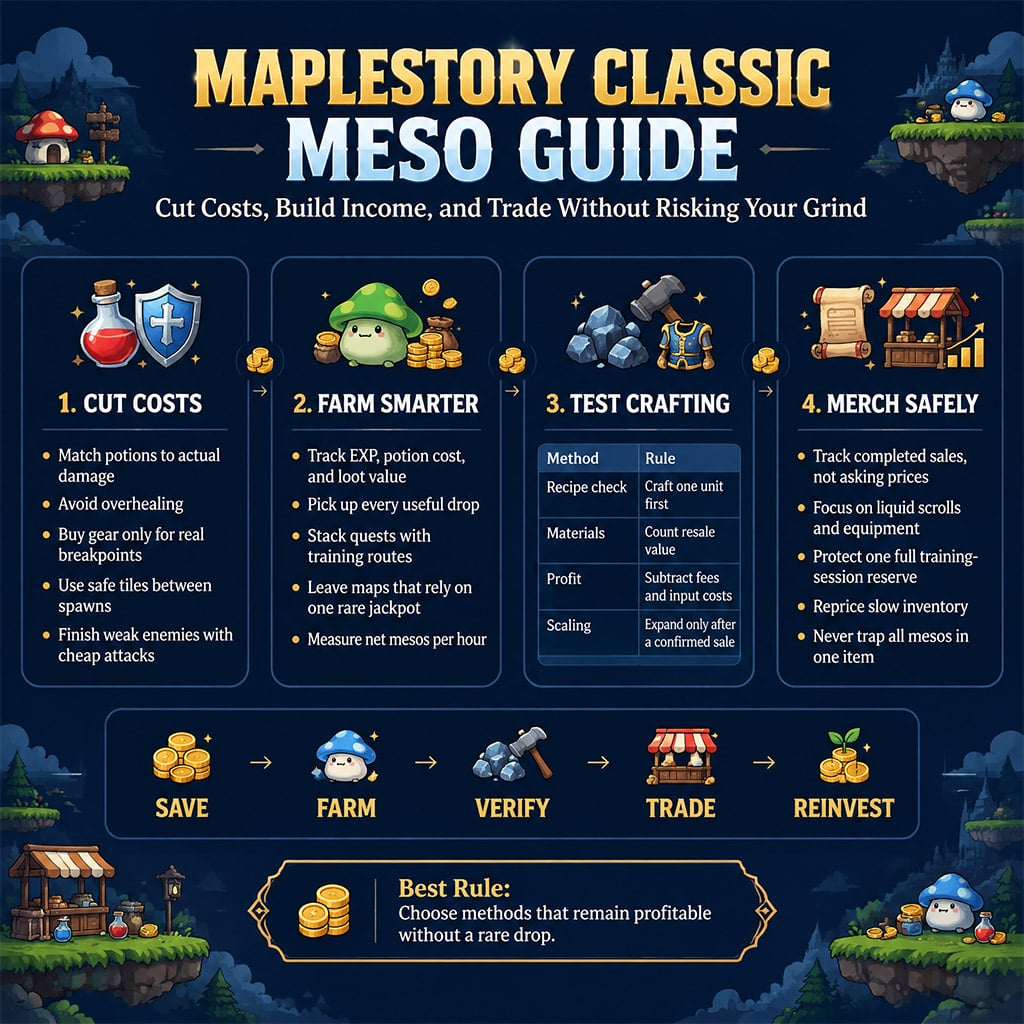
To make mesos early, cut potion waste first, keep your training profitable, and invest only in upgrades or items that improve future income. Rare drops can help, but efficient grinding, quests, verified crafting margins, and disciplined merching build a safer bankroll.
Global MapleStory Classic World enters Founder's Access on October 6, 2026, followed by Grand Launch on October 21, 2026. Nexon states that closed-test content may change before launch, so beta prices and drop assignments are not reliable launch guarantees.
- Stop Losing Mesos While Training
- Buy Potions Based on Net Training Value
- Buy Damage Breakpoints, Not Equipment Tiers
- Use Spawn-Safe Positions
- Stop Overkilling Low-Health Monsters
- Build Reliable Income From Every Grind
- Pick Up Everything, but Price Your Time
- Stack Quests With Existing Training Routes
- Measure Maps by Net Mesos per Hour
- Test Crafting Profit Before Scaling
- Merch Without Stalling Your Character
- Build Prices From Sales, Not Listings
- Specialize in Liquid Items
- Protect a Training Reserve
- Handle Fresh-Server Inflation Selectively
- Run a Ten-Minute Market Routine
- FAQ (Frequently Asked Questions)
- What is the fastest way to make mesos early in MapleStory Classic?
- Which monsters are best for early meso farming?
- Should you sell rare scrolls immediately?
- How much should you save before merching?
- When should you avoid crafting for profit?
Stop Losing Mesos While Training
The first problem is usually spending, not income. If potions and unnecessary equipment consume every drop, a lucky scroll only delays the next cash shortage.
Buy Potions Based on Net Training Value
Use the smallest consumable that restores your typical HP or MP loss without interrupting combat. Smaller potions reduce overhealing; larger ones become better when repeated inputs lower kills per minute or increase death risk.
| Recovery Method | Use It When | Avoid It When |
|---|---|---|
| Small HP potion | Monsters deal light, predictable damage | Repeated inputs disrupt attacks |
| Larger HP potion | Damage arrives in heavy bursts | Most recovery becomes overheal |
| Small MP potion | Your skill rotation uses MP steadily | Potion inputs interrupt your rotation |
| Larger MP potion | Downtime costs more than the price increase | Your skills produce excessive overkill |
| Chair recovery | You are waiting for a party or safe respawn cycle | Sitting replaces profitable combat time |
Use small potions for efficiency, then move up when input frequency—not item price—becomes the bottleneck.
Do not assume the cheapest recovery per point is always best. A larger potion can produce more net mesos per hour when it prevents deaths, missed attacks, or frequent interruptions.
Buy Damage Breakpoints, Not Equipment Tiers
Skip equipment that adds negligible defense without improving your farming speed. Prioritize purchases that:
- Reduce attacks required per kill.
- Fix an accuracy problem.
- Add relevant offensive stats.
- Reduce damage enough to lower potion use.
- Provide access to a stronger training area.
A weapon that changes a monster from a two-hit kill to a one-hit kill can justify its price. A more expensive weapon that leaves the kill count unchanged is often a cosmetic upgrade disguised as progression.
Test before buying: remove or equip the candidate upgrade, attack the same monster repeatedly, and compare hits to kill, misses, damage taken, and potion use. Do not pay for a change you cannot measure.
Use Spawn-Safe Positions
Standing on a monster's spawn point creates avoidable contact damage. Watch several respawn cycles, identify clear ledges, and move there before the next wave.
Use this map-reading routine:
1. Mark where each monster appears.
2. Track where it walks, jumps, or falls.
3. Identify nearby tiles without direct spawns.
4. Attack from platform edges where possible.
5. Reposition before the next cycle.
6. Reassess when party members alter monster movement.
This method performs poorly against flying monsters, teleporting enemies, or Best maps where spawns cover the full platform. In those cases, faster kills or a safer map matter more than precise positioning.
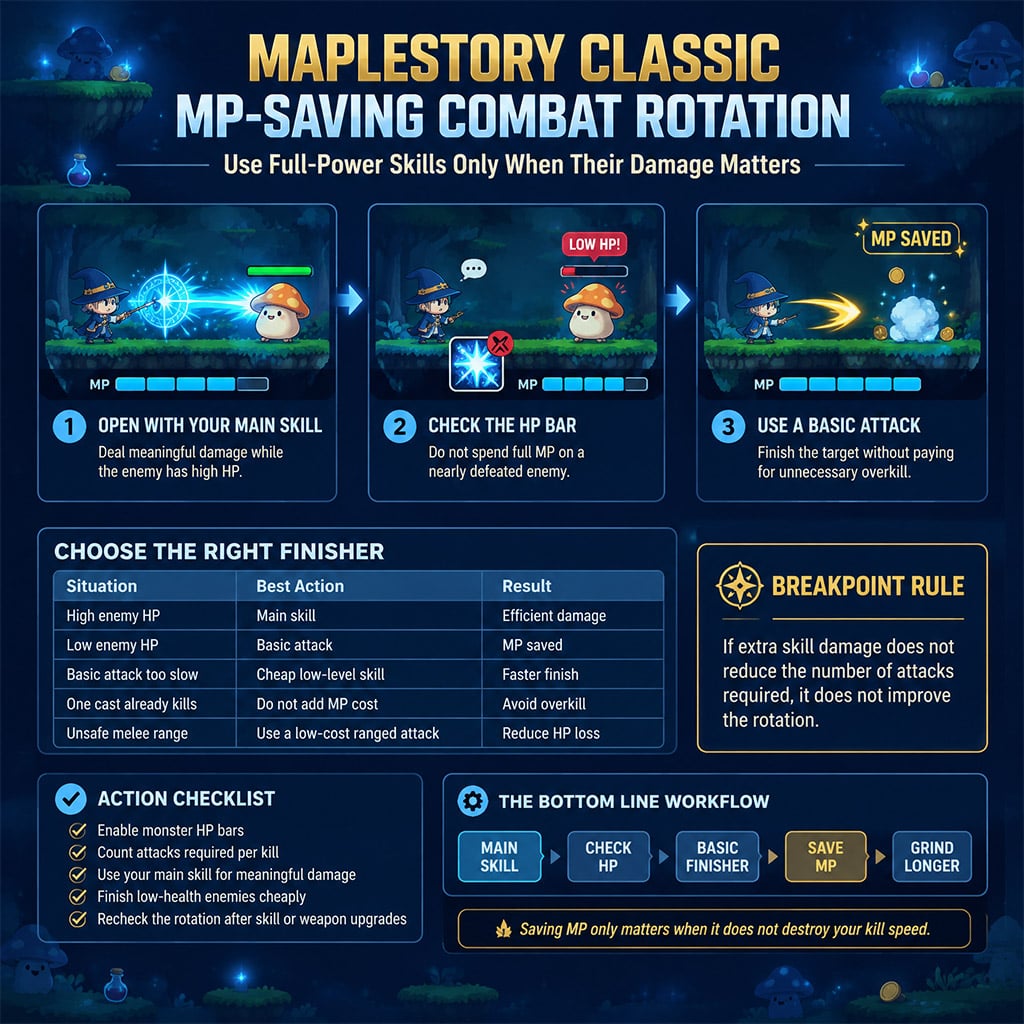
Stop Overkilling Low-Health Monsters
Use your main attack for meaningful damage, then finish nearly defeated monsters with a basic attack or cheaper skill. Enable monster HP bars when the client supports them.
Do not add skill levels blindly. If higher MP consumption does not reduce the number of casts required, the upgrade lowers economic efficiency.
Count casts, not damage numbers.
Build Reliable Income From Every Grind
Rare drops produce irregular profit. Ordinary loot, quests, NPC sales, and controlled spending must cover routine training costs.
Pick Up Everything, but Price Your Time
Collect equipment, ETC items, ores, consumables, arrows, and quest materials. Then compare:
- NPC sellback value.
- Realistic player price.
- Selling fees.
- Expected time to find a buyer.
- Inventory space consumed.
Selling a common weapon to another player may beat its NPC value. It still fails if earning a small premium requires 20 minutes of advertising.
Use this rule:
Player-sell scarce or immediately useful items; NPC common goods when the extra margin does not justify the delay.
The missing metric in most money guides is mesos earned per minute of selling effort. A lower instant price can outperform a higher price that stalls progression.
Stack Quests With Existing Training Routes
Accept quests before farming their required monsters. Quest rewards can replace potion purchases, provide travel items, award equipment, or generate direct mesos.
Follow four steps:
1. Group quests by town and monster.
2. Complete overlapping objectives together.
3. Value rewarded consumables by the purchases they replace.
4. Check the market before selling equipment or scroll rewards.
Do not travel across Victoria Island for a weak standalone reward. A quest becomes efficient when it overlaps with training, unlocks later content, or replaces meaningful spending.
Nexon's first closed test included Maple Island, Victoria Island, first and second job advancements, Kerning City Party Quest, and a new crafting system available from level 10. The second test later added Ossyria access and third-job testing, showing why test-era routes and markets can change with content availability. Sources: Closed Online Test Release Notes and Closed Online Test #2 Release Notes.
Measure Maps by Net Mesos per Hour
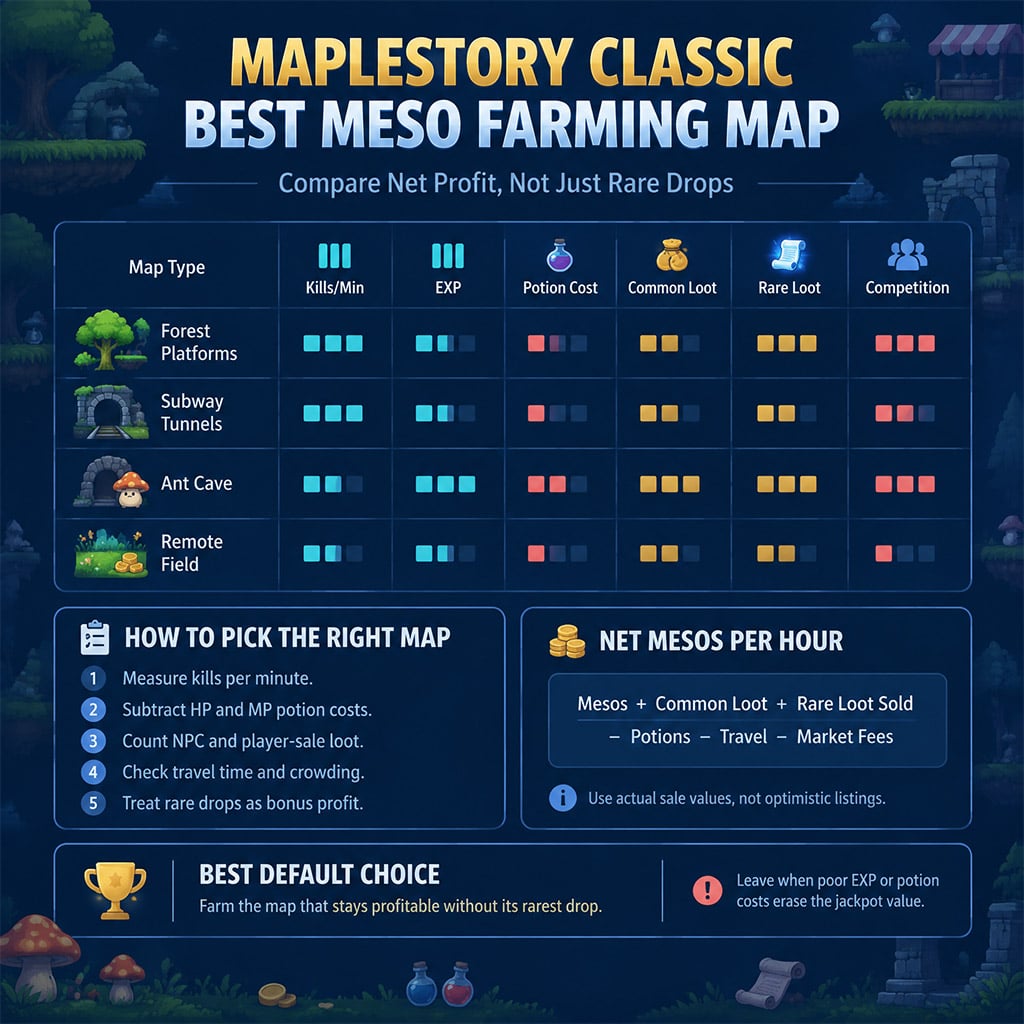
Do not choose a map solely because one monster may drop an expensive item. Compare the complete result:
| Factor | What to Measure | Failure Signal |
|---|---|---|
| Kill speed | Kills per minute | Monsters require too many attacks |
| Experience | EXP per hour | Progress stalls for a rare-drop chance |
| HP cost | Potions consumed per session | Contact damage erases common loot |
| MP cost | MP spent per kill | Overkill consumes the margin |
| Common loot | NPC and player-sale value | The map loses money without a jackpot |
| Rare loot | Demand and expected sale speed | The item is expensive but illiquid |
| Competition | Available monsters and interruptions | Crowding destroys the route |
Choose the map that remains worthwhile without its rarest drop.
This avoids the most common farming trap: staying at low-level monsters long after their experience becomes poor because one valuable scroll might appear.
Test Crafting Profit Before Scaling
Crafting profit depends on the value of every ingredient, not just the crafting fee. A material you farm yourself is not free; using it means giving up its NPC or player-sale value.
Calculate each recipe as:
Net profit = output sale value − ingredient value − crafting cost − transaction cost
As of September 14, 2026, MeowDB's community crafting database lists 348 recipes, with 11 classified as profit-positive against NPC values. Its model includes ingredient opportunity cost, but it does not model player-market prices.
Selected database entries illustrate the difference:
| Recipe | Listed Profit per Craft | Restriction |
|---|---|---|
| Iron Knuckle | +1,576 mesos | Farm-only inputs |
| Mithril Arrows for Crossbows ×500 | +1,170 mesos | Farm-only inputs |
| Adamantium Arrows for Bows ×500 | +1,070 mesos | Farm-only inputs |
| Iron Arrows for Bows ×500 | +880 mesos | Farm-only inputs |
| Iron Arrows for Crossbows ×500 | +880 mesos | Farm-only inputs |
Treat these as recipes to test, not guaranteed launch income. Nexon explicitly says closed-test content does not represent the final release version.
Before crafting in bulk:
1. Confirm the current recipe and quantity.
2. Record each ingredient's NPC and player value.
3. Include catalysts and crafting fees.
4. Craft one unit.
5. Confirm the output's sale value.
6. Scale only after the test sale succeeds.
A recipe may appear profitable against NPC prices while consuming an ingredient worth far more to another player. Check both markets.
Source: MeowDB Crafting Efficiency Guide.
Merch Without Stalling Your Character
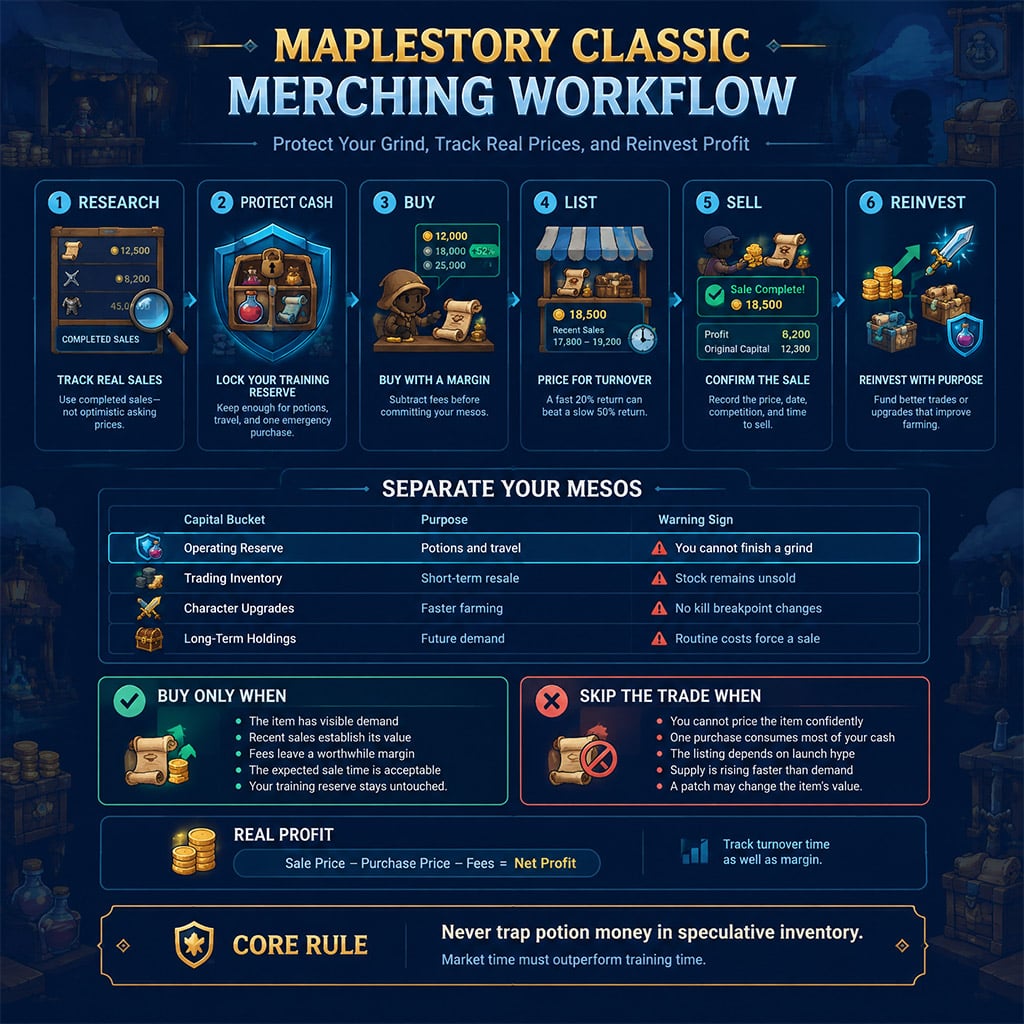
Merching works when buyers have money and items trade regularly. It fails when you invest your entire bankroll in unfamiliar stock.
Build Prices From Sales, Not Listings
An asking price shows what a seller wants. A completed sale shows what a buyer accepted.
Track:
- Exact item and scroll percentage.
- Equipment stats and remaining slots.
- Observed sale price.
- Date and time.
- Number of competing listings.
- Time required to sell.
- Applicable market or trade fee.
If an item repeatedly sells at 45,000–50,000 mesos but remains listed at 55,000, its working market range is below 55,000. One unusually cheap sale is an opportunity, not a new market price.
Specialize in Liquid Items
Do not learn every item at once. Track a narrow group with recurring demand:
- Popular weapon attack scrolls.
- Offensive glove scrolls.
- Throwing stars.
- Rare early shields.
- Above-average weapons.
- Proven quest or crafting materials.
Turnover matters more than headline margin. A 20% profit completed today can beat a 50% profit that traps your cash for a week.
Protect a Training Reserve
Keep enough liquid mesos for one full training session, travel, and an emergency purchase. Never use that reserve for speculative inventory.
| Capital Bucket | Purpose | Warning Sign |
|---|---|---|
| Operating reserve | Potions and travel | You cannot complete a normal grind |
| Trading inventory | Short-term resale | Stock remains unsold while better deals appear |
| Character upgrades | Higher farming output | The purchase changes no breakpoint |
| Long-term holdings | Inflation exposure | Routine expenses force an early sale |
Skip any trade that puts normal training at risk.
The required reserve depends on class, level, map, and potion consumption. Record the cost of one complete session instead of copying another player's fixed number.
Handle Fresh-Server Inflation Selectively
Fresh-server inflation does not make every item a good investment. Scarce scrolls and class-defining equipment may gain value as buyers accumulate mesos, while common equipment can fall as more copies enter the market.
Use these rules:
- Hold scarce items with recurring class demand.
- Sell common equipment before supply expands.
- Equip items that create a farming breakpoint.
- Avoid stockpiling goods sold cheaply by NPCs.
- Reprice inventory frequently during the opening weeks.
- Reduce exposure before major content or balance updates.
Nexon's Founder's Package page confirms Founder's Access on October 6, 2026, and Grand Launch on October 21, 2026. Package equipment is cosmetic and provides no stats or bonuses, so it should not affect combat-gear demand directly. Source: MapleStory Classic World Founder's Package.
Run a Ten-Minute Market Routine
Check the market between training sessions rather than camping it without a plan.
1. Deposit your operating reserve.
2. Review only tracked items.
3. Record credible sale prices.
4. Ignore items you cannot value.
5. Calculate profit after fees.
6. Buy only when demand is visible.
7. List near proven sale prices.
8. Return to training.
9. Discount stale stock before it blocks better trades.
Market time must outperform training time. If it does not, go back to the map.
FAQ (Frequently Asked Questions)
What is the fastest way to make mesos early in MapleStory Classic?
Combine low-cost grinding, complete looting, and quests that overlap with your training route. Add crafting or merching only after protecting enough cash for potions and travel.
Which monsters are best for early meso farming?
Farm monsters you can kill quickly without heavy potion use and whose common drops cover operating costs. Do not commit to a specific rare-drop target until its launch drop table is confirmed through current game data.
Should you sell rare scrolls immediately?
Sell when the proceeds fund potions, travel, or an upgrade that reduces hits to kill. Hold only when your operating reserve is secure and the item has durable demand rather than temporary launch hype.
How much should you save before merching?
Reserve the full cost of one training session, necessary travel, and one emergency purchase. Calculate that amount from your own potion usage because melee classes, ranged classes, and Magicians carry different operating costs.
When should you avoid crafting for profit?
Avoid bulk crafting when ingredient values, fees, output prices, or buyer demand remain unclear. Test one unit first and count self-farmed materials at the price you could receive by selling them.

I’m Emily Zhang, an American Research Writer at GGWTB covering Korean MMORPGs and games based on classic franchises. My guides focus on class choices, leveling routes, and long-term character progression. I look at what a class needs beyond its starter skills—and which upgrades are worth your materials before the next gear tier arrives.

Most Popular Posts
- MapleStory Classic World CBT2: The No-BS Guide to 3rd Job, Orbis, and Class Reworks
- MapleStory Classic World Early Best Maps, PQ, and Party Spot): The No-BS 1-30 Leveling Guide
- MapleStory Classic Early Leveling Guide: Best Maps, Fastest Route, Real Player Tips
- MapleStory Classic World Release Date Guide: Launch Date, Founder Access
- MapleStory Classic Mage Guide: 1st & 2nd Job Builds, AP & Routes
- MapleStory Classic World Priest Guide: Skills, Nerfs and Holy Arrow build
Popular Category Lists
- ARC Raiders / (356)
- Grow a Garden / (294)
- CoD: Black Ops 7 / (167)
- Star Citizen / (163)
- MLB 26 / (159)
- Monopoly Go / (153)
- ARK Survival Ascended / (128)
- Steal a Brainrot / (99)
- Blox Fruits / (74)
- Adopt Me / (74)
- Forza Horizon 6 / (72)
- Sailor Piece / (68)
- Grow a Garden 2 / (68)
- Diablo IV / (62)
- CoD: BLACK OPS 6 / (55)
- Aion 2 / (53)
- Path of Exile 2 / (48)
- Monster Hunter Wilds / (46)
- Windrose / (44)
- COD: Modern Warfare 4 / (44)