



 0
0 Created: Oct 11,2026 | Maplestory Classic
MapleStory Classic Mesos Farming: Class Choices and Profit Guide

If your mesos barely increase after training, compare loot value against potion consumption before changing classes. We use route efficiency, replacement costs, and completed sales to identify profitable farming—not kill speed alone.

- Choose a Route Your Class Can Clear Efficiently
- Match the class to the route
- Measure Profit Without Overvaluing Drops
- Distinguish wallet growth from sustainable profit
- Save Resources and Sell Drops Without Losing Time
- Buy usable recovery
- Compare upgrades by practical results
- Set a selling deadline
- FAQ (Frequently Asked Questions)
- What is the best MapleStory Classic class for farming mesos?
- How do we calculate net mesos per hour?
- Should we use basic attacks to save MP?
- Should we sell equipment to players or NPCs?
- Should we upgrade our weapon or armor first?
Choose a Route Your Class Can Clear Efficiently
There is no supported net-income ranking in the available material. Use each class's attack pattern to shortlist maps, then test the results under your server's current mechanics.
Match the class to the route
Start with these route characteristics.
| Class | Route to test | Reason to reject it |
|---|---|---|
| Ice/Lightning | Accessible groups within its area attack | Sparse targets or excessive MP consumption |
| Cleric | Enemies susceptible to its current damage skills | Advice relies on mechanics your server does not use |
| Assassin | Scattered targets with reliable quick kills | Frequent finishing attacks |
| Crossbowman | Floors with enemies aligned along its attack path | Split platforms require repeated repositioning |
| Hunter | Groups consistently reachable by its area attack | Close-range interference interrupts clearing |
| Spearman, Fighter, Page | Compact floors with reachable packs | Climbing, chasing, and misses dominate |
| Bandit | Nearby targets it finishes efficiently | Travel takes longer than attacking |
| Fire/Poison | Targets with affordable complete kill cycles | Survivors require repeated cleanup passes |
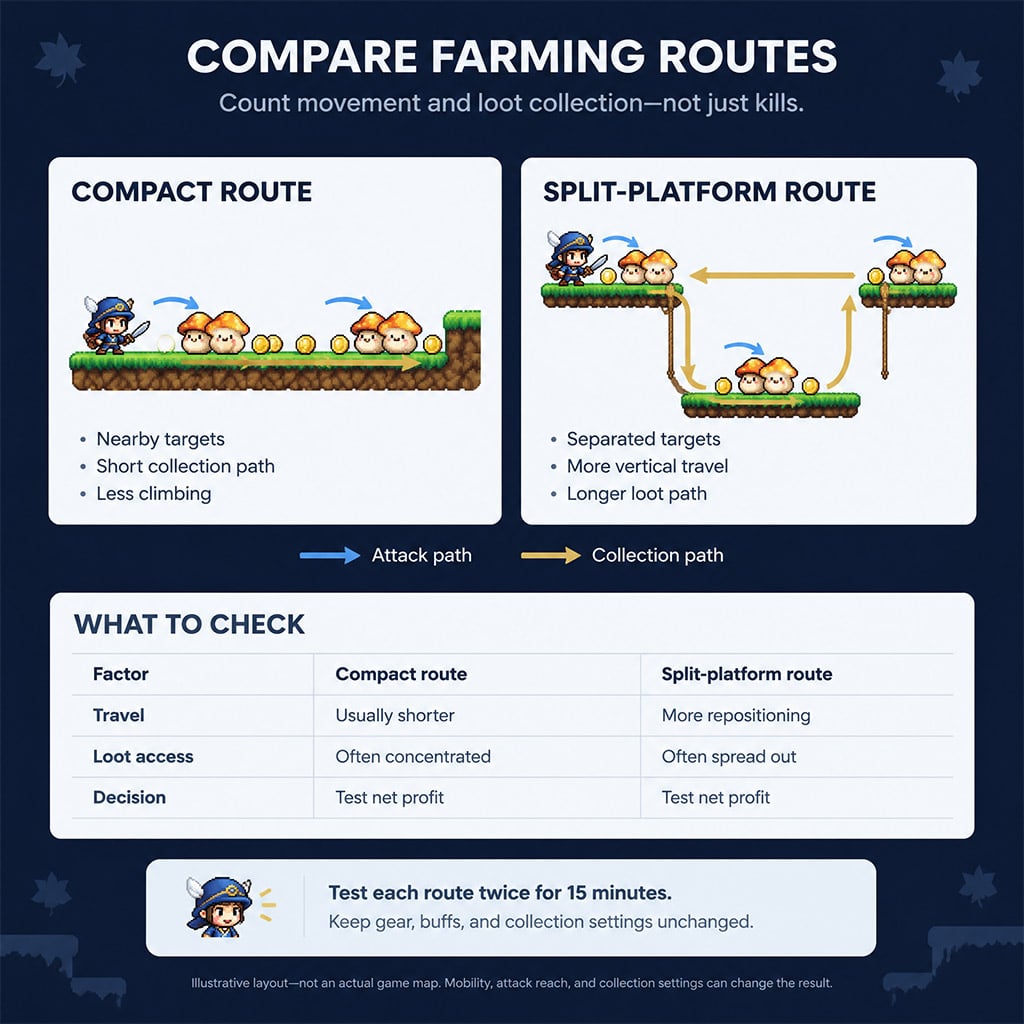
Reject a route when movement and unfinished enemies consume its apparent damage advantage.
Fast clearing can also scatter loot across awkward platforms. If you collect drops manually, include the collection path; if you use a pet, keep its settings consistent across tests.
Measure Profit Without Overvaluing Drops
Run two 15-minute sessions per candidate map with unchanged equipment, buffs, and collection rules. These are screening tests, not enough evidence to establish a class leaderboard.
Record the following.
| Measure | Recording rule |
|---|---|
| Mesos collected | Exclude transfers, trades, and unrelated rewards |
| Consumables used | Count units consumed, including supplies from existing stock |
| Loot retained | Use NPC sell value as a conservative baseline |
| Recurring expenses | Include travel and applicable operating costs |
| Experience gained | Track separately from income |
| Interruptions | Note competition, deaths, disconnects, and long detours |
Repeat close results and extend tests dominated by one rare drop.
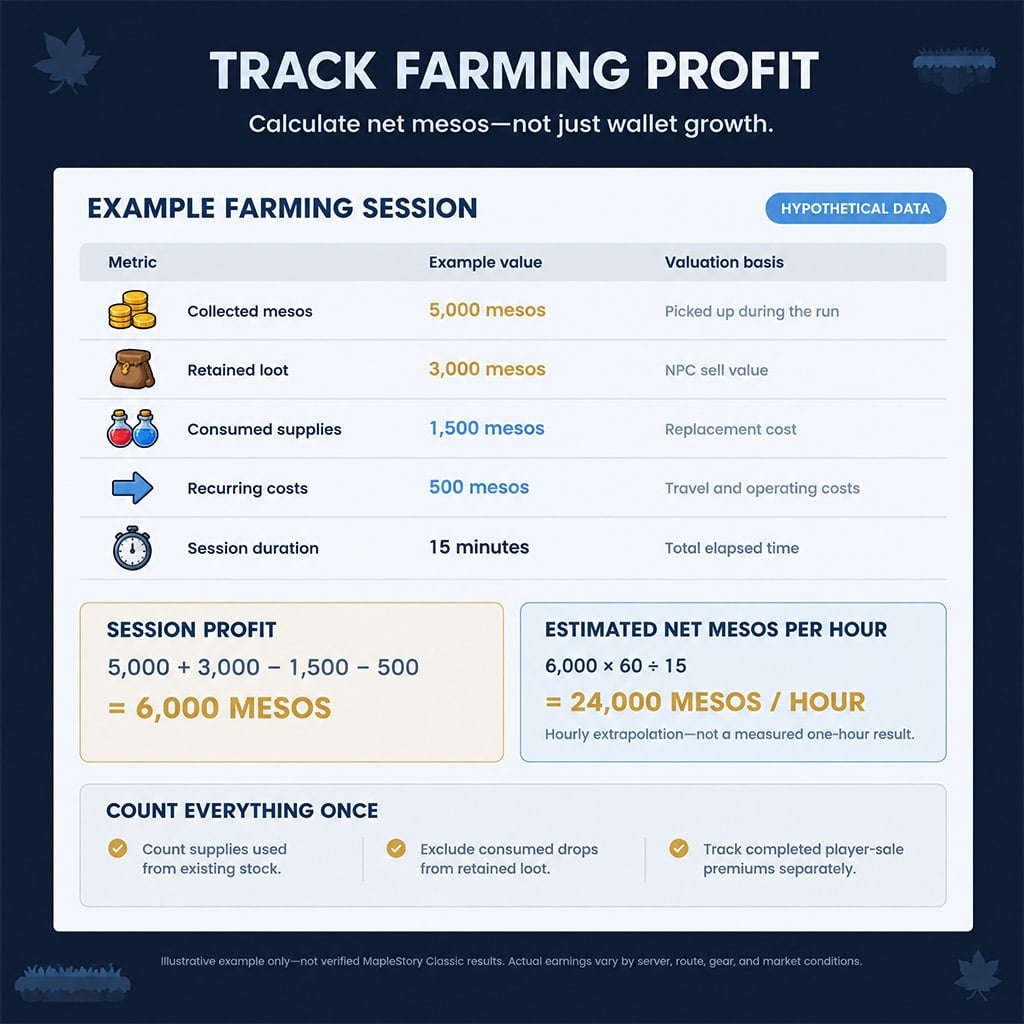
We calculate operating profit by adding collected mesos and retained loot value, then subtracting consumable replacement and recurring expenses. Divide by the session's duration in hours for an hourly estimate.
Do not count the same item twice. A dropped potion consumed during the run belongs in supply consumption, not retained loot.
Distinguish wallet growth from sustainable profit
Using stocked potions can make your wallet rise while depleting valuable supplies. We price consumed units at a consistent replenishment cost to expose that expense.
For a broader sell-versus-use decision, also consider what those supplies could realistically earn through disposal. Do not switch valuation methods between maps.
Save Resources and Sell Drops Without Losing Time
Cut a finishing cast only when the alternative stays safe and keeps the route moving. Basic attacks that miss, cause contact damage, or delay the next pack can cost more than they save.
Buy usable recovery
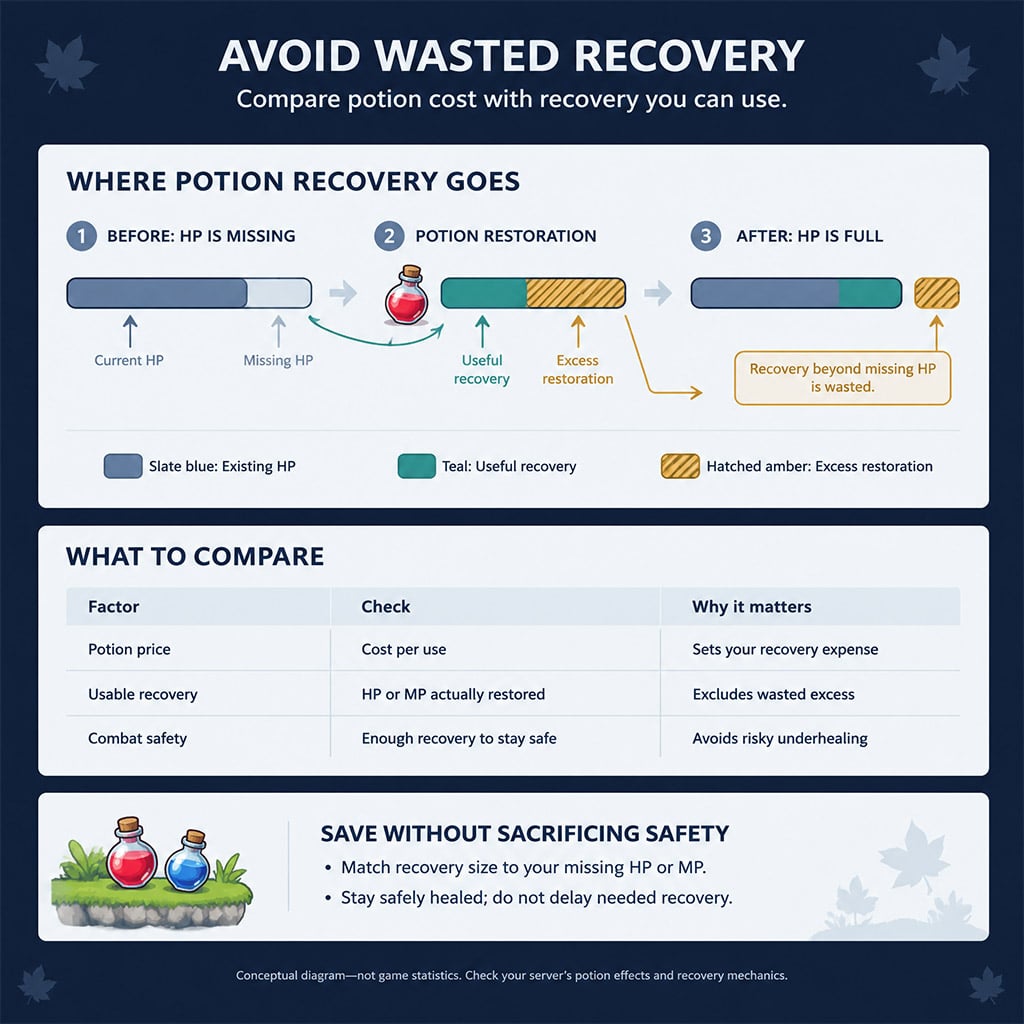
Compare potion price with restoration you can actually use. Healing beyond your missing HP or MP wastes part of the purchase.
Include MP consumed by defensive mechanics where applicable. An HP-only calculation can understate recovery spending.
Compare upgrades by practical results
| Option | Prioritize when | Defer when |
|---|---|---|
| Weapon | It reliably removes an attack per kill | Extra damage leaves the kill cycle unchanged |
| Armor | Unavoidable damage prevents sustainable farming | Measured savings do not justify its cost |
| Quest reward | It replaces a purchase with little additional travel | Attempts and required materials outweigh the benefit |
| Player-sold equipment | Comparable usable stats cost less | Requirements or item quality do not match |
Buy the improvement that changes your route's results, not simply the larger stat number.
Test armor using the same character, enemy, and active skills. Comparing damage taken by different classes cannot isolate an armor upgrade's effect.
Set a selling deadline
Compare the completed player-sale proceeds with NPC disposal value, after applicable costs. The NPC purchase price helps explain a buyer's alternative; it does not establish your selling premium.
If arranging a trade consumes more valuable farming time than the premium earns, use the faster disposal option.
Keep only materials needed for a confirmed near-term recipe. Selling them now and repurchasing them later can erase the original gain.
FAQ (Frequently Asked Questions)
What is the best MapleStory Classic class for farming mesos?
No universal net-income winner is established by the available evidence. We shortlist classes by map layout, then compare recovery costs, completed kills, and collection time.
How do we calculate net mesos per hour?
Add collected mesos and conservatively valued retained loot, subtract recurring costs, then divide by session hours. Count consumed supplies even when they came from existing stock, and record completed player-sale premiums separately.
Should we use basic attacks to save MP?
Only when they safely finish enemies without delaying productive clearing. Keep using the skill if basic attacks cause damage, miss, or interrupt the route.
Should we sell equipment to players or NPCs?
Sell to players when the additional proceeds justify trading time and applicable costs. Use NPC disposal when demand is weak or the premium is too small.
Should we upgrade our weapon or armor first?
Upgrade the item that fixes your measured farming problem. Favor a weapon that reduces attacks per kill; favor armor when unavoidable damage or deaths prevent consistent sessions.

I’m Emily Zhang, an American Research Writer at GGWTB covering Korean MMORPGs and games based on classic franchises. My guides focus on class choices, leveling routes, and long-term character progression. I look at what a class needs beyond its starter skills—and which upgrades are worth your materials before the next gear tier arrives.

Most Popular Posts
- MapleStory Classic World CBT2: The No-BS Guide to 3rd Job, Orbis, and Class Reworks
- MapleStory Classic World Early Best Maps, PQ, and Party Spot): The No-BS 1-30 Leveling Guide
- Maplestory Classic Closed Beta #2: 3rd Job Skills, Class Reworks & What to Test First
- MapleStory Classic Early Leveling Guide: Best Maps, Fastest Route, Real Player Tips
- MapleStory Classic World Release Date Guide: Launch Date, Founder Access
- MapleStory Classic World Priest Guide: Skills, Nerfs and Holy Arrow build
Popular Category Lists
- ARC Raiders / (345)
- Grow a Garden / (292)
- CoD: Black Ops 7 / (167)
- Star Citizen / (161)
- MLB 26 / (159)
- Monopoly Go / (152)
- ARK Survival Ascended / (126)
- Steal a Brainrot / (98)
- Blox Fruits / (74)
- Adopt Me / (73)
- Forza Horizon 6 / (72)
- Sailor Piece / (68)
- Grow a Garden 2 / (68)
- Diablo IV / (62)
- CoD: BLACK OPS 6 / (55)
- Path of Exile 2 / (48)
- Monster Hunter Wilds / (46)
- Aion 2 / (46)
- Windrose / (44)
- Donut SMP / (41)