


 0
0 Created: Sep 26,2026 | Maplestory Classic
MapleStory Classic Mesos Farming: Net-Profit Testing & Route Triage

High-damage mobbing means nothing if potion upkeep drains your inventory before you visit an NPC. Reliable early-game wealth accumulation relies entirely on net meso yield per hour—not rare drop speculation or volatile free-market listings.

- The Net-Yield Formula: Quantify Actual Income
- Triage Monster Drops: Liquidation vs. Speculation
- Verify Server Mechanics and Economy Rules
- FAQ (Frequently Asked Questions)
- What is the most reliable beginner meso farming map?
- Should I farm lower-level monsters to minimize potion burn?
- When should I choose the Free Market over direct NPC liquidation?
- How should rare drops and scrolls factor into my farming benchmarks?
- Do modern meso strategies like boss crystal farming apply to classic environments?
The Net-Yield Formula: Quantify Actual Income
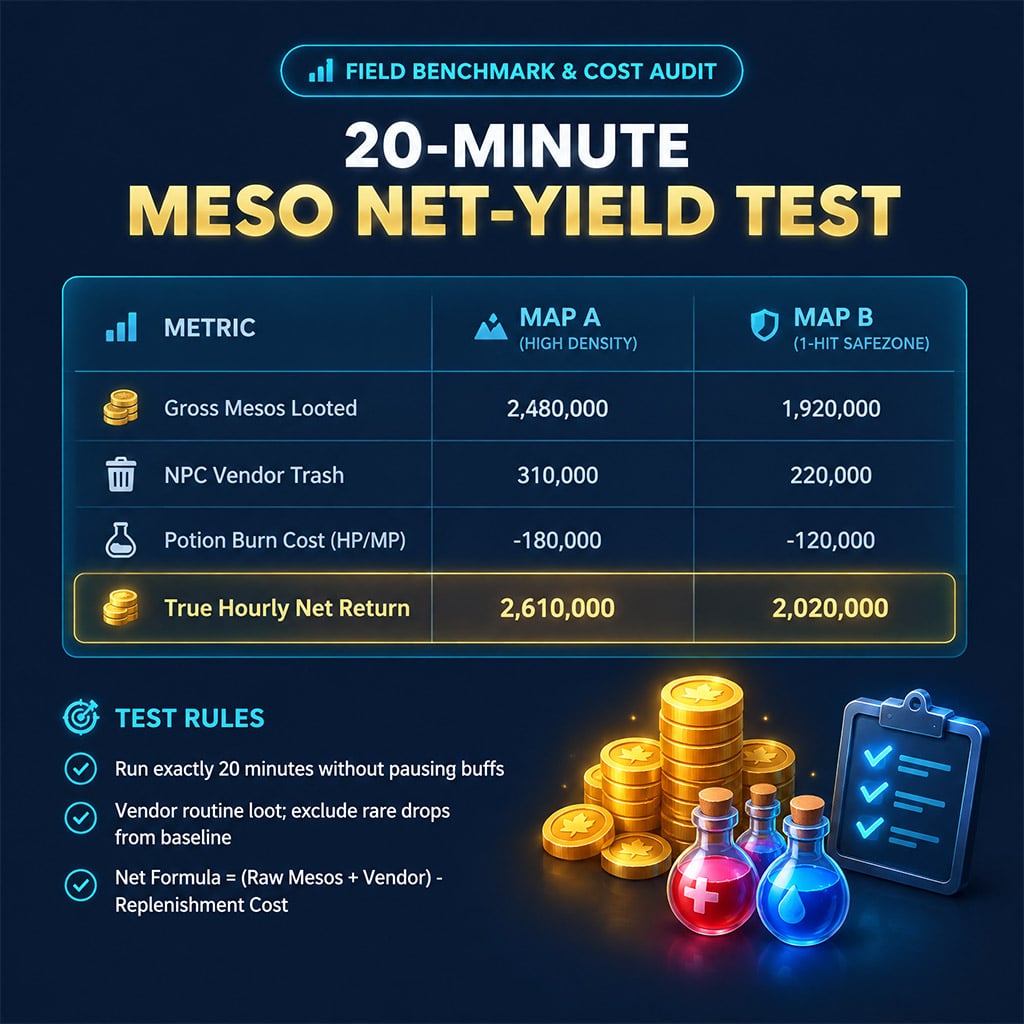
Never evaluate a farming location by its gross monster meso drops. Calculate your true operational profit using this baseline benchmark:
Net Meso Rate = (Raw Mesos+NPC Vendor Trash) − (HP/MP Potions Consumed+Travel / Town Return Costs)
To lock in an accurate, reproducible baseline, run a strict 20-minute field test:
1. Clear and Log: Empty your 'Etc' and 'Use' inventories of all trade goods. Record your exact starting meso balance and consumable stack counts.
2. Execute a Timed Hunt: Grind for precisely 20 minutes without pausing, using only standard rotations and sustainable buffs.
3. Liquidate Immediately: Vendor all common monster drops, unneeded equipment, and misc items directly to an NPC. Do not factor in potential market value.
4. Deduct Replenishment Costs: Multiply the number of white/blue potions or food items consumed during the run by their merchant purchase price, then subtract that sum from your gross income.
5. Scale to 60 Minutes: Multiply the resulting figure by 3 to calculate your deterministic hourly floor.
Retest immediately if an unexpected high-value scroll or rare equip drops during the 20-minute window; rare drops belong in a speculative side-ledger, not your baseline operational budget.
Triage Monster Drops: Liquidation vs. Speculation
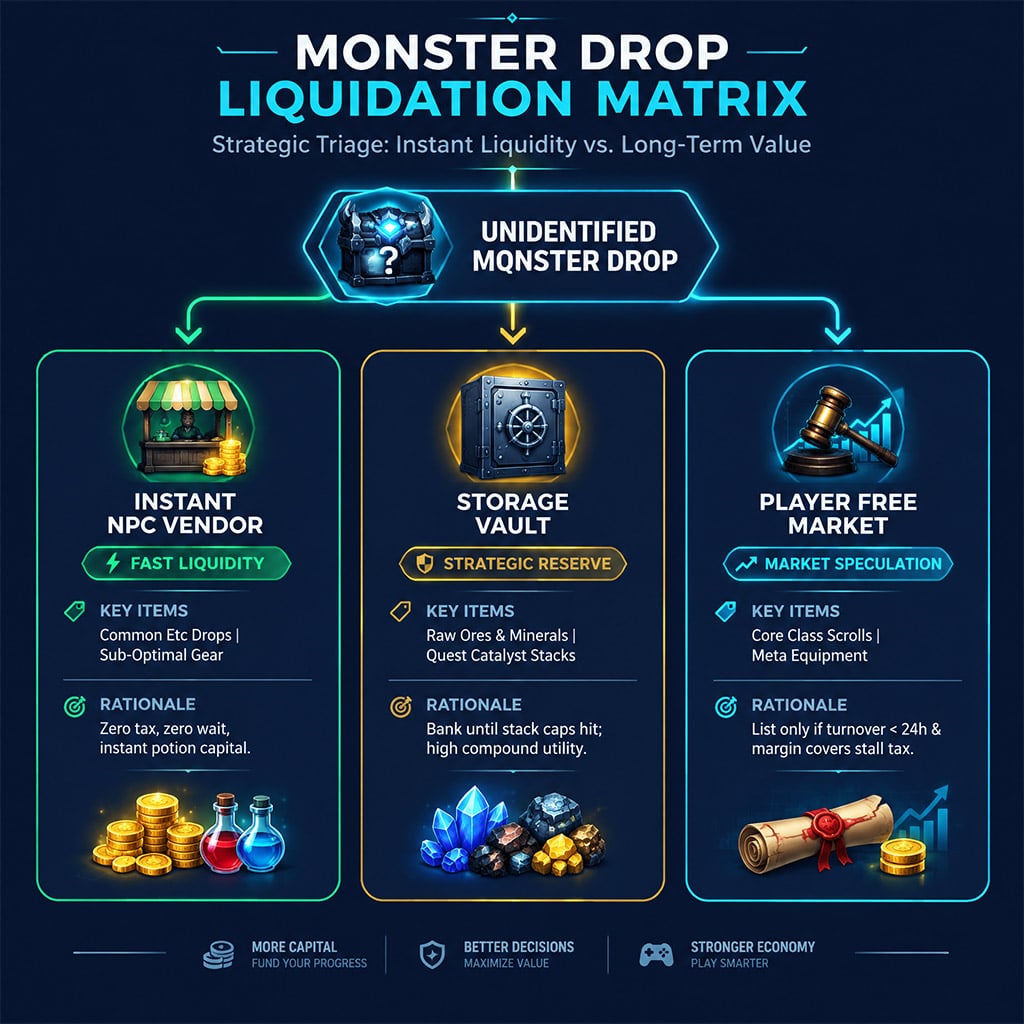
Early game progression collapses when players hoard inventory items hoping for free-market premiums that carry high transaction costs or negligible turnover.
| Drop Classification | Primary Action | Operational Justification |
|---|---|---|
| Common Monster 'Etc' Items | Vendor to NPC immediately | Yields guaranteed, zero-risk liquidity required for sustained potion cycles without market taxes. |
| Raw Crafting Ores & Refined Minerals | Bank in storage until stack caps hit | Low unit value creates negative opportunity cost if sold prematurely; holds compound utility for late-game forge projects. |
| Class-Specific Gear (Sub-Optimal Stats) | Vendor to NPC directly | Market transaction fees and listing latency routinely outstrip realized gains on common-tier equipment drops. |
| High-Tier Equipment / Core Class Scrolls | Track player-market clears before selling | Realize cash flow only when average listing speed is under 24 hours and net margin comfortably covers platform cut. |
| Unscrolled Weapons Requiring Setup | Skip upgrading entirely | Avoid gambling limited capital on scroll variance; low-percentage failure directly liquidates your working capital. |
Verify Server Mechanics and Economy Rules
Most public farming guides combine mechanics from post-Big Bang patches, modern private frameworks, or disparate MapleStory Worlds templates.
Never base your economic strategy on modern progression systems:
- Exclude Modern Systems: Disregard any guide recommending Potential lines, Bonus Potential, Cubes, Transfer Hammers, or Star Force enhancement systems unless specifically present in your server's design document.
- Factor Mob Collision Damage: In authentic classic iterations, mob touch damage is often your single highest operational expense. If a monster takes three or four hits to clear and consistently hits back, potion drain typically flips net profit negative.
- Confirm Loot Ownership Rules: Loot drop permanence and pet auto-looting latency directly cap how many raw meso drops you can collect before despawn timers trigger. If vertical mobility is slow, flat, single-tier maps consistently beat multi-platform zones regardless of mob density.
FAQ (Frequently Asked Questions)
What is the most reliable beginner meso farming map?
The optimal map is whichever single-tier or easily looped zone allows you to consistently dispatch monsters in 1 to 2 hits while breaking even on consumable recovery. A named meta map will drain your capital if your class mobility cannot sustain the map's layout or if the monsters inflict high touch damage.
Should I farm lower-level monsters to minimize potion burn?
Yes, down-tier farming is often the most cost-effective path if clearing weaker mobs drops your consumable burn rate to zero. If you can eliminate damage intake entirely through positioning, safe ranges, or passive regen, your gross loot becomes 100% net profit.
When should I choose the Free Market over direct NPC liquidation?
List items on the player market only when verified transaction prices exceed vendor prices by an amount substantial enough to offset trade taxes, market stall costs, and the downtime of listing. Common equipment and standard quest items rarely justify player-to-player trade overhead.
How should rare drops and scrolls factor into my farming benchmarks?
Treat rare drops as anomalous windfalls rather than recurring income. Exclude 1% or 0.1% drops from your hourly revenue calculations so you can confirm whether the map remains self-sustaining when drop luck runs cold.
Do modern meso strategies like boss crystal farming apply to classic environments?
No. Classic server rulesets rarely feature standardized intense power crystals, automated queue rewards, or modern daily boss payouts. Sustainable income relies almost entirely on raw field meso drops, efficient vendor liquidation, and smart inventory management.

I’m Emily Zhang, an American Research Writer at GGWTB covering Korean MMORPGs and games based on classic franchises. My guides focus on class choices, leveling routes, and long-term character progression. I look at what a class needs beyond its starter skills—and which upgrades are worth your materials before the next gear tier arrives.

Most Popular Posts
- MapleStory Classic World CBT2: The No-BS Guide to 3rd Job, Orbis, and Class Reworks
- MapleStory Classic World Early Best Maps, PQ, and Party Spot): The No-BS 1-30 Leveling Guide
- Maplestory Classic Closed Beta #2: 3rd Job Skills, Class Reworks & What to Test First
- MapleStory Classic Early Leveling Guide: Best Maps, Fastest Route, Real Player Tips
- MapleStory Classic World Release Date Guide: Launch Date, Founder Access
- MapleStory Classic World Priest Guide: Skills, Nerfs and Holy Arrow build
Popular Category Lists
- ARC Raiders / (350)
- Grow a Garden / (294)
- CoD: Black Ops 7 / (167)
- Star Citizen / (162)
- MLB 26 / (159)
- Monopoly Go / (152)
- ARK Survival Ascended / (127)
- Steal a Brainrot / (99)
- Blox Fruits / (74)
- Adopt Me / (74)
- Forza Horizon 6 / (72)
- Sailor Piece / (68)
- Grow a Garden 2 / (68)
- Diablo IV / (62)
- CoD: BLACK OPS 6 / (55)
- Aion 2 / (50)
- Path of Exile 2 / (48)
- Monster Hunter Wilds / (46)
- Windrose / (44)
- Donut SMP / (41)