


 0
0 Created: Apr 13,2026 | MLB 26
MLB The Show 26 Best Settings, Hitting, Pitching, and Diamond Dynasty Advice Tips

MLB The Show 26 does not reinvent the series, but it changes enough small systems that a lot of players feel off early. That usually shows up in familiar ways: late swings on hittable fastballs, weak PCI placement, extra bloop hits on defense, or wasting MLB stubs in Diamond Dynasty.
After putting time into the game across offline grind modes and competitive settings, the biggest takeaway is simple: the players who improve fastest are the ones who clean up the basics first. That means using the right camera, reading the full card instead of the summary rating, choosing an input method that fits your skill level, and not treating defense like an afterthought.
Below is a practical breakdown of the MLB The Show 26 tips that matter most.
- Ratings the Right Way
- The most important hitting and pitching ratings
- Best MLB The Show 26 Settings to Change First
- Settings worth using right away
- Best Hitting and Pitching Interfaces
- Hitting options
- Pitching options
- Defense Matters More Than Many Players Expect
- Defensive priorities
- Small Gameplay Mechanics That Create Easy Value
- A few simple mechanics to learn
- Diamond Dynasty Tips That Save Time and Stubs
- Best early Diamond Dynasty habits
- FAQ
- What is the best hitting interface in MLB The Show 26?
- What is the best pitching interface in MLB The Show 26?
- What settings should we change first in MLB The Show 26?
- Does defense really matter in MLB The Show 26?
- How should we earn stubs early in Diamond Dynasty?
- Final Thoughts
Ratings the Right Way
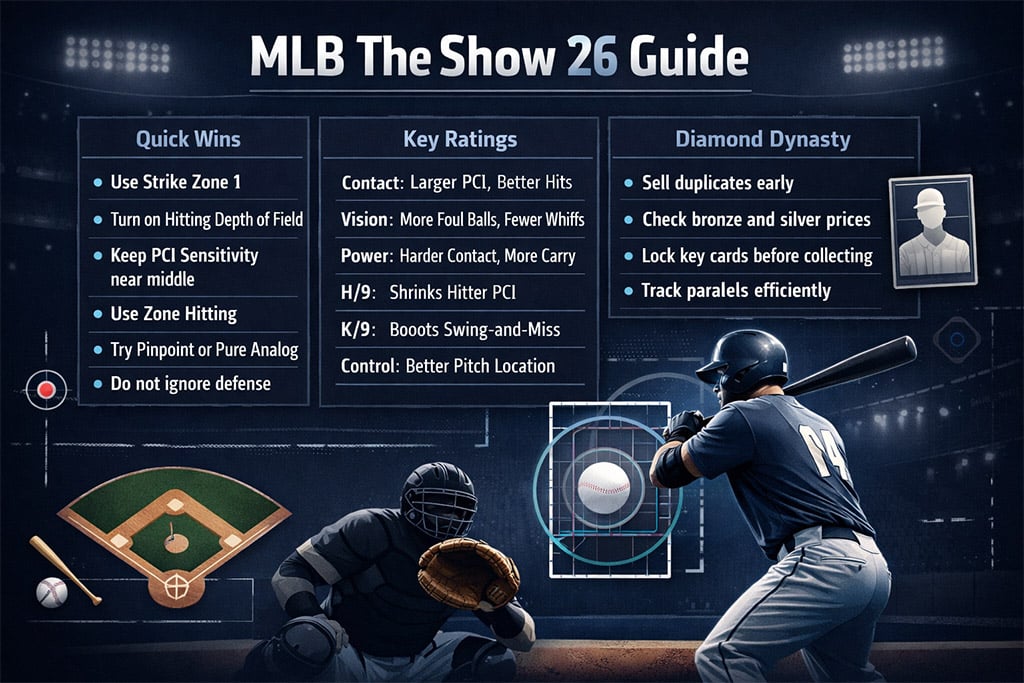
One of the easiest mistakes in MLB The Show 26 is trusting the grouped ratings too much. They look clean, but they can hide what a card really does.
If you are comparing hitters or pitchers, check the full attribute page, not just the top-line summary.
The most important hitting and pitching ratings
| Attribute | Why It Matters | What to Look For |
|---|---|---|
| Contact | Affects PCI size and hit quality | Important for consistent base hits |
| Vision | Helps on slightly missed swings | Useful if you strike out often |
| Clutch | Replaces Contact with runners in scoring position | Big in RBI situations |
| Power | Impacts exit velo and carry | Key for extra-base hits and home runs |
| H/9 | Shrinks opponent PCI | One of the best pitching stats |
| K/9 | Counters hitter Vision | Helps generate swings and misses |
| Control | Improves pitch accuracy | Important for living on the corners |
From experience, this matters most when two cards look similar at a glance. A hitter with an average-looking summary can still mash if his split Contact and Power numbers are strong where you need them.
Best MLB The Show 26 Settings to Change First
A few settings make an immediate difference, especially if you are struggling to read pitches or speed through offline games.
Settings worth using right away
| Setting | Recommendation | Why It Helps |
|---|---|---|
| Hitting Camera | Strike Zone 1 | Best for reading pitches cleanly |
| Hitting Depth of Field | On | Reduces background clutter |
| PCI Sensitivity | Around middle | Prevents over- or under-moving PCI |
| Quick CPU Pitching | On | Speeds up offline games |
| Pitcher Delivery | Stretch Only | Faster pace in Conquest and grind modes |
| Fixed Pitch Location | On | Helps repeat pitch spots more easily |
If you find your PCI feels too jumpy, lower sensitivity a little. If it feels heavy and slow, move it up slightly. This is one of those settings that is worth testing for a few games instead of guessing once and forgetting about it.
Best Hitting and Pitching Interfaces
Not every interface is equal, and not every good interface is good for every player.
Hitting options
| Interface | Best For | Verdict |
|---|---|---|
| Zone | Competitive and improving players | Best overall ceiling |
| Big Zone | Newer players | Easier, but less precise |
| Directional | Casual players | Simple, but more limited |
| Timing | True beginners | Easiest, but least control |
If your goal is to get better long term, Zone hitting is still the best choice. It gives you control over both PCI placement and timing, which is why most strong online players stick with it.
Pitching options
| Interface | Best For | Verdict |
|---|---|---|
| Pinpoint | High-skill players | Most accurate |
| Pure Analog | Players wanting control without Pinpoint complexity | Excellent option |
| Meter | Beginners to intermediate players | Easy to learn |
| Pulse | Casual use | Serviceable, but less precise |
| Classic | Very casual play | Not recommended online |
In real play, Pinpoint and Pure Analog separate themselves because they let us attack edges more consistently. Meter is still fine if you are learning, but it gives up some command.
Defense Matters More Than Many Players Expect
This year, weak defenders get exposed more often. We notice it most on bloops, slow reactions, and infield balls that better defenders usually turn into outs.
The new directional reaction split also adds more depth, so defensive fit matters more than it used to.
Defensive priorities
| Position / Trait | What Matters Most | Why |
|---|---|---|
| Middle infield | Fielding + reaction | Prevents extra singles and bad first steps |
| Center field | Speed + reaction | Covers gaps and cleans up mistakes |
| Catcher | Pop time + arm strength | Helps control the running game |
A good example is catcher defense. The difference between an average arm and a strong pop-time catcher is noticeable, especially against players who like to run often.
Small Gameplay Mechanics That Create Easy Value
These are not flashy, but they win games over time.
A few simple mechanics to learn
- Stealing: Speed helps, but Steal rating affects your jump. Fast runners with weak stealing can still get bad jumps.
- Wrap slides: These help on stolen bases and close extra-base plays.
- Bunting direction: Use directional input to deaden drag bunts or place sac bunts better.
- Bear Down pitching: Useful in key spots, but not overpowered. Treat it like a bonus tool, not a bailout button.
If you find yourself getting thrown out often on steals, do not only blame speed. Check the runner's stealing rating and your timing.
Diamond Dynasty Tips That Save Time and Stubs
Early Diamond Dynasty is where a lot of players waste resources. The smarter move is usually to build value steadily instead of chasing every shiny card on day one.
Best early Diamond Dynasty habits
| Strategy | Why It Works | Best Use Case |
|---|---|---|
| Sell duplicates | Early prices are often inflated | Quick stub building |
| Check low-tier card prices | Some commons and bronzes sell well early | Team collection demand |
| Use card locking in collections | Prevents mistakes | Safer collection management |
| Track parallels intentionally | Better PXP efficiency | Grinding your main roster |
One habit that consistently pays off is cleaning the binder. Early in the cycle, duplicate commons, bronzes, and silvers can quietly add up to a solid stub total.
FAQ
What is the best hitting interface in MLB The Show 26?
For most players who want to improve, Zone hitting is the best option. It takes more practice, but it gives the most control and the best long-term results.
What is the best pitching interface in MLB The Show 26?
Pinpoint is the most accurate, while Pure Analog is the best alternative if you want strong control with a simpler input.
What settings should we change first in MLB The Show 26?
Start with Strike Zone 1, Hitting Depth of Field On, PCI Sensitivity near the middle, Quick CPU Pitching On, and Fixed Pitch Location On.
Does defense really matter in MLB The Show 26?
Yes. Defense feels more important this year, especially in the middle infield, center field, and at catcher.
How should we earn stubs early in Diamond Dynasty?
Sell duplicates, check inflated low-tier card prices, and avoid wasting stubs too early on short-term upgrades.
Final Thoughts
MLB The Show 26 rewards clean decisions more than flashy ones. If we read the right attributes, use better settings, pick the right interface, and respect defense, the game becomes much more manageable very quickly.
The biggest edge is not hidden. It comes from doing the small things right, over and over again.


The GGWTB Editorial Team features 10 full-time gaming editors and 23 specialist contributors, delivering hands-on tested walkthroughs, easter egg breakdowns, and game updates.
Mateo — who spearheads our in-depth MLB 26, Marathon, Monopoly Go, Monster Hunter Wilds guides, and patch notes—every guide is rigorously verified on live servers for accuracy.

Most Popular Posts
- MLB The Show 26 God Squad Guide: Best Lineup, 98 Tarik Skubal, Bullpen Picks, and Legend Tips
- MLB The Show 26 Tier List: Best Diamond Dynasty Cards by Position
- MLB The Show 26 Hall of Fame Guide: 99 Hoffman, Best Spotlights & Chase Pack Value
- MLB The Show 26 Top 20 Endgame Cards Ranked for New Seasons
- MLB The Show 26 New Threads 2.0 Tier List Guide: Best Cards, Budget Picks, and Meta Fits
- MLB 26 Best Infielders in July: Ranked Tier List for Catcher, First Base, Second Base, Third Base, and Shortstop
Popular Category Lists
- ARC Raiders / (354)
- Grow a Garden / (294)
- CoD: Black Ops 7 / (167)
- Star Citizen / (163)
- MLB 26 / (159)
- Monopoly Go / (153)
- ARK Survival Ascended / (128)
- Steal a Brainrot / (99)
- Blox Fruits / (74)
- Adopt Me / (74)
- Forza Horizon 6 / (72)
- Sailor Piece / (68)
- Grow a Garden 2 / (68)
- Diablo IV / (62)
- CoD: BLACK OPS 6 / (55)
- Aion 2 / (52)
- Path of Exile 2 / (48)
- Monster Hunter Wilds / (46)
- Windrose / (44)
- Maplestory Classic / (42)