



 0
0 Created: Oct 8,2026 | Maplestory Classic
MapleStory Classic Mesos Guide: Cut Costs, Farm Better, Trade Smarter

Start by finding a training route whose ordinary returns cover your consumed supplies. We then add overlapping quests, sell useful drops, and test small crafting or trading opportunities without spending the next session's potion budget.

- Choose the Right Method for Your Budget
- Protect a consumption-based reserve
- Compare Farming Routes Without Counting Jackpots
- Run a repeatable session test
- Reduce potion waste—not useful damage
- Test party efficiency personally
- Sell and Reinvest Without Trapping Your Cash
- Check drops and price matching copies
- Keep useful rewards and materials deliberately
- Verify one craft or trade before scaling
- FAQ (Frequently Asked Questions)
- What is the best early-game mesos farming spot?
- How can we reduce potion costs without slowing leveling?
- Should we sell rare drops immediately?
- Is crafting a reliable money-making method?
- How much should we save before trading?
Choose the Right Method for Your Budget
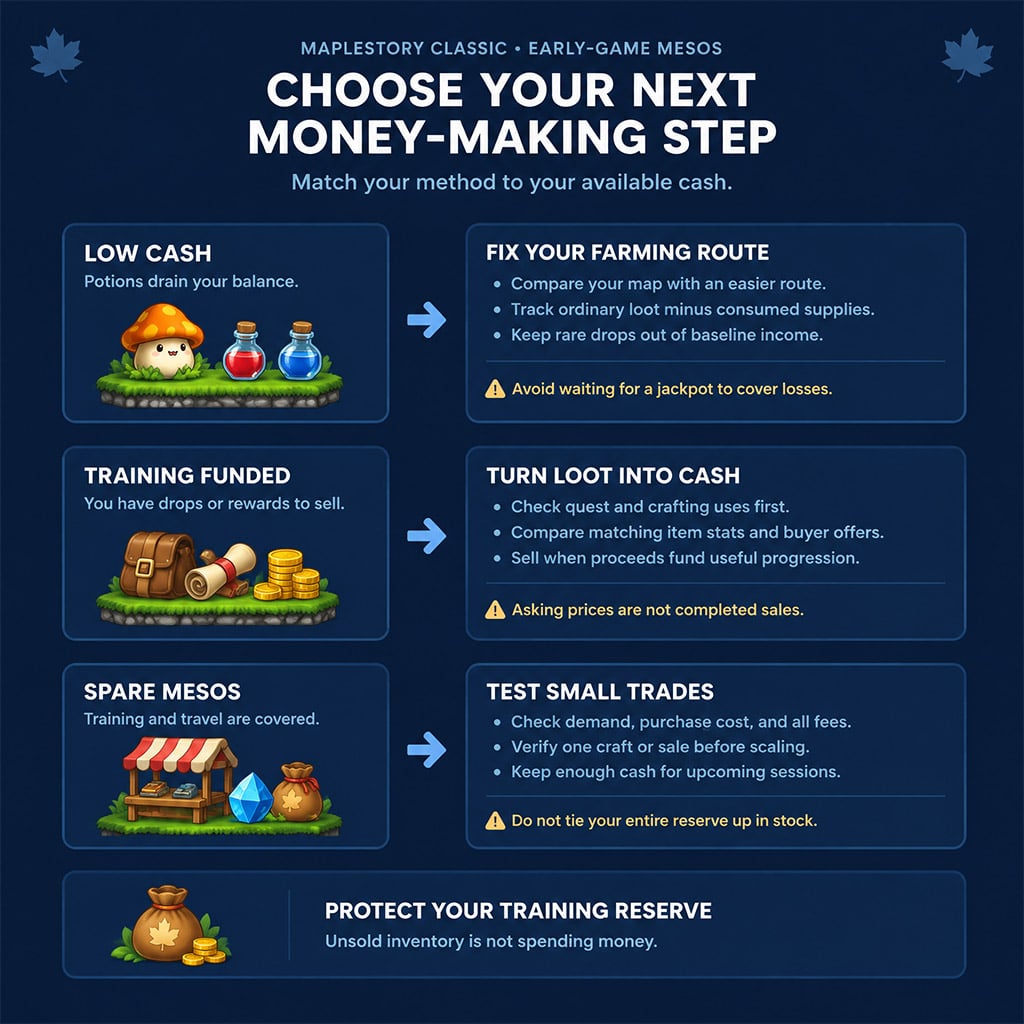
If you need immediate cash, unsold inventory is not a solution. We use this order to separate dependable funding from opportunities that require buyers or luck.
| Your Situation | Next Action | Avoid |
|---|---|---|
| Training drains your balance | Compare your current map with an easier route | Waiting for a rare drop to cover losses |
| Training pays its costs | Add quests that overlap your route | Detours with weak rewards |
| You have saleable equipment | Check matching stats and current buyer offers | Treating an asking price as a sale |
| You have spare capital | Test one small trade or craft | Spending your recovery reserve |
| A boss spawn is contested | Return to productive training | Ignoring travel and waiting time |
Fix repeatable losses before adding speculative income.
Protect a consumption-based reserve
Keep enough currency for upcoming potions, travel, and planned upgrades. Your reserve should follow actual consumption—not an arbitrary amount copied from another player.
If a purchase would prevent your next training session, it is too large for your current budget.
Compare Farming Routes Without Counting Jackpots
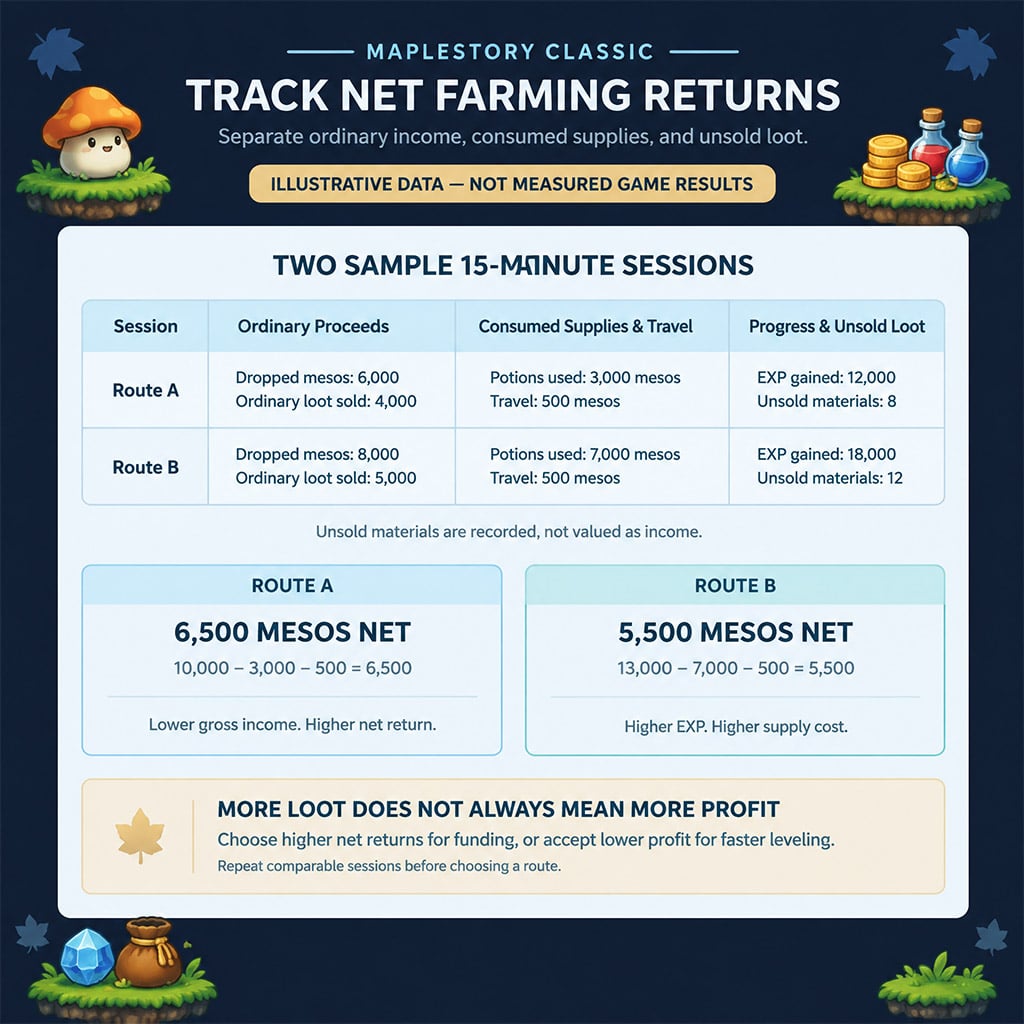
A map can drop more currency yet leave you with less after supplies. We compare ordinary returns, experience, and time lost before deciding where to stay.
Run a repeatable session test
Use a 15-minute session as an initial comparison window, then repeat. Keep equipment, skills, party status, and looting behavior consistent where possible.
Record these separately:
| Record | Include | Exclude or Separate |
|---|---|---|
| Ordinary cash return | Dropped mesos and ordinary loot sold | Unsold items at optimistic prices |
| Supply cost | Replacement cost of consumed recovery and travel items | The cost of unused supplies |
| Progress | Experience gained and deaths | Assumed future leveling gains |
| Downtime | Travel, recovery, congestion, and selling | Unrelated breaks |
| Rare rewards | Actual drops and realized sale proceeds | Expected jackpots |
Judge routine funding without rare drops; record those rewards separately.
Selling items acquired before the test can inflate results. Likewise, buying a large potion stack does not mean the entire stack was consumed during that session.
Reduce potion waste—not useful damage
If your main attack leaves little health, test a cheaper finisher. Reject it when missed attacks, extra movement, or damage taken erase the savings.
Compare potions by recovery actually used. A larger recovery item can waste more when used early, while a small one can require inconvenient repeated inputs.
For upgrades, check the result rather than the level requirement. A weapon that reliably reduces attacks per kill may improve income; a cosmetic armor change does not.
Test party efficiency personally
Divide platforms instead of repeatedly chasing the same targets. Compare your experience, loot share, and supply use with solo training.
A party clearing more monsters does not establish that every member earns more—or that monsters respawn instantly.
Sell and Reinvest Without Trapping Your Cash
Rare drops, materials, and resale stock need different decisions. We evaluate each against immediate progression and realistic sale proceeds.
Check drops and price matching copies
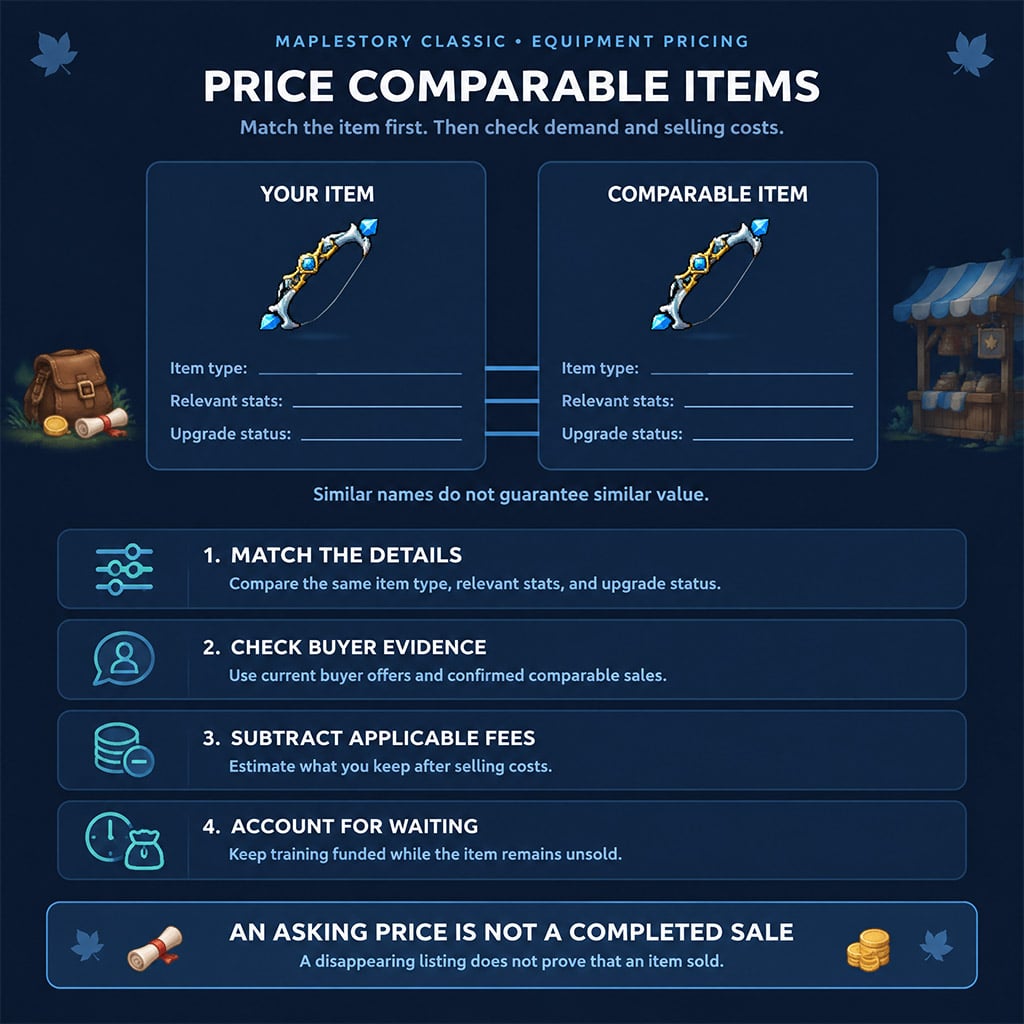
Confirm a target's current drop source before choosing a route. Item names alone are insufficient: equipment stats, restrictions, and other relevant attributes can change value.
Compare similar copies and credible buyer offers. A disappearing listing is not proof of a completed sale.
For bosses, include access failures and waiting time. A quick kill can still be an inefficient farming session.
Keep useful rewards and materials deliberately
Check quests before selling collected materials. Favor objectives involving monsters already on your training route.
Keep recovery rewards when using them avoids a greater purchase cost than their sellback value. Do not hoard materials without an identified recipe, quest, or credible buyer.
Verify one craft or trade before scaling
For crafting, total all inputs, refining fees, and additional costs. Compare finished-item proceeds with what the raw materials could sell for unchanged.
For trading, subtract purchase costs and applicable fees from conservative resale proceeds. Then account for selling time and the risk of a price decline.
Owned materials are not free, and listed inventory is not cash.
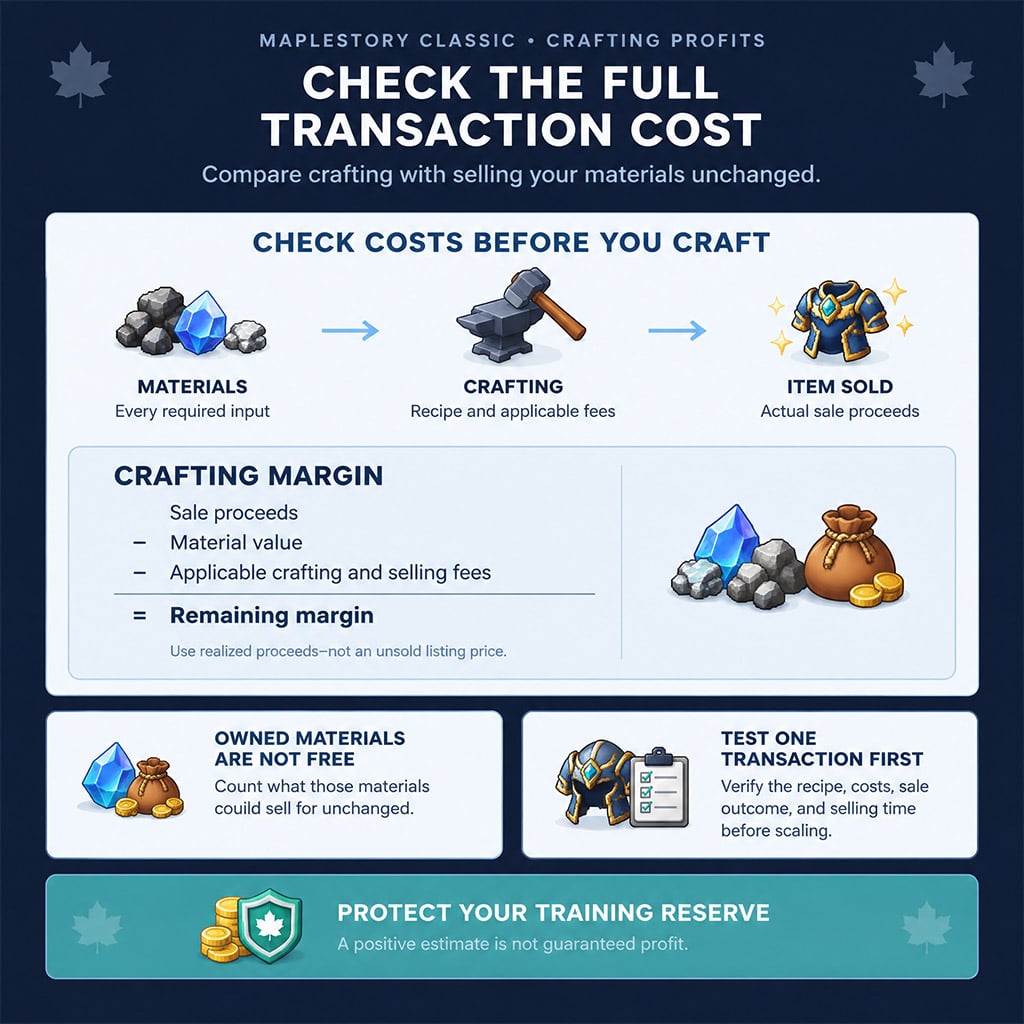
Test one small transaction before purchasing a batch. If the realized margin differs from your estimate, investigate before repeating.
FAQ (Frequently Asked Questions)
What is the best early-game mesos farming spot?
Choose the accessible map with the best repeatable net return for your character. Compare ordinary proceeds, consumed supplies, and experience rather than relying on a rare-drop reputation.
How can we reduce potion costs without slowing leveling?
Avoid unnecessary damage and wasted recovery while keeping efficient attacks. Use cheaper finishers only when they land reliably without adding substantial time or incoming damage.
Should we sell rare drops immediately?
Sell when the proceeds fund necessary recovery or a meaningful upgrade. Hold only when training is funded and current demand supports the risk of waiting.
Is crafting a reliable money-making method?
Crafting works only when current inputs, fees, and sale proceeds leave a worthwhile margin. Complete one transaction and include the raw materials' alternative sale value before scaling.
How much should we save before trading?
Reserve enough for upcoming training, travel, and planned upgrades before buying stock. Start with a purchase small enough that a delayed sale will not interrupt progression.

I’m Emily Zhang, an American Research Writer at GGWTB covering Korean MMORPGs and games based on classic franchises. My guides focus on class choices, leveling routes, and long-term character progression. I look at what a class needs beyond its starter skills—and which upgrades are worth your materials before the next gear tier arrives.

Most Popular Posts
- MapleStory Classic World CBT2: The No-BS Guide to 3rd Job, Orbis, and Class Reworks
- MapleStory Classic World Early Best Maps, PQ, and Party Spot): The No-BS 1-30 Leveling Guide
- Maplestory Classic Closed Beta #2: 3rd Job Skills, Class Reworks & What to Test First
- MapleStory Classic Early Leveling Guide: Best Maps, Fastest Route, Real Player Tips
- MapleStory Classic World Release Date Guide: Launch Date, Founder Access
- MapleStory Classic World Priest Guide: Skills, Nerfs and Holy Arrow build
Popular Category Lists
- ARC Raiders / (341)
- Grow a Garden / (292)
- CoD: Black Ops 7 / (167)
- Star Citizen / (160)
- MLB 26 / (159)
- Monopoly Go / (152)
- ARK Survival Ascended / (125)
- Steal a Brainrot / (98)
- Blox Fruits / (74)
- Adopt Me / (73)
- Forza Horizon 6 / (72)
- Sailor Piece / (68)
- Grow a Garden 2 / (68)
- Diablo IV / (62)
- CoD: BLACK OPS 6 / (55)
- Path of Exile 2 / (48)
- Monster Hunter Wilds / (46)
- Aion 2 / (45)
- Windrose / (44)
- Donut SMP / (41)