


 0
0 Created: May 1,2026 | MLB 26
MLB The Show 26 Stub Making Guide: Best Diamond Quest Method and Long-Term Investments

Diamond Quest has become one of the best stub-making methods in MLB The Show 26 Diamond Dynasty, especially after reward updates made the mode more worthwhile for everyday players. We do not need to play perfectly on Legend, and we do not need to clear the entire board. The real value comes from fast routing, repeatable packs, and selling reward cards when demand is high.
From testing this method in short sessions, the best approach is simple: move directly toward reward stadiums, grab Ballin' is a Habit packs, hit the Zone Sweeper when it makes sense, then reset and repeat. If you pair that grind with smart roster update investing, you can build MLB 26 stubs without relying only on pack luck.
- Best Diamond Quest Stub Method
- Best Route to Farm Packs
- Expected Rewards Per Hour
- How to Make Diamond Quest Faster
- Build the Right Lineup
- Avoid Low-Value Detours
- Selling Diamond Quest Reward Cards
- Simple Stub Estimate
- Best Long-Term Investments in MLB The Show 26
- What We Look For
- Investment Watchlist
- Anti-Investing: Buy the Panic Dip
- Anti-Investment Watchlist
- When to Sell for Profit
- FAQ
- What is the best way to make stubs in Diamond Quest?
- What difficulty should we play Diamond Quest on?
- Is Diamond Quest better than Mini Seasons?
- Are Diamond Quest packs guaranteed profit?
- When should we sell Diamond Quest reward cards?
- What are the best roster update investments?
- Summary
Best Diamond Quest Stub Method
Diamond Quest is strong because it gives us fast, repeatable rewards. The mistake many players make is treating the board like something we need to fully complete. We don't. We are here for efficiency.
Best Route to Farm Packs
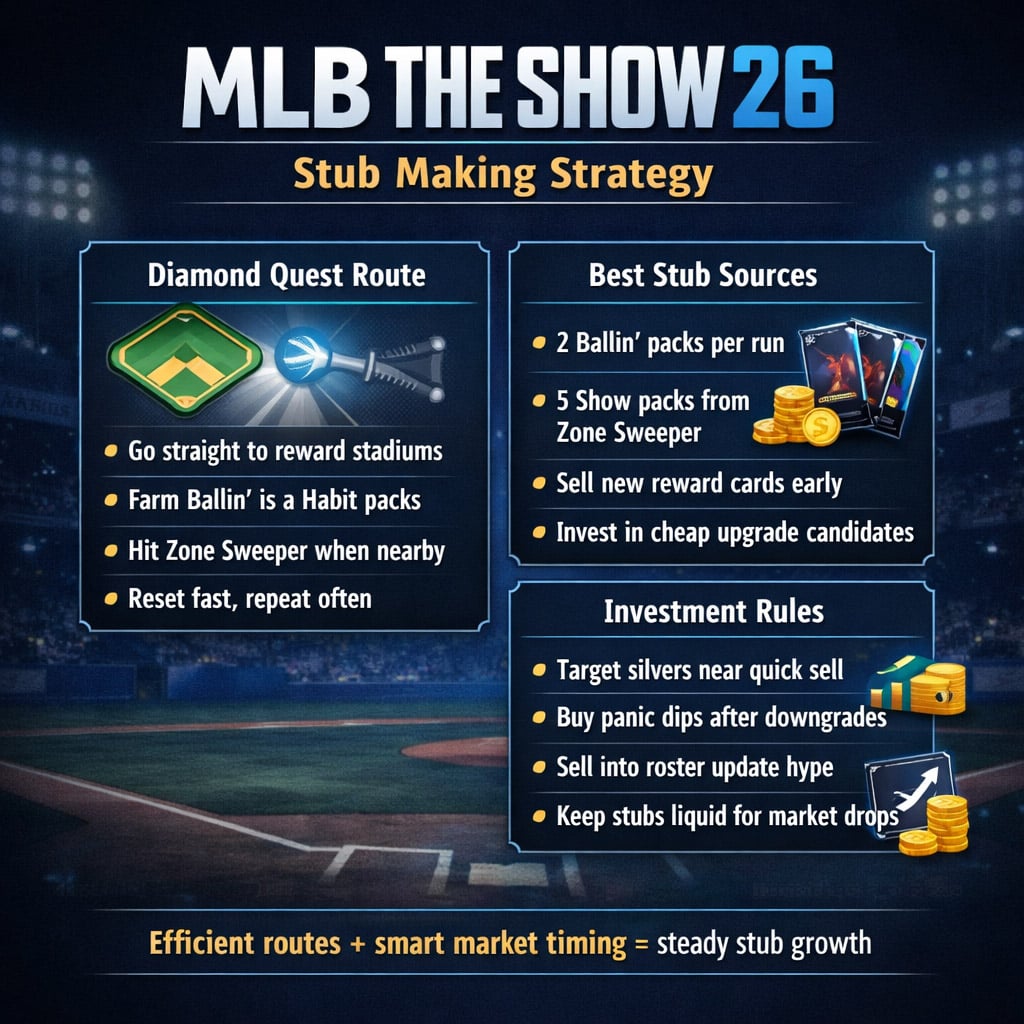
The main goal is to earn:
- 2 Ballin' is a Habit packs
- 5 standard Show packs from Zone Sweeper, if nearby
- Extra sellable rewards from stadium clears
- Possible player reward cards
| Step | What We Do | Why It Matters |
|---|---|---|
| 1 | Start Diamond Quest on Rookie, Veteran, or All-Star | Pick a difficulty you can clear quickly |
| 2 | Move straight toward the first stadium | Stadiums are the main reward source |
| 3 | Complete only necessary missions | Saves time and boosts reward odds |
| 4 | Beat the stadium game | Chance at Ballin' is a Habit pack |
| 5 | Hit Zone Sweeper if close | Can give 5 Show packs |
| 6 | Move to the second stadium | Target another Ballin' pack |
| 7 | Reset and repeat | Keeps rewards per hour high |
For most players, All-Star is the best balance. If you are losing games or failing missions, drop the difficulty. A clean Rookie run is better than a messy All-Star run that wastes 30 minutes.
Expected Rewards Per Hour
If you play efficiently, one run usually takes around 15–20 minutes. That means we can often complete about 3 runs per hour.
| Estimate | Amount |
|---|---|
| Time per run | 15–20 minutes |
| Runs per hour | Around 3 |
| Ballin' is a Habit packs | Around 6 per hour |
| Standard Show packs | Around 15 per hour |
| Best difficulty for most players | All-Star |
This is not guaranteed profit every single run because packs are still packs. But the value comes from volume. More packs mean more chances at diamonds, golds, collection pieces, and quick-sell value.
How to Make Diamond Quest Faster
The fastest stub grinders are not always the best hitters. They are usually the players who waste the least time.
Build the Right Lineup
Diamond Quest missions often ask us to get hits, steal bases, strike batters out, or protect leads. That means our lineup should be built for short-game tasks.
| Lineup Need | Why It Helps |
|---|---|
| Contact hitters | Makes hit missions easier |
| Speed players | Helps with steal missions |
| Power bats | Ends 3-inning games faster |
| Strong bullpen | Protects short leads |
| Switch hitters | Handles more matchups |
If you find steal missions slowing you down, put fast players near the top of your lineup. If you are struggling to score in stadium games, add more power bats instead of only using cards for missions.
Avoid Low-Value Detours
If a space does not move us toward a stadium, Zone Sweeper, or a useful boost, we usually skip it.
| Avoid This | Do This Instead |
|---|---|
| Clearing the entire board | Go straight to stadiums |
| Playing too high a difficulty | Use a level you can clear fast |
| Taking every challenge | Take only efficient missions |
| Using slow hitters | Add speed and contact |
| Chasing random spaces | Prioritize pack rewards |
This is where the method becomes profitable. A 15-minute run repeated four times is much better than one perfect board that takes an hour.
Selling Diamond Quest Reward Cards
The second way to make stubs from Diamond Quest is by farming new reward cards. This is best when a fresh Diamond Quest drops and players are rushing to buy the new cards.
Early supply is low. Demand is high. That creates a good selling window.
| Reward Card Situation | Best Move |
|---|---|
| New Diamond Quest just released | Farm early and sell fast |
| Card is selling for 10,000+ stubs | Prioritize the reward route |
| Card has already dropped hard | Focus more on packs |
| Card is useful for collections | Check price before quick selling |
If a new reward card opens around 10,000–15,000 stubs, the method becomes much stronger. At roughly three runs per hour, even a few successful reward pulls can add up quickly.
Simple Stub Estimate
| Card Price | Runs Per Hour | Possible Gross Value |
|---|---|---|
| 6,500 stubs | 3 | 19,500 stubs |
| 10,000 stubs | 3 | 30,000 stubs |
| 15,000 stubs | 3 | 45,000 stubs |
This does not include market tax or pack luck, but it shows why timing matters. The best profits usually come early, before the market gets flooded.
Best Long-Term Investments in MLB The Show 26
Diamond Quest gives active stub income. Roster update investing gives us upside while we are not playing.
The safest long-term plays are usually silvers near quick sell with real-life stats that support an upgrade. We want players who are cheap now but have a path to gold or higher.
What We Look For
A good investment usually has:
- Strong real-life performance
- Cheap current price
- Low current overall
- Regular playing time
- Name value or prospect hype
- Past gold or diamond rating
- Clear attribute upgrade path
If you find a 76–78 overall silver playing like a gold, that is the kind of card worth tracking.
Investment Watchlist
| Player | Why We're Watching | Risk |
|---|---|---|
| Roman Anthony | Big name, possible buy-the-dip card | Medium |
| Otto Lopez | Strong early production, gold path | Low-Medium |
| Christian Walker | Past high gold, power upside | Medium |
| Dylan Lee | Strong reliever stats | Low-Medium |
| Chase Burns | Prospect hype and strikeout upside | Medium |
| Nolan McLean | Strong pitching profile | Medium |
| Jacob Misiorowski | Huge K/9 upside, diamond ceiling | Medium-High |
| Gavin Williams | Strikeouts and hits allowed look strong | Medium |
| Mickey Moniak | Power boost potential | Medium |
| Jung Hoo Lee | Contact upgrade path | Low-Medium |
| Tanner Scott | More innings, past gold value | Medium |
Do not go all-in on one player. Spread your stubs across several names so one bad update does not ruin the whole plan.
Anti-Investing: Buy the Panic Dip
Anti-investing is one of the most underrated stub strategies. Instead of buying before a downgrade, we wait for the downgrade to happen, then buy when the market overreacts.
This works best with proven players who are struggling but still have talent.
| Player Type | What We Want |
|---|---|
| Struggling diamond | Buy if downgraded too harshly |
| Proven veteran | Buy after panic selling |
| Injured star returning | Buy before hype comes back |
| High-name prospect | Buy near quick sell |
| Pitcher with bad ERA but good K numbers | Buy if attributes can rebound |
Anti-Investment Watchlist
| Player | Why It Makes Sense |
|---|---|
| Jarren Duran | Talent is still there if price crashes |
| Logan Webb | Proven pitcher, possible rebound |
| Wyatt Langford | Name value and upside |
| Jesus Luzardo | Strikeout profile can recover |
| Brandon Woodruff | Long-term diamond upside if healthy |
| Adley Rutschman | Premium name and position |
| Michael Harris II | Strong long-term talent |
| Gerrit Cole | Return hype can move price |
| Spencer Strider | Return hype and pitcher-flip value |
| Grayson Rodriguez | Rehab watch with future hype |
If you see a good player drop from diamond to gold and everyone panic sells, check the real stats before reacting. Sometimes the best buy is the card everyone else just dumped.
When to Sell for Profit
Buying good cards is only half the job. Selling at the right time is where the stubs become real.
| Situation | Best Move |
|---|---|
| Player spikes before roster update | Sell some into hype |
| Player reaches your target price | Take profit |
| Player gets upgraded but price drops | Hold only if another upgrade is likely |
| Player misses the update | Recheck stats before panic selling |
| Player gets injured | Exit quickly unless price already crashed |
A safe approach is to sell part of your stack before the roster update. For example, if we buy a silver near quick sell and the price doubles before the update, locking in profit is smart. We do not need to hit the absolute top every time.
FAQ
What is the best way to make stubs in Diamond Quest?
The best method is to route directly to reward stadiums, earn Ballin' is a Habit packs, hit Zone Sweeper when nearby, and reset quickly. Do not waste time clearing the entire board.
What difficulty should we play Diamond Quest on?
Most players should use All-Star because it balances reward odds and clear speed. If you struggle, play Veteran or Rookie. Fast completions matter more than pride.
Is Diamond Quest better than Mini Seasons?
Diamond Quest is better when the current rewards are strong and you can finish runs quickly. Mini Seasons is better for steady, predictable grinding. We should use whichever mode has better rewards at the time.
Are Diamond Quest packs guaranteed profit?
No. Packs are never guaranteed profit. The method works because we earn a lot of packs quickly, which increases our chances at valuable pulls and sellable inventory.
When should we sell Diamond Quest reward cards?
Sell new reward cards early, especially if they are above 10,000 stubs. Prices usually fall as more players complete the quest and add supply to the market.
What are the best roster update investments?
The best investments are usually cheap silvers or bronzes with strong real-life stats, regular playing time, and a clear path to an upgrade. Avoid buying after the hype has already peaked.
Summary
Diamond Quest is one of the best MLB The Show 26 stub methods because it is fast, repeatable, and flexible. We should focus on quick stadium routes, Ballin' is a Habit packs, Zone Sweeper rewards, and new reward cards when prices are high.
For long-term stub growth, combine Diamond Quest grinding with smart roster update investing. Buy cheap players with upgrade paths, watch for panic dips, and sell into hype instead of waiting for perfect prices. That mix gives us the best balance of active rewards and market upside.

Most Popular Posts
- MLB The Show 26 Draft Cards Guide: Best Budget Picks, Tier List, and Must-Use Rewards
- MLB The Show 26 God Squad Guide: Best Lineup, 98 Tarik Skubal, Bullpen Picks, and Legend Tips
- MLB The Show 26 Hall of Fame Guide: 99 Hoffman, Best Spotlights & Chase Pack Value
- MLB The Show 26 All-Star Collection Guide: Fastest Way to Unlock 99 Yordan Alvarez
- MLB The Show 26 Tier List: Best Diamond Dynasty Cards by Position
- Best MLB 26 God Squad: Ranked Lineup, Rotation, Bullpen, and Platoon Meta
Popular Category Lists
- ARC Raiders / (345)
- Grow a Garden / (292)
- CoD: Black Ops 7 / (167)
- Star Citizen / (161)
- MLB 26 / (159)
- Monopoly Go / (152)
- ARK Survival Ascended / (126)
- Steal a Brainrot / (98)
- Blox Fruits / (74)
- Adopt Me / (73)
- Forza Horizon 6 / (72)
- Sailor Piece / (68)
- Grow a Garden 2 / (68)
- Diablo IV / (62)
- CoD: BLACK OPS 6 / (55)
- Path of Exile 2 / (48)
- Monster Hunter Wilds / (46)
- Aion 2 / (46)
- Windrose / (44)
- Donut SMP / (41)