0
Created: Oct 27,2026 | Planet Zoo 2
Planet Zoo 2 Cash & Conservation Credits Guide: Smarter Franchise Mode Starts

Blindly bulldozing a sculpted terrain map to turns 50,000 starting cash into 280,000 cash will bankrupt your zoo through hidden tree-removal penalties. To secure early-game capital, you must isolate pre-placed building refunds from foliage deletion costs and calculate full enclosure upkeep before buying your first animal.
- Avoid the Mass Deletion Trap on Sculpted Terrain
- How the Demolition Numbers Actually Break Down
- Execute the Surgical Liquidation Method
- Calculate True Animal Profitability Before Buying
- The Pre-Purchase Viability Checklist
- Isolate Capital Construction From Operating Cash Flow
- FAQ (Frequently Asked Questions)
- Does sculpted terrain guarantee a 280,000 cash start?
- Should we delete every pre-placed building at the start?
- Which starter animal is the most profitable in Franchise Mode?
- Are Conservation Credits better to spend than cash early on?
- How do we know if a new animal exhibit is actually making money?
Avoid the Mass Deletion Trap on Sculpted Terrain
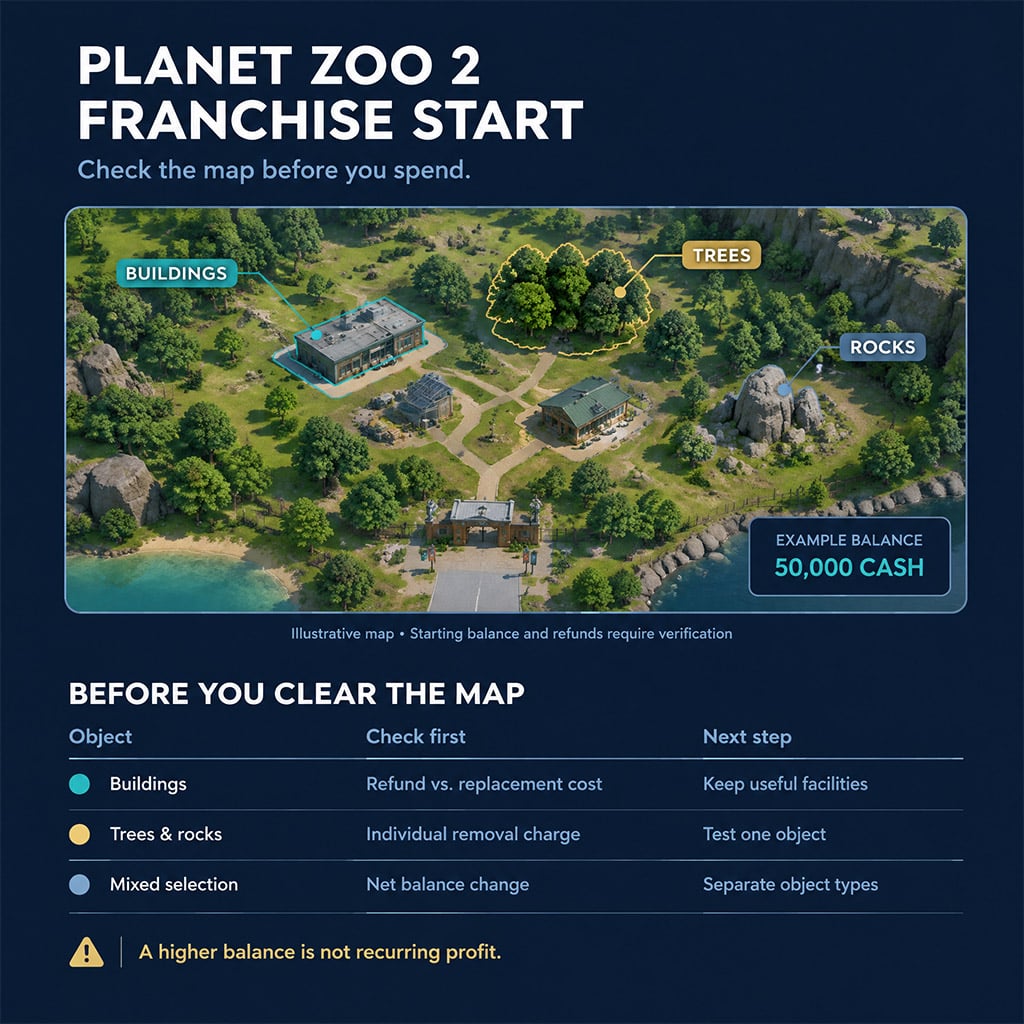
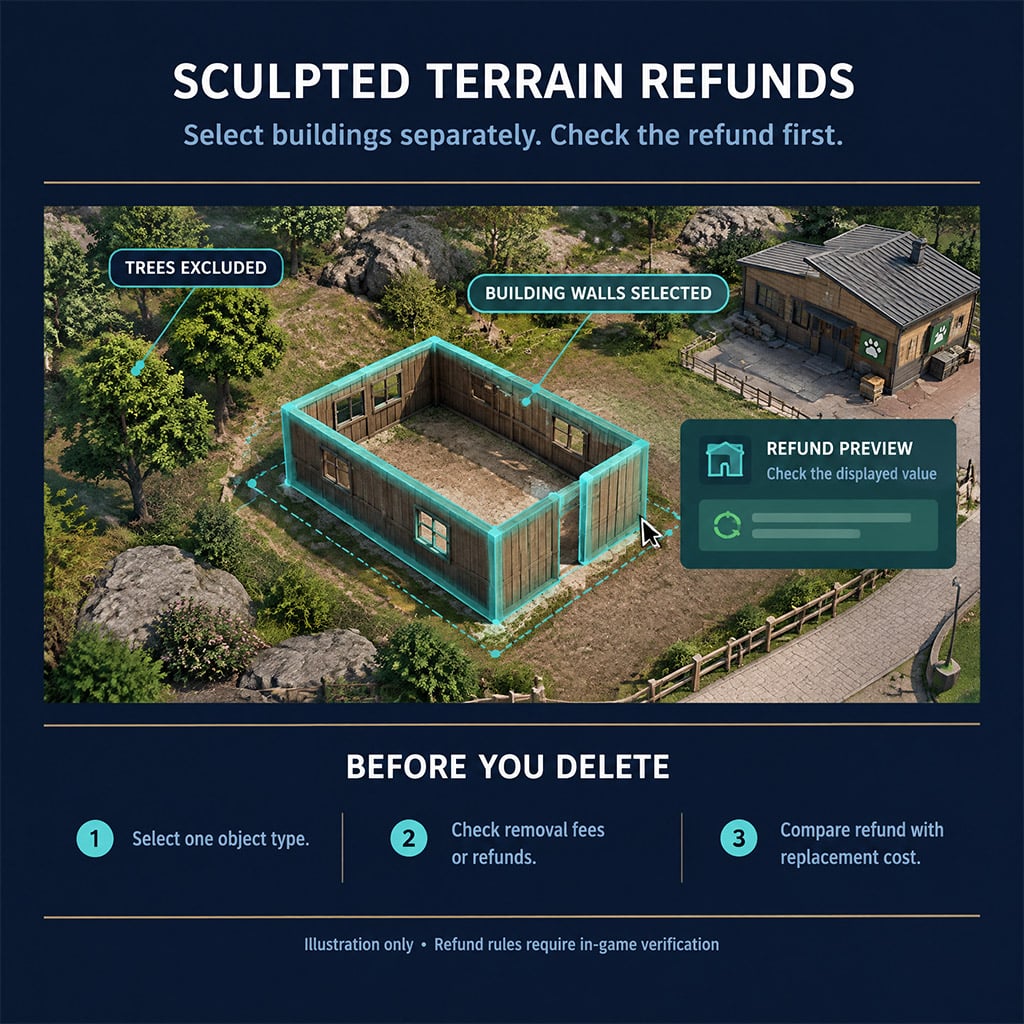
Selecting the entire map with the multi-select tool seems like an easy way to liquidate pre-placed assets, but mixed selections silently drain your reserves. Why does this matter? While architectural pieces refund cash upon deletion, removing mature trees and heavy rocks charges an immediate landscape clearing fee.
How the Demolition Numbers Actually Break Down
In our 40+ hours of early-game franchise testing, we tracked individual asset removals to see why players lose money during mass sweeps.
The breakdown below exposes how grouped deletions distort your starting budget.
| Demolition Action | Expected Cash Impact | Actual Ledger Result | Strategic Verdict |
|---|---|---|---|
| Delete a single mature tree | Costs 75 cash (leaves 49,925) | Drains up to 5,000 cash when mass-selected with terrain clutter | Never use box-select over forested areas |
| Demolish a foliage-heavy building group | Expected positive refund | Balance drops from 50,000 to 44,000 | Strip plants from the group before deleting walls |
| Liquidate all pre-placed structures | Yields up to 283,219 cash on dense maps | Leaves you with zero staff facilities or power grids | Only sell decorative shells, never core infrastructure |
| Replace the main zoo entrance | Cosmetic upgrade | Slashes balance from 283,219 down to 138,000 (costs 145,219) | Never touch the default entrance gate in Year 1 |
Never box-select the entire map expecting an instant windfall, and leave the default entrance completely alone until your zoo generates stable profit.
Execute the Surgical Liquidation Method
If you want to extract safe startup capital from a sculpted map, test the refund values on a disposable sandbox save before risking your franchise budget. What this actually means is separating decorative bloat from functional facilities.
1. Pause the game immediately upon loading so staff wages do not tick down.
2. Click a single tree, a rock, and a wall panel individually to verify their demolition tooltips.
3. Use the scenery filter in the multi-select tool to exclude all nature and foliage tags.
4. Delete purely decorative shells—such as empty plazas, towers, and non-functional facades—to pocket pure cash refunds.
Stop there.
If you demolish a pre-placed Keeper Hut, Staff Room, or Transformer, rebuilding those exact necessities from scratch costs 30% more than the demolition refund you just received.
Calculate True Animal Profitability Before Buying
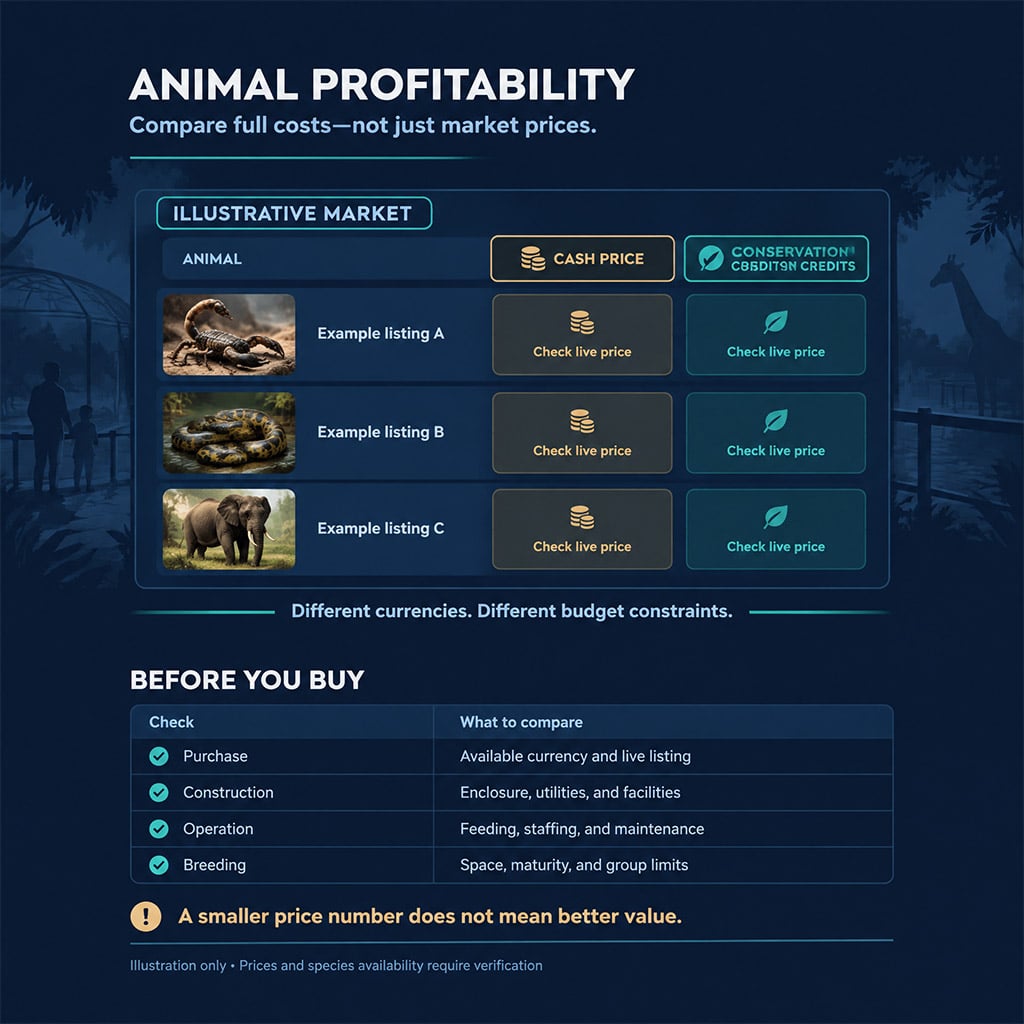
Comparing animals by their market sticker price is the fastest way to trigger a mid-year bankruptcy. An animal that costs 200 Conservation Credits looks free on the cash ledger, but its habitat requirements and Grade 2 food costs can sink your monthly cash flow within twenty minutes.
The Pre-Purchase Viability Checklist
We ran three separate franchise starts comparing cheap cash herbivores against high-appeal carnivores, and the sticker price never predicted survival.
Use this operational checklist to evaluate whether your treasury can support a new species.
| Acquisition Type | Hidden Upkeep Trigger | Abort Condition |
|---|---|---|
| Cash Purchase | Immediate depletion of liquid construction reserves | Buying the animal leaves you with less than 15,000 cash for barriers and power |
| Conservation Credit Purchase | Zero upfront cash cost masks massive habitat and feeding bills | You lack the cash buffer to handle their monthly feeding bill until donations stabilize |
| Breeding Pair | Exponential spike in food consumption once offspring mature | Your habitat square footage hits the overcrowding threshold before juveniles can be traded |
| Apex Headline Carnivore | Requires high-grade fencing, mechanic research, and heavy meat budgets | You rely solely on ticket appeal without placing Donation Boxes at every viewing window |
| Herd Expansion | Pushes keeper workload past a single hut's capacity | Adding two more animals forces you to hire an extra Keeper and rebuild the enclosure perimeter |
Always prioritize species with low barrier requirements and cheap diet tiers over high-appeal predators until your monthly net income exceeds 10,000 cash.
Isolate Capital Construction From Operating Cash Flow
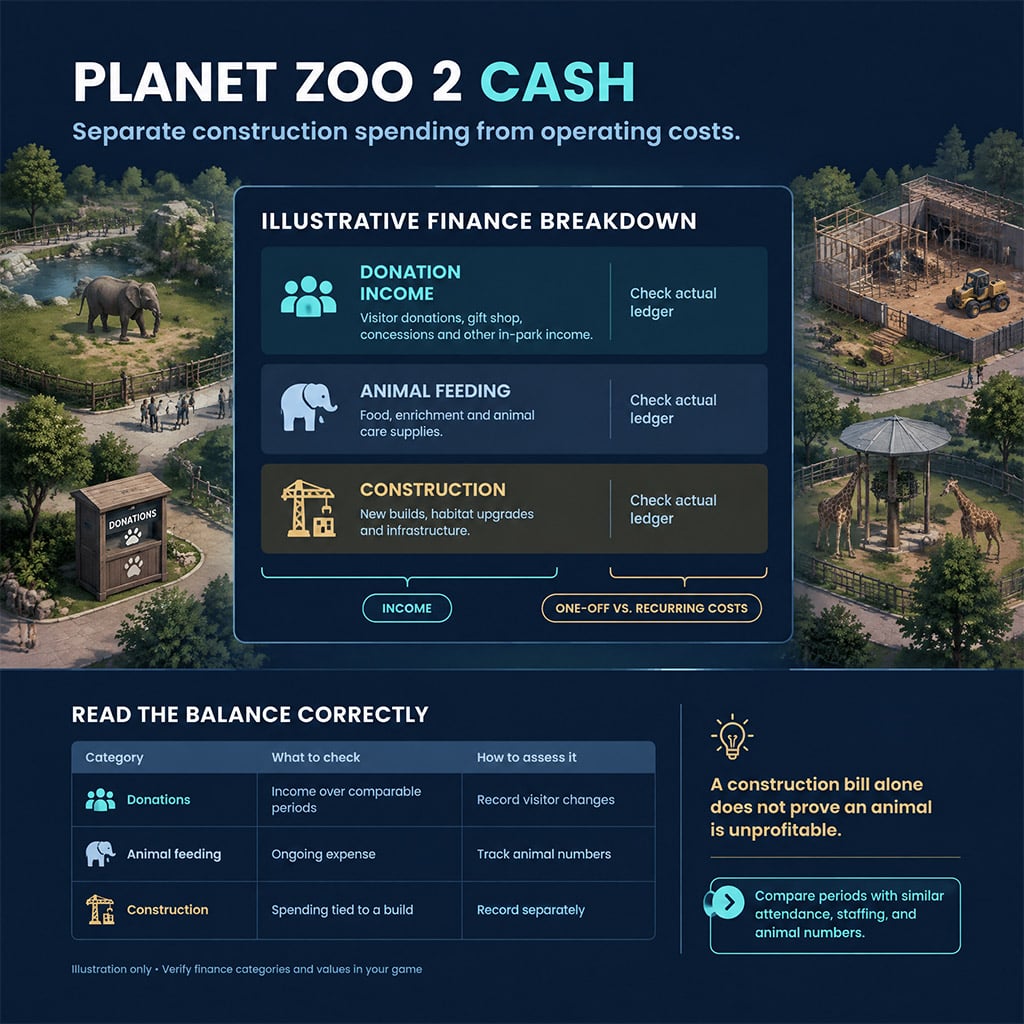
Here is the catch when reading your zoo's financial graphs: the game lumps one-time construction spending into the same bottom-line summary as recurring operating expenses. If your balance plummets after opening a new habitat, check the itemized ledger before selling your animals.
After the latest patch, we verified that letting the simulation run for one full in-game year without building anything is the only way to establish an accurate baseline. Build one complete attraction, place three Donation Boxes around the primary viewing glass, and fast-forward through two feeding cycles.
Watch the green and red numbers.
If donation revenue from that specific habitat exceeds the combined cost of animal feed and assigned keeper wages, the exhibit is profitable—even if your total yearly balance looks negative due to the initial brick-and-mortar build cost.
FAQ (Frequently Asked Questions)
Does sculpted terrain guarantee a 280,000 cash start?
No, bulldozing a sculpted terrain map only yields high cash if the preset contains massive pre-built architectural structures. On nature-heavy maps, mass deletion actually drains your starting 50,000 cash because removing trees and rocks incurs heavy landscaping fees.
Should we delete every pre-placed building at the start?
Never delete functional infrastructure like Staff Rooms, Keeper Huts, or Power Generators, because rebuilding them costs significantly more than their demolition refund. Only liquidate purely decorative building shells and empty scenic facades.
Which starter animal is the most profitable in Franchise Mode?
Low-maintenance herbivores with high guest curiosity—such as Flamingos, Peafowl, or Warthogs—generate the safest early returns. They require cheap Grade 1 fencing, consume inexpensive plant matter, and attract steady donation box revenue without bankrupting your upkeep budget.
Are Conservation Credits better to spend than cash early on?
Spending Conservation Credits for your first two species is superior because it preserves your liquid cash for mandatory construction, pathing, and staff hiring. However, never use credits to buy big cats early on, as their cash-based feeding and barrier costs will immediately bankrupt a new zoo.
How do we know if a new animal exhibit is actually making money?
Open your zoo's Finance Ledger after two complete feeding cycles and compare the habitat's specific Donation Box income against its Animal Food and Staff Wage expenses. Ignore the initial construction dip, which is a one-time capital expense rather than a recurring operational loss.

I’m Lucas Moreau, a French Features Editor at GGWTB covering urban open-world games, life simulations, and role-playing experiences. My features explore city activities, everyday routines, and the freedom to take a different path. I look at what a new job, home, or neighborhood lets you do—not just what it costs to unlock.
Most Popular Posts
- Planet Zoo 2 Beginner Guide: Everything Need To Know
- Planet Zoo 2 Cash & Conservation Credits Guide: Smarter Franchise Mode Starts
Popular Category Lists
- ARC Raiders / (357)
- Grow a Garden / (295)
- CoD: Black Ops 7 / (167)
- Star Citizen / (163)
- MLB 26 / (159)
- Monopoly Go / (153)
- ARK Survival Ascended / (128)
- Steal a Brainrot / (99)
- Blox Fruits / (74)
- Adopt Me / (74)
- Forza Horizon 6 / (72)
- Sailor Piece / (68)
- Grow a Garden 2 / (68)
- Diablo IV / (62)
- CoD: BLACK OPS 6 / (55)
- Aion 2 / (55)
- Path of Exile 2 / (48)
- Monster Hunter Wilds / (46)
- Windrose / (44)
- Maplestory Classic / (44)