


 0
0 Created: Apr 21,2026 | Star Citizen
Star Citizen 4.8 Crafting Guide: Best Blueprint Strategy, Salvage Materials, Player Trading

Star Citizen 4.8 is shaping up to be one of the more important updates for anyone who mines, salvages, crafts, hauls, or just likes making Star Citizen aUEC through systems instead of pure combat. The big story is simple: crafting is starting to connect everything. Material quality, blueprint progression, salvaging, refining, inventory management, and future player trading are all moving into the same loop. If we understand that loop early, we make better decisions and waste fewer valuable resources.
- What Actually Matters in 4.8
- Crafting and Material Quality: What We Should Do Differently
- Blueprints: The Real Long-Term Progression
- How to handle blueprints efficiently
- Salvage Materials: Why Salvagers May Win Big Later
- Player Trading Will Be the Real Multiplier
- Inventory Tips That Will Save Us Credits
- Practical storage rules
- Best Strategy for 4.8 Players
- FAQ
- What is the biggest crafting takeaway in Star Citizen 4.8?
- Should we save high-quality materials?
- Are low-quality materials still useful?
- Why are blueprints so important now?
- Will salvage become more valuable?
- How should we handle inventory in 4.8?
- Conclusion
What Actually Matters in 4.8
From a practical player point of view, 4.8 is less about more stuff to craft and more about why certain materials and blueprints will matter more than others.
The biggest takeaways are:
- High-quality materials are meant to stay valuable
- Low- and mid-quality materials still have real use
- Blueprints are becoming long-term progression assets
- Salvage is moving toward more meaningful material recovery
- Inventory management is now part of profit, not just convenience
- Player trading will eventually make all of this much more valuable
In other words, this patch rewards players who stay organized.
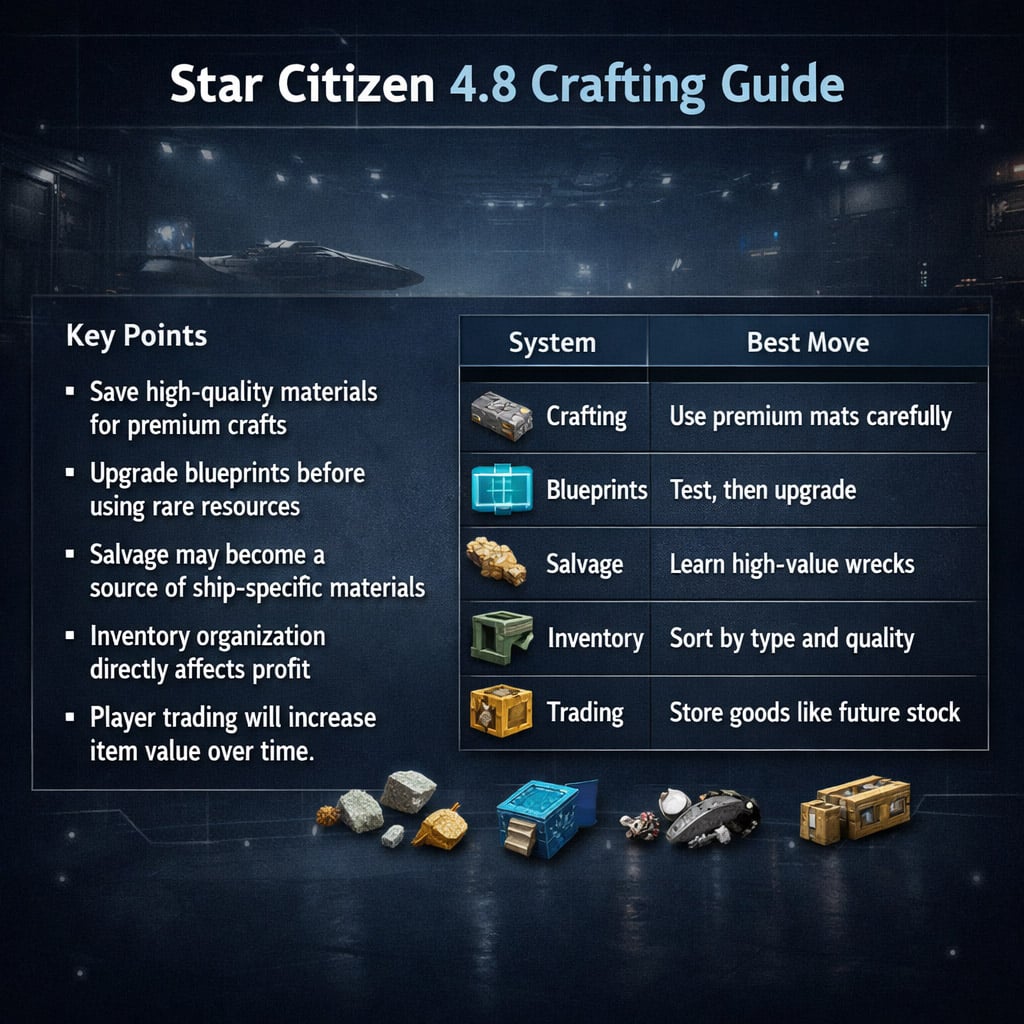
| System | Why It Matters | Best Habit Right Now |
|---|---|---|
| Crafting | Better items depend on better inputs | Save premium mats for strong blueprints |
| Blueprints | Progression unlocks better output | Test first, upgrade later |
| Salvage | Future source of valuable crafting mats | Learn which ships are worth stripping |
| Inventory | Quality variants create clutter fast | Sort by type and quality early |
| Player Trading | Will drive long-term economy value | Start storing goods like future stock |
That is the core loop. Gather smart, store smart, craft smart.
Crafting and Material Quality: What We Should Do Differently
One of the clearest design choices is that material quality is not something we can just freely upgrade. That makes sense. If top-tier materials were easy to manufacture from average resources, rare finds would stop feeling rare, and crafted gear would lose value fast.
As players, this means we should stop thinking in terms of good materials and useless materials.
A better way to read the system is:
- High-quality materials = premium crafting stock or high-end trade goods
- Mid-quality materials = reliable everyday crafting resources
- Low-quality materials = support materials, filler inputs, bulk use
This is especially important once alloy refining expands. If a recipe uses one main input that defines quality and one secondary input that mainly supports the process, then lower-grade stock still has real value.
| Material Quality | Best Use | Value Outlook |
|---|---|---|
| Low | Secondary refining inputs, bulk jobs | Steady utility value |
| Medium | Standard crafting, flexible production | Strong all-rounder |
| High | Premium gear, top-end components, trade | Highest profit potential |
From experience, one of the most expensive mistakes in MMO crafting economies is using rare materials too early. If you are still testing a blueprint, do it with cheaper stock first.
Blueprints: The Real Long-Term Progression
Blueprints are quietly becoming one of the most valuable assets in the whole system. They are not just recipes anymore. They are progression, access, and eventually market leverage.
The key point is that blueprints can come from multiple sources:
- missions
- reputation unlocks
- loot
- datapads
- shops
- boss rewards
That matters because not every player will have the same crafting options.
In practice, this means a player with a rare blueprint and the materials to support it may be more useful than a player sitting on a pile of credits.
How to handle blueprints efficiently
My advice is simple:
1. Test the item first
2. Figure out whether the stat gains are worth it
3. Upgrade the blueprint before committing premium mats
4. Craft for real demand, not just curiosity
| Blueprint Tier | What It Means | How We Should Use It |
|---|---|---|
| Tier 1 | Entry level | Cheap testing and learning |
| Tier 2 | Better stats | Good for serious production |
| Tier 3 | Best normal item tier | Use premium mats carefully |
| Ship Tiers | Higher-end progression | Long-term org and industrial play |
This is where 4.8 starts to feel deeper than a normal crafting patch. It is not just about what we can make. It is about who can make it well.
Salvage Materials: Why Salvagers May Win Big Later
Salvage looks especially promising because it is moving toward a more detailed material system. Instead of only broad outputs, the long-term plan points toward getting back materials that better match what a ship was actually made from.
That is a big deal.
If that system lands well, salvagers will not just be collecting generic industrial filler. They will be supplying specific crafting materials that crafters may actively seek out.
For players who enjoy salvage, this creates a stronger identity in the economy.
| Salvage Path | What We Get | Why It Matters |
|---|---|---|
| Scraping | RMC-style output | Broad industrial use |
| Fracture / dismantle | Structural materials | Bulk supply value |
| Future ship-based recovery | Specific source materials | Better crafting relevance |
I have always felt salvage needed this extra layer. Once we can say this wreck is worth doing because of what it is made of, the profession becomes far more skill-based and much more interesting.
Player Trading Will Be the Real Multiplier
A lot of these systems become much more meaningful once player trading is fully in place. Without it, crafting is useful. With it, crafting becomes part of an actual economy.
That future loop is easy to picture:
- miners find premium materials
- salvagers recover rare source materials
- refiners process alloys
- crafters make improved gear and components
- traders and haulers move those goods to buyers
That is when specialization starts to matter.
| Role | Main Economic Value |
|---|---|
| Miner | Supplies premium raw mats |
| Salvager | Recovers rare crafting materials |
| Crafter | Turns inputs into higher-value gear |
| Trader / Hauler | Connects supply with buyers |
| Org Logistics | Keeps production efficient |
If you are already storing quality materials, rare loot, or useful blueprints, you are not hoarding randomly. You are building future inventory.
Inventory Tips That Will Save Us Credits
Inventory might not be the glamorous part of 4.8, but it is one of the most important. Once we have multiple qualities of the same material, bad storage habits become expensive.
The upcoming quality-of-life tools matter because they reduce inventory bloat:
- folders
- merge and split options
- box renaming
- better readability
- improved responsiveness
What works best right now is keeping things simple.
Practical storage rules
- Separate materials by type
- Split them again by quality
- Keep premium mats in their own containers
- Rename boxes clearly
- Merge low-value mixed stock only when needed
| Inventory Habit | Why It Helps |
|---|---|
| Sort by type and quality | Prevents wasting premium stock |
| Rename boxes | Speeds up crafting and hauling |
| Merge low-priority materials | Reduces clutter |
| Split outgoing stock | Makes trading and transport easier |
From personal experience, a clean inventory saves more time than most players expect. It also stops those annoying moments where we accidentally burn rare materials on a mediocre craft.
Best Strategy for 4.8 Players
If we want one simple plan for 4.8, it is this:
- Do not waste high-quality materials
- Treat blueprints as progression, not collectibles
- Keep salvage materials organized
- Prepare for player trading even before it fully arrives
- Craft with purpose, not just because we can
For solo players, the strongest approach is usually to pair one main profession with one support role. For orgs, the smart move is to split responsibilities early between gathering, refining, research, crafting, and logistics.
That is where the patch starts to shine. The more coordinated we are, the more profitable it becomes.
FAQ
What is the biggest crafting takeaway in Star Citizen 4.8?
The biggest takeaway is that material quality, blueprint progression, and inventory management now matter much more than before. Crafting is becoming part of a larger economic loop.
Should we save high-quality materials?
Yes. In most cases, premium materials should be saved for upgraded blueprints, high-value crafts, or future trade.
Are low-quality materials still useful?
Yes. They are likely to remain useful for secondary refining inputs, bulk crafting, and lower-risk production runs.
Why are blueprints so important now?
Because they are becoming a major progression system. Better blueprints mean better output, better stat potential, and more long-term value.
Will salvage become more valuable?
Very likely. If ship-based material recovery expands the way it seems to be heading, salvagers could become key suppliers for high-demand crafting materials.
How should we handle inventory in 4.8?
Keep it clean and deliberate. Sort by type, separate by quality, rename boxes, and avoid mixing premium materials with general stock.
Conclusion
Star Citizen 4.8 looks strongest when we stop viewing crafting as a side activity and start viewing it as the center of a growing industrial economy. Better materials, better blueprints, better storage habits, and smarter specialization all feed into the same result: more value from the same time investment.

Most Popular Posts
- Star Citizen 4.9 Mining Guide: Best Laser Buffs, Crafted Heads, Scanning, Materials and Nyx Missions
- Star Citizen 4.9 Ship Buying Guide: What to Buy, Skip, and Prioritize
- Star Citizen 4.9 Salvage Guide: Easy AUEC from Battaglia Ship in Distress + Golem Module Fix
- Star Citizen 4.9 Battaglia Contracts, Persistence Fixes, Best Loot, Scanning Changes, and Ship Rewards
- Star Citizen Alpha 4.9 Guide: Best Features, Mining Scan Upgrade, Weapon Nerfs
- Star Citizen 4.9 Hull C Cargo Hauling Guide: Make Millions aUEC Without Autoload
Popular Category Lists
- ARC Raiders / (339)
- Grow a Garden / (292)
- CoD: Black Ops 7 / (167)
- Star Citizen / (160)
- MLB 26 / (159)
- Monopoly Go / (152)
- ARK Survival Ascended / (125)
- Steal a Brainrot / (98)
- Blox Fruits / (74)
- Adopt Me / (73)
- Forza Horizon 6 / (72)
- Sailor Piece / (68)
- Grow a Garden 2 / (68)
- Diablo IV / (62)
- CoD: BLACK OPS 6 / (55)
- Path of Exile 2 / (48)
- Monster Hunter Wilds / (46)
- Windrose / (44)
- Aion 2 / (43)
- Donut SMP / (40)