



 0
0 Created: Jun 8,2026 | Star Citizen
Star Citizen Player Trading Changes: New aUEC Limits, Online Confirmation, and Safe Transfers

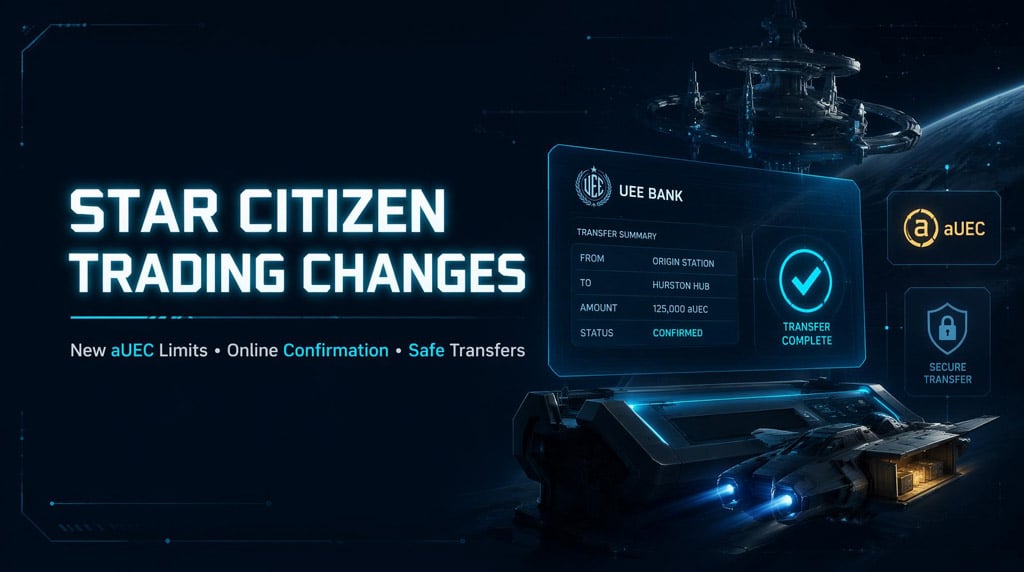
Star Citizen player trading is no longer a simple send money and move on system. In Alpha 4.8, CIG added recipient confirmation, online-only transfers, and UEE bank authorization checks.
- Star Citizen Player Trading Changes in Alpha 4.8
- Why CIG Added aUEC Transfer Limits
- What the New Trading Rules Mean for Regular Players
- If You Are Paying a Friend
- If You Are Splitting Crew Profits
- Safe Star Citizen Trading Rules
- Clean Transfer Habits
- What Limits Would Actually Work?
- Best Player Strategy During the Tuning Period
- FAQ
- Is the Star Citizen online trading requirement permanent?
- Can I still send aUEC to friends?
- What happens if a Star Citizen trade expires?
- Why are there aUEC transfer limits?
- What is the safest way to split crew payouts?
- Summary
The pain point is obvious: normal players need fast payouts after salvage, cargo, mining, or org events. CIG needs to stop dupes, stolen-account transfers, and real-money trading. That is the fight here.
Use this guide to trade cleanly, avoid flags, and keep your crew payouts moving.
Star Citizen Player Trading Changes in Alpha 4.8
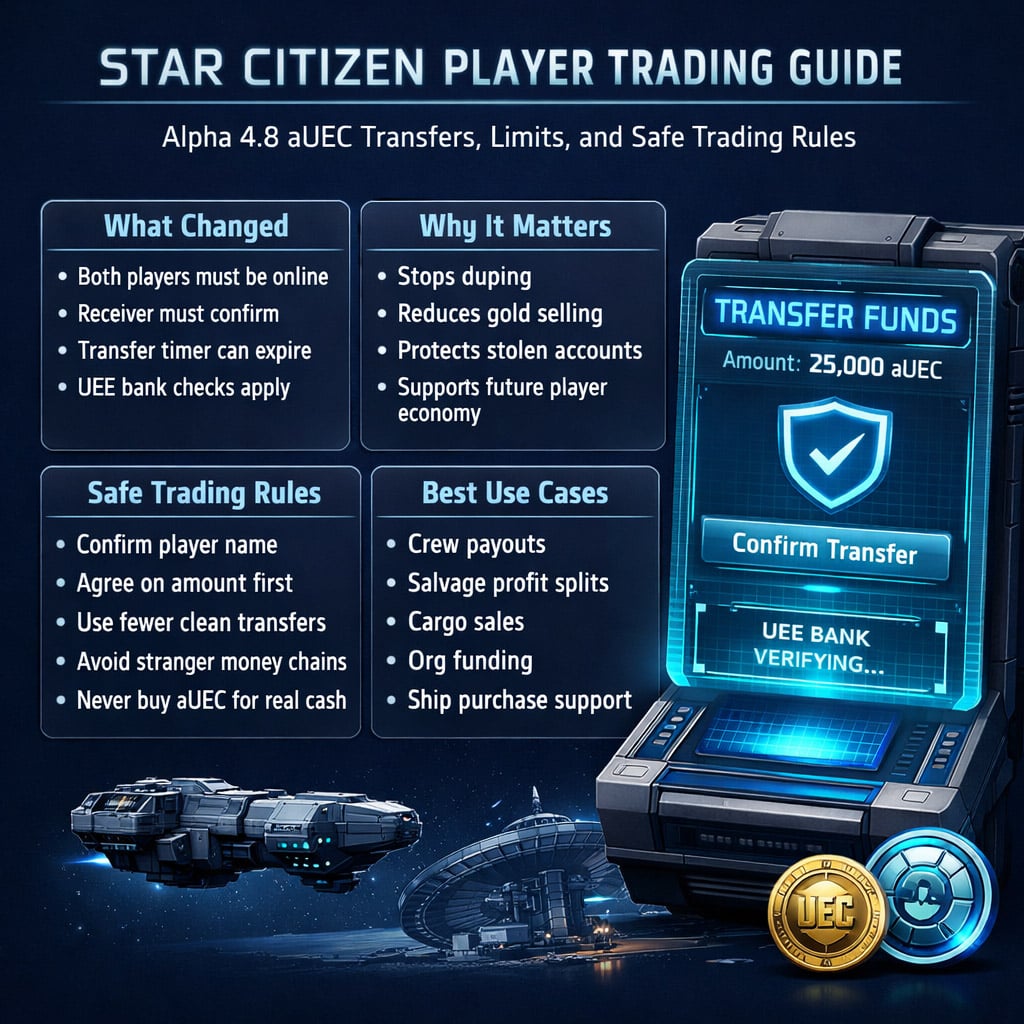
CIG's current trading setup adds friction, but it also gives the economy better protection.
| Feature | Current Rule | Player Impact |
|---|---|---|
| Online confirmation | Both players must be online | No offline payments for now |
| Recipient approval | Receiver must accept the trade | Fewer mistaken transfers |
| Timer on acceptance | Trade expires if ignored | Coordinate before sending |
| aUEC transfer limits | Rate and amount caps apply | Large payouts may need planning |
| UEE bank checks | Transactions are verified | Suspicious patterns can be flagged |
The key detail: the online requirement is temporary.
CIG plans to support offline trade offers later. The recipient will still need to approve the transaction, but they should be able to do it after logging in.
Why CIG Added aUEC Transfer Limits
The problem is not your buddy paying you after a Reclaimer run. The problem is dirty money moving through the economy.
CIG is targeting:
- aUEC duping
- Exploit farming
- Gold selling
- Real-money trading
- Stolen account draining
- Mule account networks
- Suspicious rapid transfers
This matters because Star Citizen is moving toward a real player economy. Player shops, crafting, item sales, auction-style systems, and offline trade offers all need cleaner transaction data.
If CIG cannot control currency abuse, deeper trading becomes a mess fast.
What the New Trading Rules Mean for Regular Players
Most players can still trade normally. You just need cleaner habits.
If You Are Paying a Friend
Do this:
1. Make sure both players are online.
2. Tell the receiver before sending.
3. Wait for them to confirm the prompt.
4. Send one clear amount when possible.
5. Avoid spam-clicking failed transfers.
If the trade fails, do not hammer the button. Confirm the player is ready, then retry.
If You Are Splitting Crew Profits
Big group payouts are where the new system gets annoying.
| Activity | Common Payout Issue | Best Practice |
|---|---|---|
| Bunker run | Small split | Direct transfer |
| Salvage run | Multi-million payout | One payer distributes shares |
| Cargo sale | Large profit split | Write amounts first |
| Org event | Many recipients | Use a treasurer |
| Ship funding | High single transfer | Check current cap first |
In real play, 1 million aUEC per transaction is too low for serious crews. A Reclaimer crew, cargo group, or org bank can hit that instantly.
CIG already appears to be tuning those numbers upward. Expect more changes.
Safe Star Citizen Trading Rules
If you trade often, keep it boring. Boring looks legitimate.
Clean Transfer Habits
| Do This | Avoid This |
|---|---|
| Confirm player name | Sending to similar names |
| Agree on amount first | Random test transfers |
| Use fewer large transfers | Dozens of tiny transfers |
| Keep screenshots for big deals | No record of agreement |
| Trade with known players | Acting as a middleman |
| Report exploits | Farming bugs for profit |
The biggest rule: do not receive and forward money for strangers.
That pattern looks like laundering. Even if you think it is harmless, your account may look like part of the chain.
What Limits Would Actually Work?
A flat cap is easy to deploy but bad long term. Star Citizen needs tiered limits.
| Account Type | Better Limit Logic | Why It Works |
|---|---|---|
| New account | Lower cap | Stops throwaway abuse |
| Old account | Higher cap | Rewards trust history |
| Active org role | Higher verified limit | Supports logistics |
| Repeated same-recipient trades | Pattern review | Finds laundering |
| Huge one-time transfer | Extra confirmation | Safer without blocking |
This is the real fix: trust-based limits, not one-size-fits-all caps.
A new account farming suspicious money should not have the same freedom as a long-standing org treasurer paying a 12-player salvage crew.
Best Player Strategy During the Tuning Period
Right now, treat trading like a logged financial system.
Use this workflow:
1. Confirm the amount.
2. Confirm the recipient name.
3. Make sure both players are online.
4. Send the payment.
5. Wait for acceptance.
6. Record large deals.
7. Stop if transfers start failing repeatedly.
If you hit a limit during normal play, document it:
- Amount sent
- Number of transfers
- Activity type
- Player count
- Time of issue
- Whether the prompt appeared
- Whether the trade expired
Good reports help CIG tune limits faster. Vague rage posts do not.
FAQ
Is the Star Citizen online trading requirement permanent?
No. The online requirement is temporary. CIG plans to add offline trade offers later, while still requiring recipient approval.
Can I still send aUEC to friends?
Yes. Both players must be online, and the receiver must accept the transaction before the timer expires.
What happens if a Star Citizen trade expires?
The transaction is cancelled. Confirm the receiver is ready, then send it again. Do not spam repeated attempts.
Why are there aUEC transfer limits?
The limits help CIG detect duping, exploit laundering, gold selling, stolen-account transfers, and real-money trading.
What is the safest way to split crew payouts?
Use one payer, agree on exact shares, then send clean transfers to each crew member. For large groups, assign a treasurer and keep a payout list.
Summary
Star Citizen's new player trading rules are rough, but the direction makes sense.
The system now requires online confirmation, recipient approval, and bank-side checks. That slows down payouts, but it also makes duping, stolen-account draining, and gold selling harder.
For players, the move is simple: trade clean, coordinate first, avoid suspicious money chains, and never buy aUEC for real cash.
If CIG tunes the caps properly, this becomes the foundation for safer player shops, crafting markets, org logistics, and a stronger in-game economy.

Most Popular Posts
- Star Citizen 4.9 Mining Guide: Best Laser Buffs, Crafted Heads, Scanning, Materials and Nyx Missions
- Star Citizen 4.9 Ship Buying Guide: What to Buy, Skip, and Prioritize
- Star Citizen 4.9 Salvage Guide: Easy AUEC from Battaglia Ship in Distress + Golem Module Fix
- Star Citizen 4.9 Battaglia Contracts, Persistence Fixes, Best Loot, Scanning Changes, and Ship Rewards
- Star Citizen Alpha 4.9 Guide: Best Features, Mining Scan Upgrade, Weapon Nerfs
- Star Citizen 4.9 Hull C Cargo Hauling Guide: Make Millions aUEC Without Autoload
Popular Category Lists
- ARC Raiders / (343)
- Grow a Garden / (292)
- CoD: Black Ops 7 / (167)
- Star Citizen / (160)
- MLB 26 / (159)
- Monopoly Go / (152)
- ARK Survival Ascended / (125)
- Steal a Brainrot / (98)
- Blox Fruits / (74)
- Adopt Me / (73)
- Forza Horizon 6 / (72)
- Sailor Piece / (68)
- Grow a Garden 2 / (68)
- Diablo IV / (62)
- CoD: BLACK OPS 6 / (55)
- Path of Exile 2 / (48)
- Monster Hunter Wilds / (46)
- Aion 2 / (45)
- Windrose / (44)
- Donut SMP / (41)